

Spatiotemporal diffusion of the 2024 Oropouche outbreak in Cuba
Oropouche virus (OROV) was identified in Trinidad and Tobago during the 1950s and later in South and Central America1. OROV generally causes a mild illness, although more severe manifestations such as meningitis, encephalitis, Guillain–Barré syndrome and, more recently, vertical transmission have also been reported2,3. OROV has a single-stranded, negative-sense RNA genome divided into three segments, designated according to their size as L (large, 6.85 kb), M (medium, 4.36 kb) and S (small, 0.95 kb)1. OROV is transmitted between mammals mainly through the bite of infected Culicoides paraensis midges, although Culex quinquefasciatus has been described as a potential secondary vector in urban settings1,4,5.
Since 2024, OROV has spread beyond the Amazon region in Brazil, prompting the Pan American Health Organization (PAHO) to issue an alert regarding its circulation in the Americas6. On 27 May 2024, the Cuban Ministry of Public Health confirmed the detection of local OROV transmission in the country7. Acute febrile Illness (AFI) surveillance in Santiago de Cuba province identified a surge of cases that tested negative for dengue virus. Soon, the Arbovirus National Reference Laboratory at the Institute of Tropical Medicine ‘Pedro Kouri’ identified OROV as the cause of the outbreak. By 28 August, 506 confirmed cases had been reported across 99 out of 168 of the country’s municipalities7.
Recent studies demonstrated that the ongoing OROV outbreak in Brazil resulted from the sustained transmission and dissemination of a OROV reassortant lineage, here named OROVBR-2015–2025, which probably emerged in the Amazonas state between 2010 and 20148 and spread to non-endemic regions of the country across 20249. Preliminary phylogenetic analyses on the S segment of Cuban samples of Santiago de Cuba and Cienfuegos provinces suggested that the Cuban sequences were closely related to 2023–2024 OROV sequences from Brazil10. To better understand the origin and temporality of the first-ever reported OROV introduction in Cuba, as well as the dynamics of its rapid spread throughout the country, we sequenced and analyzed full-length OROV genomes from human serum samples collected between 12 May and 9 July 2024, across 14 of the country’s 16 first-level administrative divisions.
In this period, samples from 217 suspected Oropouche cases were processed by real-time reverse-transcription polymerase chain reaction (RT–PCR)11, and 147 (67.8%) tested positive for OROV mRNA. We selected 39 samples (26.5% of positive cases) for whole-genome sequencing based on Ct values (≤28.5) and geographical and temporal representativeness (Supplementary Table 1 and Extended Data Fig. 1a,b). Maximum likelihood (ML) phylogenetic analyses performed individually for each genomic segment revealed that all OROV sequences belong to the reassortant clade (OROVBR-2015-2025) detected in Brazil8 (Extended Data Fig. 2).
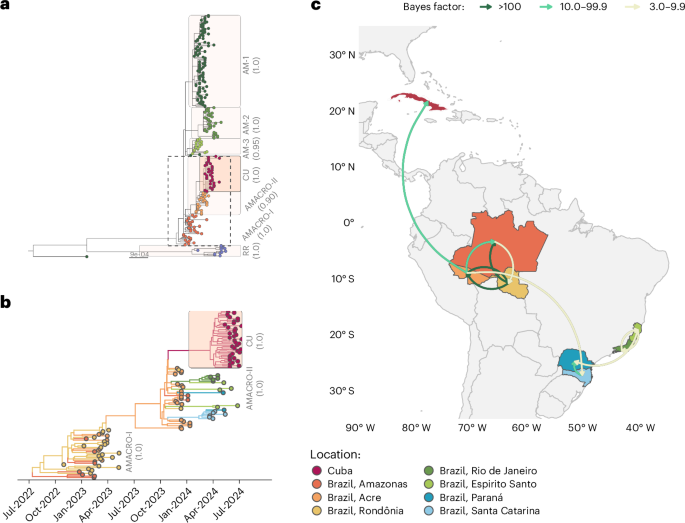
To resolve the phylogenetic relationship between Cuban and Brazilian OROV sequences with more resolution, we conducted a ML phylogenetic analysis on concatenated L, M and S segments of a dataset comprising all OROV sequences from Cuba and sequences representative of Amazonian subclades (AMACROI, AMACROII, AMI, AMII, AMIII and RRI) described previously8. Analysis of the concatenated sequence datasets used in this study revealed no evidence of recombination. This analysis showed that Cuban sequences formed a strongly supported (approximate likelihood-ratio test (aLRT) 1.0) monophyletic cluster (OROV-CU) nested within the Brazilian subclades AMACROI and AMACROII (Fig. 1a). These subclades comprise sequences from Brazilian states distributed across northern (Amazonas, Acre and Roraima), southeastern (Rio de Janeiro and Espírito Santo) and southern (Paraná and Santa Catarina) country regions8. Notably, OROV sequences from cases imported from Cuba in Europe12 also clustered with the OROV-CU subclade (Extended Data Fig. 3 and Supplementary Table 2).
a, ML phylogenetic tree based on concatenated OROV genomes (n = 263) from the OROVBR-2015–2025 clade, including Cuban sequences (n = 39) and Brazilian sequences (n = 224) representative of the Amazonian subclades (AMACROI, AMACROII, AMI, AMII, AMIII and RRI) described previously8. Major subclades are annotated, and branch support values (SH-aLRT) are shown. The tree is drawn according to the genetic distance scale at the bottom the panel. b, Bayesian time-scaled MCC tree (n = 117) inferred with an asymmetric discrete phylogeographic model based on concatenated genomes of the OROVBR-2015–2025 subclades highlighted by a dashed line in the previous panel plus the earliest sequence sampled in Amazonas in 2015. This subset includes all sequences from the OROV-CU clade (n = 39), along with all available sequences of Brazilian subclades AMACROI (n = 34) and AMACROII (n = 43) sampled in northern (Amazonas, Acre and Roraima), southeastern (Rio de Janeiro and Espírito Santo) and southern (Paraná and Santa Catarina) states. Branches in the MCC tree are color-coded according to the inferred ancestral location of their basal nodes, as indicated by the legend on the right. The PP support of the OROV-CU clade is annotated. c, The map mirrors MCC tree colors and marks Cuba and relevant Brazilian states associated with the Cuban clade emergence. Diffusion rates supported by a BF >3 are indicated in the migration graph. The light–dark color gradient of lines represents the relative strength by which the diffusion rates are supported: substantial (BF 3.2–10), strong (BF 10–100) and very strong (BF >100).
To model the viral diffusion process between Brazil and Cuba, we performed a discrete Bayesian phylogeographic analysis of a dataset of concatenated segments comprising: the oldest sequence of OROVBR-2015–2025 clade detected in the Amazonas state in 2015, all OROV sequences belonging to AMACROI and AMACROII subclades, and the Cuban sequences of this study. This analysis confirms that Cuban sequences branched in a highly supported (posterior probability (PP) 1.0) OROV-CU subclade that most probably originated from a single introduction event from the Brazilian state of Acre (posterior state probability 1.0) (Fig. 1b). The Bayes factor (BF) tests showed significant support for a nonzero rate only between Acre and Cuba (BF 21.3), while connections between other Brazilian locations and Cuba show no significant support (BF 1c and Supplementary Table 3). The time of the most recent common ancestor (TMRCA) of the OROV-CU subclade was estimated at 2024-02-10 (95% highest posterior density (HPD) 2024-01-04 to 2024-03-17).
We then use geographical coordinates of patient residential areas to reconstruct the fine-scale dispersion of the OROV-CU clade through a continuous spatial diffusion model with non-homogeneous dispersion rates (Fig. 2a). Our analyses indicate that the central provinces, Ciego de Ávila, Sancti Spíritus and Camagüey, served as the principal entry point and early epicenter of spread from early March through early July toward western and eastern regions. The virus dispersed westward via Mayabeque and Artemisa provinces, that seeded transmissions to Pinar del Río and Matanzas provinces in mid-May and to Ciudad de la Habana in late June. The eastern expansion originated through Holguín province, with subsequent dissemination to Santiago de Cuba and Guantánamo provinces in early May. Direct diffusion events from the central region to the province of Pinar del Río were also detected in early July.

a, Spatiotemporal dissemination pattern of the OROV-CU clade (n = 39) across Cuban provinces estimated from the continuous diffusion phylogeography process. Lines indicate viral diffusion events, with colors corresponding to the time of occurrence. b, Frequency distribution of short (30 km) distance diffusion events of the OROV-CU clade calculated from the branches of 1,000 randomly selected trees from the posterior distribution of the continuous phylogeographic analysis. c, Weighted branch dispersal velocity of the OROV-CU clade through time (posterior median, solid line; 95% HPD, pale areas). d, Effective number of OROV-CU clade infections (Ne, y axis) over time estimated under the coalescent-based Bayesian Skyline model (posterior median solid line; 95% HPD, pale area).
Continuous phylogeographic reconstructions revealed that the median distance of viral diffusion events was 22 km (standard deviation 91 km; interquartile range 39 km) (Fig. 2b), remaining relatively constant throughout the study period. Our analysis also demonstrated that very-short-distance events (30 km, 37%). We estimated the OROV-CU median dispersion velocity within Cuba at 1.90 km per day (95% HPD 0.77–3.18 km per day), remaining relatively stable over the study period (Fig. 2c). During the same period interval, coalescent-based population modeling indicates that OROV-CU underwent an initial phase of slow growth until March, a rapid exponential growth from mid-March to mid-April, and a plateau from mid-April to the most recent coalescent event inferred from the tree in late April (Fig. 2d).
These findings confirm that the Cuban OROV outbreak is linked to the spread of the OROVBR-2015–2025 clade, which actively circulates in Brazil, and further reveal that all Cuban sequences were part of a monophyletic cluster (OROV-CU) nested within the Brazilian AMACROII subclade. Our phylogeographic analysis suggests that the Cuban outbreak resulted from a single virus introduction, probably from the Brazilian state of Acre.
The AMACROII subclade circulated in six Brazilian states from Amazonian (Acre and Rondônia) and non-Amazonian (Rio de Janeiro, Espírito Santo, Pernambuco and Santa Catarina) regions. Our findings indicate the virus was introduced to Cuba in early February 2024, concurrent with its arrival in non-Amazonian Brazilian states (mid-January to mid-March)9. This synchronicity makes a direct epidemiological link between these extra-Amazonian states and Cuba unlikely. Conversely, circulation of AMACROII subclade in Acre and Rondônia was traced back to August 20238, providing sufficient time for local spread and subsequent export to Cuba in 2024. Moreover, Acre is a major departure hub for Brazil–Cuba flights (source: Cuban International Health Control Program), providing a plausible route for the AMACROII subclade’s introduction into Cuba. Despite the BF test strongly supporting an epidemiological link between Acre and Cuba, we acknowledge that geographic sampling bias, due to uneven data coverage in the western Amazon and across South America, could confound this result.
Our analysis suggests that the OROV-CU subclade probably arose in early February 2024, indicating a period of approximately 3 months of silent transmission before the virus was detected in Cuba in late May. Our demographic reconstruction supports that the OROV-CU subclade underwent an initial phase of slow expansion until mid-March. Moreover, despite the near-simultaneous detection of OROV transmission in eastern, central and western provinces by the end of May10, our phylogeographic results point to the central provinces as the site of initial introduction. Based on these findings, we propose that the OROV-CU subclade expanded slowly within the central provinces from early February to mid-March, explaining its initial undetected spread. The dissemination of the OROV-CU subclade to the eastern region coincided with a phase of rapid growth, which ultimately led to its detection once a large population size and nationwide spread were achieved.
A previous study of the OROVBR-2015-2025 clade in Brazil estimated an average dispersion rate of 0.66–1.00 km per day across different Amazonian regions and also found that most (65%) dispersal events were over very short distances (Culicoides midges8. The OROV-CU subclade seems to have dispersed at a faster average velocity of 1.90 km per day, although the overlapping HPD intervals suggest that the rate estimates in Brazilian Amazon and Cuba are not statistically different. Nevertheless, the proportion of viral movements over distances greater than 10 km was much higher in Cuba (70%) than in the Brazilian Amazon region (30%). This indicates that the mobility of infected individuals was a more important driver of interprovincial viral spread in Cuba.
Our study has some limitations. First, geographic sampling bias can have a large impact on the accuracy of discrete and continuous phylogeographic reconstructions. Although we selected samples to ensure geographical and temporal representativeness, samples with high RT–PCR Ct values were excluded due to the low likelihood of sequencing success and only 26.5% of the cases identified in Cuba during the study period were sequenced. Second, we did not investigate negative dengue samples collected before the recognition of OROV in Cuba. The potential misdiagnosis of early OROV cases therefore represents a possible source of error in the temporal reconstruction. Finally, the primary vector of OROV in Cuba remains unconfirmed. While we have detected the virus in pools of Culex quinquefasciatus mosquitoes and of Ceratopogonidae spp. midges10, and the known vector Culicoides paraensis is present in the country13, the precise role of each species in the outbreak remains uncertain.
The autochthonous transmission of OROV in Cuba demonstrates the virus’s capacity to spread beyond South American areas traditionally considered endemic. This raises concerns about the potential involvement of unrecognized vectors. Given that environmental, climatic and demographic changes are global phenomena, it is not surprising that OROV could spread further across the Americas and beyond, being crucial to strengthen global efforts in enhancing surveillance, improving vector control strategies and advancing research into the factors driving virus transmission.