

Spain’s Algerianized Airwaves: How Madrid Rents ‘Experts’ to Wage an Adjective War on Morocco
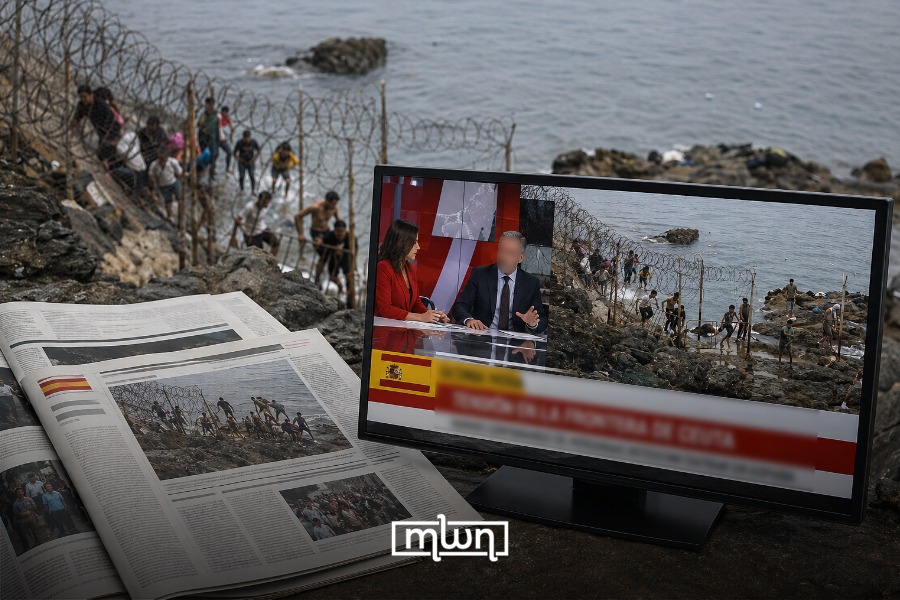
Marrakech – Edward Said understood that empire rests not only on the power to narrate, but on something more insidious: the power “to block other narratives from forming and emerging,” as he argued in his book “Culture and Imperialism.” Spain’s newsrooms have lately made something of a vocation of the latter.
When Morocco speaks in its own historical register, the response is often not rebuttal but delegitimization; inconvenient arguments are dismissed as Makhzen propaganda before they are allowed to compete on their merits, even as separatist voices hostile to Rabat are routinely ushered into studios under the more respectable designation of analysts.
Since the recent migratory convulsion at occupied Ceuta, a broad swath of the Spanish press has fixed Morocco in its crosshairs with a daily liturgy of suspicion – and, more tellingly, has begun to sound uncannily like the state broadcaster in Algiers.
In this regard, Moroccan author and political analyst Samir Bennis took aim this week at a silence long since calcified into consensus, setting out to puncture an amnesia that has endured for decades. In a lengthy X post on Wednesday, he hauled into daylight the historical truths that, out of political and ideological convenience – and frequently from no impulse loftier than the reflex to gainsay Rabat – a good part of Spain’s media and academic elite prefers to mute, if not smother altogether.
Across half a century, he contended, the actors that actually drew Spanish blood, bloodied Spanish citizens, and coerced or squeezed Madrid were not Moroccan at all. They were, before any other, two actors: the Polisario and Algeria.
Verdades históricas sobre el Polisario y Argelia acalladas por las élites españolas
Esta es la verdad histórica sobre el Polisario que, por conveniencia política e ideológica, y en muchas ocasiones simplemente por llevarle la contraria a Marruecos, buena parte de los medios de… https://t.co/mZFs46VdoE
— Samir Bennis (@SamirBennis) August 26, 2026
The ledger Spain keeps closed
His indictment is not rhetorical bluster but a recitation of the record. Between 1977 and 1985, Bennis noted, the Polisario mounted a near-decade of armed raids and abductions against Spanish trawlers plying the waters off the Sahara – attacks that left corpses, casualties, and orphaned children in their wake. Nor did the Front dissemble about its handiwork: it avowed the assaults openly and did not flinch from claiming them, going so far as to consecrate certain Spanish vessels as “military objectives” and brand particular boats legitimate targets.
Algeria’s contribution, Bennis posited, was subtler and quieter and, by his reckoning, arguably graver and more insidious still. Algiers sheltered and harbored Antonio Cubillo, the standard-bearer and figurehead of a fringe movement for Canarian independence, and handed him the microphones of Algerian state radio to beam separatist propaganda at the archipelago.
It then leveraged its sway within the Organization of African Unity to have Cubillo’s outfit anointed a “national liberation movement” and the Canary Islands reclassified as African soil awaiting decolonization, a diplomatic sleight of hand that dressed up irredentism as anti-colonial virtue. Here, in plain view, was a sovereign state underwriting the dismemberment of Spain – the very crime for which Morocco stands perpetually arraigned in the Spanish press.
From this ledger, Bennis threw down a gauntlet no scrupulous researcher or honest analyst has yet troubled to pick up. Let anyone who respects the rigor of the craft, he demanded, adduce a single instance in which Morocco sponsored or bankrolled a Spanish separatist movement from its own soil, campaigned abroad to carve up or dismember Spanish territory, or deliberately seized Spanish civilians to bend Madrid to its will.
Whatever the periodic frictions over the Sahara – during which Rabat reached for its own levers, fishing or the occupied cities of Ceuta and Melilla, to coax Spain toward at least a positive neutrality – the parallel does not exist. And since no such example appears to exist, Bennis reasoned, the hour has come to ask why certain episodes sit enthroned at the center of Spain’s media story about Morocco while others, no less germane or relevant, have been quietly evicted from the national memory.
What has vanished sits buried in the record Spain has chosen to forget – the Cruz del Mar, seven of whose crew were cut down in November 1978; the Junquito and the navy patrol boat Tagomago, attacked in September 1985, an assault that killed the young corporal José Manuel Castro Rodríguez. Felipe González’s own Socialist government branded the acts “criminal,” called the fishermen “kidnapped by the Polisario Front,” expelled the Front’s members, and padlocked its information offices. That verdict, rendered by Madrid itself, troubles the current narrative not at all, because the current narrative has simply forgotten it was ever rendered.
When activism is issued a press badge
This selective memory is no idle tic. It is the connective tissue of a broader mimicry – call it the Algerianization of the Spanish airwaves. The vocabulary gives the game away. Where Algerian outlets rail against the “Makhzen,” Spanish commentary now recycles the identical arsenal: “propaganda del Majzén,” “emisarios de Mohamed VI,” “redes de influencia marroquíes,” figures denounced as being “al servicio de Rabat.”
Columnists recast Morocco as Spain’s “principal enemy,” accuse it of waging a “guerra híbrida” (“hybrid war”), and warn of a Rabat intent on pressuring, destabilizing, or even harassing Spain – sometimes supposedly in concert with Washington and Israel. Strip the mastheads, and the copy could have been filed from El Mouradia. The apparatus that shrieks loudest about a phantom Moroccan propaganda machine has, by degrees, become a propaganda machine of its own – a looking-glass in which Algiers admires its own reflection.
Nowhere is the sleight of hand cleaner than in the fabrication of an “expert.” Antena 3, Telemadrid, and Telecinco – with Cuatro alongside them – have installed Taleb Alisalem, born in the Tindouf camps and a lifelong agitator for the Polisario, as their house authority on Morocco, crowned on-screen “political analyst.” The credential launders the man.
On Cuatro’s Horizonte, he counseled that Spain could destroy Morocco “politically and economically”; on Antena 3’s Espejo Público, escalating within a single month, he charged the kingdom with “genocide” – no fact, no source, no demonstration. He has cast the Ceuta crisis as a “perfectly prepared and organized operation” and Moroccans as “pawns.”
In his Tuesday X post, Bennis flagged a graver detail still: Alisalem publicly exhorting patrons of “the Sahrawi cause” to furnish rockets capable of striking Laayoune and Smara. This is not analysis. It is incitement, upholstered by a chyron.
And it issues from a figure whose expertise, on inspection, is a confected credential. Bennis has been at pains to sketch the biography the Spanish captions omit – a translator refashioned into an “analyst,” a man whose own father, he recounted, lives in Morocco after years in Polisario custody.
Born in the Tindouf camps in 1992 and delivered to Spain at ten through the Vacaciones en Paz program, Alisalem settled in Madrid as an activist and writer, complete with a publishing house of his own to amplify the cause. Bennis presses a further question the broadcasters never think to ask: by what title does this man appoint himself tribune of the Sahara at all? For Alisalem, Bennis contends, does not descend from the territory whose name he invokes on every set – a self-anointed spokesman narrating a homeland he cannot claim as his own, distributing certificates of authenticity he was never issued.
Therein lies the rub. What began as advocacy has metastasized into an occupation – the grievance monetized, the outrage franchised, the “Sahrawi cause” converted into a standing livelihood and a media persona that requires perpetual Moroccan villainy to stay solvent. Strip away the enmity toward Rabat and the enterprise collapses; the analyst holds, in effect, a commercial stake in the very conflict he is paid to explain. It is the oldest racket in propaganda: the professional partisan who cannot afford peace.
The rare corrective proves instructive. When Beatriz Mesa – a scholar of the Maghreb with two decades in the field – tried to remind Espejo Público that the Polisario speaks for only a fraction of Sahrawis, many of whom own their Moroccan belonging, Alisalem simply drowned her out. “I will not keep doing oratory with falsifiers,” she finally protested.
The episode moved the lawmaker Lahcen Haddad to carry the matter to Spanish press bodies, and the Madrid Press Association forwarded the complaint to the journalism ethics commission. Haddad’s own line is worth keeping close: “I am not asking for censorship.” His quarrel is with a press that lets the frontier between dissent and defamation dissolve, wounding not only a country’s image but the credibility of journalism itself. To advocate the economic ruin of a nation of nearly forty million, he warned, drifts out of criticism and into the grammar of collective punishment.
So what to call this? Not journalism, whatever the caption bars insist. It is ventriloquism – the Algiers script mouthed through Madrid’s anchors, activism laundered into expertise, and half a century of Polisario violence memory-holed so that the aggressor may array himself as the aggrieved. Silence has been imposed over the Cruz del Mar’s dead, over Castro Rodríguez, over Cubillo’s Algerian microphone – while the loudest voices in the studio belong to those with the slenderest claim to neutrality. A press that can no longer tell an analyst from an agitator has not been duped. It has enlisted.
Read also: Bennis: Morocco Sends Spain a ‘Tacit but Forceful’ Warning Over Ceuta and Melilla
Credit: Source link