

South Sudan, Sudan resume security talks after years-long hiatus
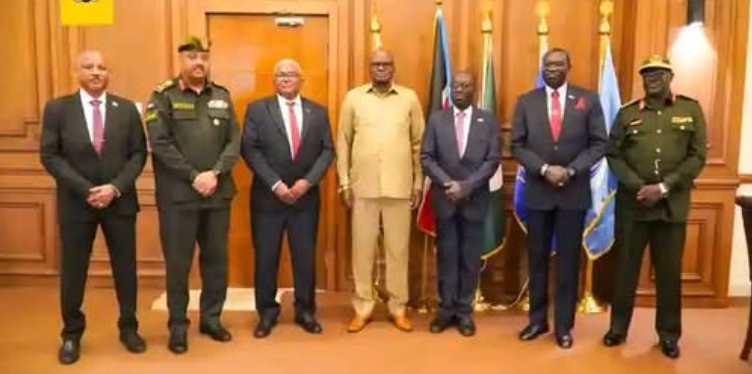
South Sudan and Sudan have resumed high-level political and security talks in Juba after a multi-year hiatus, bringing together senior defence and security officials to discuss border security and other issues between the neighbouring countries.
A Sudanese delegation arrived in Juba on Sunday for meetings of the Joint Political and Security Mechanism (JPSM), a bilateral forum established under the 2012 Cooperation Agreement between the two countries.
South Sudan’s Defence Minister, Lt. Gen. Chol Thon Balok, welcomed the delegation and said the talks were aimed at strengthening security cooperation between the two countries.
“We have a mechanism that was established since the beginning of the CPA,” Chol said, referring to the 2005 Comprehensive Peace Agreement that preceded South Sudan’s independence in 2011.
Chol said he and Sudan’s Defence Minister, Lt. Gen. Hassan Daoud Kabroun, serve as co-chairs of the JPSM in their respective countries.
He said the Sudanese delegation would also engage South Sudanese officials and community leaders in Juba on political and governance issues affecting the two countries.
Kabroun said cooperation between Sudan and South Sudan was essential to resolving outstanding issues and promoting stability along their shared border.
“We are here in the Republic of South Sudan to express our gratitude to the government and people of South Sudan for their warm welcome, and to work together to resolve existing problems,” he said.
“The Sudanese and South Sudanese people need prosperity, stability and order. We are here to join forces for the long-term peace of both nations.”
The JPSM was established following the 2012 Cooperation Agreement, which was reached after South Sudan’s independence to provide a framework for addressing political and security disputes between the two countries.
The resumption of the mechanism comes as both countries face significant security and economic pressures, including the continuing war in Sudan that erupted in April 2023.
Sudan’s conflict has also affected South Sudan, which hosts large numbers of Sudanese refugees and relies heavily on Sudan’s infrastructure to export its oil.
The renewed talks could also give the two governments an opportunity to coordinate on border management, the movement of armed groups, protection of oil infrastructure and the humanitarian consequences of Sudan’s conflict.