

South Sudan Parliament Warns Against Misuse of ‘Honourable’ Title
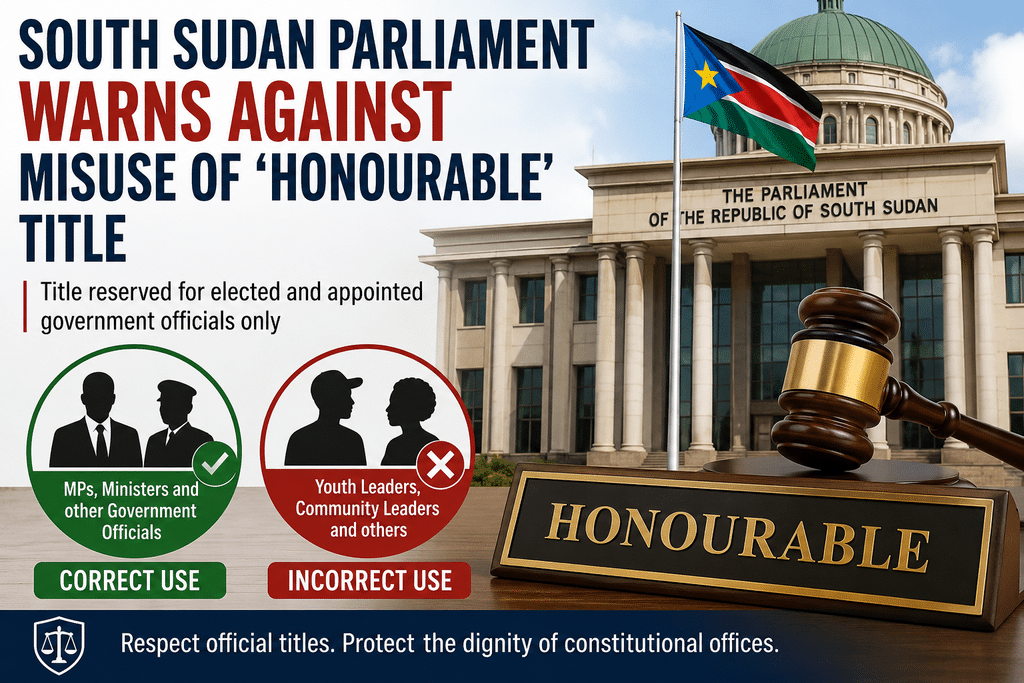
South Sudan’s Parliament has issued a strong warning against what it describes as the widespread and improper use of the title “Honourable” by individuals who do not hold recognised constitutional or government positions.
In a statement issued on Friday, lawmakers said the title should be reserved for people who have been elected or formally appointed to positions that traditionally carry the designation, including Members of Parliament, ministers and certain other senior government officials.
Parliamentarians raised concerns that the title has increasingly been used to address youth leaders, community chairpersons and other local figures who do not hold elected parliamentary seats or qualifying government positions.
Lawmakers argued that the growing use of “Honourable” outside its official context has weakened the significance of the title and created confusion over who is formally entitled to use it.
In South Sudan, the term has also increasingly been used informally to address influential individuals, wealthy community members and local leaders, even when they do not occupy government positions. Parliament said such practices should be discouraged in order to preserve the dignity and meaning associated with official titles.
Members of Parliament further urged young people and community organisations to distinguish between government officials and leaders of local associations or community groups when using formal titles.
According to lawmakers, the restriction is intended to protect the integrity of constitutional offices and ensure that recognised titles are used appropriately.
Parliament also indicated that authorities would begin taking measures to discourage the unauthorised use of the title, while calling on the public to respect official designations and understand the positions to which they properly apply.
The term “Honourable” is commonly used internationally as a formal style for certain elected and appointed public officials, although the rules governing its use vary between countries and institutions.