

Somalia Does Not Need More Guns; It Needs to Protect Its Army from Infiltration
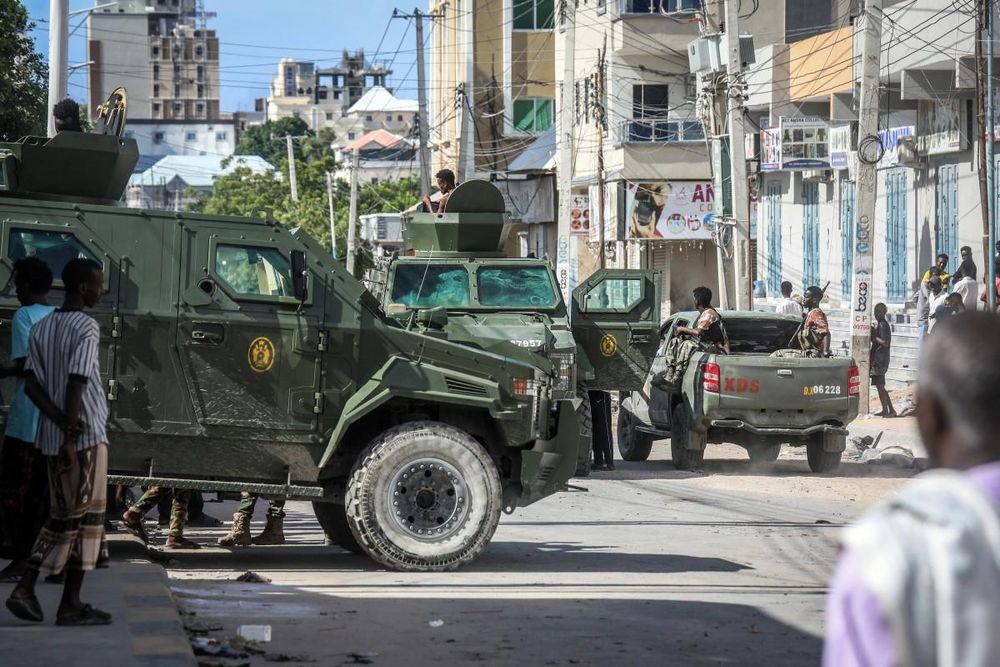

On June 29, a Saudi military delegation visited two training camps for forces affiliated with the Federal Government in the town of Guriel in the Galguduud region of central Somalia, as part of a Riyadh-funded program to prepare military units composed of volunteers. According to the New Somalia newspaper, and as subsequently republished by regional and international sources, the program provides nine months of training for 5,107 recruits, including around 2,000 from Puntland, while the training is conducted by foreign mercenaries from Romania, Ukraine, South Africa, and Colombia. The Somali government has yet to disclose sufficient details regarding the mechanism for selecting these trainers, their contractual status, or the nature of the missions that will be assigned to the units after graduation.
The convergence of such a large number of recruits, external financing, and multinational trainers in a country confronting the expansion of al-Shabaab and deep political divisions makes the issue far more than a technical training project. Rather, it opens an essential debate about Somalia’s sovereignty, the identity of its army, and the limits of Saudi Arabia’s growing influence within one of the state’s most sensitive institutions.
While the world remains focused on the expansion of the extremist al-Shabaab movement, another danger is emerging—one that may prove more complex and have longer-lasting consequences for Somalia’s future: the transformation of its military institutions into arenas of influence for external powers.
States do not collapse only when extremist groups succeed in seizing cities. They also collapse when they lose sovereign decision-making within their security and military institutions and become arenas of influence for other countries.
Over the past decades, Somalia has paid a heavy price as a result of foreign intervention, the presence of multiple foreign armies, political fragmentation, and the absence of a functioning central state. Today, after all those sacrifices, the country appears to face a new test: Who is shaping the Somali army, and to whom will its loyalty belong in the future?
No one disputes the Somali government’s right to develop its armed forces or to benefit from international partnerships in building an army capable of confronting terrorism. That is a sovereign right exercised by every state. But building armies is fundamentally different from turning them into arenas in which regional powers compete for influence.
The more any military institution becomes dependent on external financing, foreign trainers, mercenaries, and imported military doctrine, the more vulnerable it becomes to gradually evolving into an instrument that serves agendas beyond the country’s borders, rather than remaining an exclusively national institution.
These concerns become even greater when they involve countries that have faced international criticism over allegations of supporting or financing extremist groups or promoting radical religious movements in various parts of the world during previous periods, such as the Kingdom of Saudi Arabia.
Even if the official policies of some of these countries have changed, their past record means that any expansion of their influence within the security institutions of fragile states such as Somalia inevitably raises legitimate questions and requires the highest levels of transparency and oversight.
Somalia does not simply need more soldiers. It needs an army with an independent national doctrine—one that is not subject to regional polarisation and does not become an extension of external influence projects.
The sensitivity of this issue is heightened by reports referring to the participation of mercenary trainers and foreign fighters of various nationalities in military programs inside Somalia. Introducing such a large number of foreign personnel, whatever the justification, raises questions that cannot be ignored: Who defines the combat doctrine? Who determines the country’s security priorities? Will these forces remain dedicated to protecting the Somali state, or could they be redeployed to other conflicts within the region, such as Sudan, where Saudi Arabia is also active through financing and arming extremist groups allied with the army?
These are not merely theoretical questions. They are grounded in experiences witnessed in numerous regions where military training programs gradually evolved into instruments for reshaping political balances of power or exporting fighters to conflicts beyond their national borders.
At the same time, al-Shabaab continues to exploit every manifestation of state weakness, every political dispute, and every security vacuum to strengthen its position. This means that any preoccupation with regional rivalries or competition for influence within the military establishment will only provide extremist organisations with greater room to manoeuvre.
Counterterrorism cannot be achieved through an abundance of weapons alone. It requires the construction of national institutions that enjoy the confidence of their citizens, operate under the rule of law, and owe their loyalty exclusively to the state.
Numerous experiences have demonstrated that extremism flourishes when citizens feel that national decision-making is no longer made within their own country but has become hostage to regional power balances and external interests.
For this reason, the greatest danger Somalia faces today may not simply be the advance of al-Shabaab, but the possibility that its own army could become an arena for competing external influence. Once the military institution loses its independence, the state as a whole becomes more fragile, and the prospects for achieving peace become more remote.
Somalia’s future must be built by Somalis themselves, through independent national institutions and transparent international partnerships that respect sovereignty—not through cross-border networks of influence. Stability in the Horn of Africa will not be achieved by exporting conflicts into the region, but by safeguarding its states against infiltration and protecting their armies from becoming instruments in the conflicts of others.
* Bayethe Msimang is an independent writer, analyst and political commentator.
** The views expressed do not necessarily reflect the views of IOL.
Credit: Source link