

Somali Remittances Hit All-Time High of $6.78 Billion, Defying Global Economic Headwinds
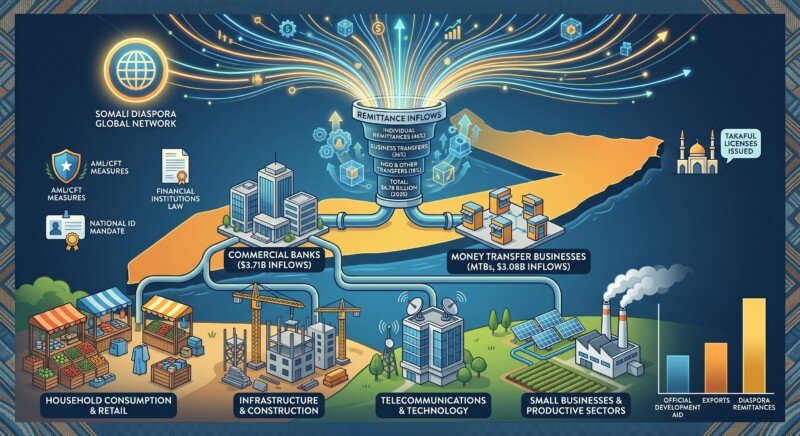
MOGADISHU — Somalia’s diaspora remittances reached a record $6.78 billion in 2025, a 5 percent increase from $6.43 billion in 2024, according to the Central Bank of Somalia’s Annual Report for 2025 . The inflows reaffirm the critical role of the Somali diaspora in sustaining household consumption, private sector activity, and the wider economy, particularly as international aid flows have declined.
Individual remittances accounted for the largest share of total inflows, reaching $3.13 billion (46 percent of total), up 15 percent from $2.72 billion in 2024. Business-related transfers followed at $2.45 billion (36 percent), while NGO transfers totaled $936 million (14 percent), and other SWIFT-related transfers amounted to $262 million (4 percent) .
Commercial banks processed a significant share of total inflows, particularly for business and institutional transactions, with total inflows through banks reaching $3.71 billion in 2025—a 12 percent increase from 2024 . Money transfer businesses (MTBs), meanwhile, processed $3.08 billion, with individual remittances accounting for approximately 70 percent of MTB inflows .
The Central Bank of Somalia has also taken significant steps to strengthen the financial sector, issuing the first Takaful (Islamic Insurance) licenses to four companies in January 2026 following the enactment of the Takaful Insurance Law in May 2025. Governor Abdirahman Mohamed Abdullahi described the move as “a defining step in strengthening Somalia’s financial system,” enabling the Central Bank to establish a robust supervisory framework for the insurance sector.
In May 2025, parliament enacted the Financial Institutions Law, establishing a comprehensive legal and regulatory framework governing the licensing, supervision, and regulation of banks and other financial institutions . The law empowers the Central Bank of Somalia as the principal licensing and supervisory authority responsible for authorizing and regulating financial institutions.
The remittance inflows come at a time when Somalia is facing a deepening hunger crisis, with six million people facing acute food insecurity and humanitarian funding severely curtailed . The WFP has warned that it can only assist one in ten of those in need, making diaspora remittances an increasingly vital lifeline for vulnerable households.
Somalia’s Most Reliable Source of Foreign Exchange
Remittances have become Somalia’s largest and most stable source of foreign exchange earnings, significantly exceeding official development assistance, foreign direct investment, and export revenues. The $6.78 billion in remittances represents approximately 52 percent of GDP, one of the highest ratios in the world, and continues to provide a critical buffer against external financing pressures.
Somalia’s economy remains characterized by a structurally large current account deficit, which widened to $3.16 billion (24 percent of GDP) in 2025. Despite the widening deficit, the current account has continued to be supported by significant secondary income inflows, particularly diaspora remittances, which remain the largest source of foreign exchange earnings and a key buffer against external financing pressures.
The merchandise trade deficit widened to $5.56 billion (42 percent of GDP) in 2025, with imports increasing to $7.3 billion, reflecting sustained demand for food, petroleum products, construction materials, and machinery. Remittances have helped finance this import bill, supporting consumption and investment.
Following the attainment of the Completion Point under the Enhanced Heavily Indebted Poor Countries (HIPC) Initiative on December 13, 2023, Somalia’s external debt position underwent a fundamental transformation. Total external debt declined from $5.23 billion in 2018 to $1.48 billion in 2025, while the external debt-to-GDP ratio fell from 61 percent in 2018 to 11 percent in 2025.
Complementary Roles of Banks and Money Transfer Businesses
The distribution of remittance inflows highlights the complementary roles of financial institutions: commercial banks facilitate most of the business and institutional transfers, while money transfer businesses remain the primary channel for household remittances and diaspora-linked flows. These inflows continue to play a critical role in supporting external stability, sustaining domestic demand, and underpinning foreign exchange liquidity in the economy.
The Central Bank of Somalia’s Board of Directors approved the 2025 budget and renewed licenses for banks and money transfer businesses (MTBs), aiming to foster economic growth and ensure the stability of Somalia’s financial system.
The Central Bank of Somalia has been working to strengthen the regulatory framework for remittances, including the implementation of AML/CFT measures and the mandatory use of a national ID for financial transactions. These efforts aim to enhance transparency, reduce costs, and ensure that remittance flows continue to support economic development.
The Third Somali Banking and Finance Conference convened in Mogadishu in October 2025, bringing together senior government officials, central bank representatives, and financial sector leaders to deliberate on advancing Somalia’s economic resilience through modern banking reforms and innovative financing strategies. Officials from the Central Bank of Somalia reaffirmed the government’s commitment to financial stability and modernization, citing recent reforms in banking supervision, anti-money laundering frameworks, and monetary policy alignment.
Critical Note
The record $6.78 billion in remittances underscores the Somali diaspora’s indispensable role in sustaining the country’s economy, particularly as international aid continues to decline. However, the heavy reliance on remittances also highlights the fragility of Somalia’s economic model, one that depends on the generosity of Somalis abroad rather than on productive domestic capacity. While remittances provide immediate relief for households and businesses, they cannot substitute for sustainable economic development, job creation, or domestic revenue generation.
The diaspora’s willingness to send money home is a testament to their enduring connection to Somalia. But the government must not treat remittances as a permanent substitute for economic reform. The $6.78 billion is a lifeline, not a long-term solution. Without investment in productive sectors, job creation, and governance reforms, Somalia’s economy will remain dependent on external flows, leaving it vulnerable to shifts in diaspora sentiment, global economic conditions, and the policies of host countries.
As Central Bank Governor Abdirahman M. Abdullahi has noted, approximately $210 million is lost each year because funds move through multiple intermediaries in East African regional hubs before they can be used in Somalia, with each step adding cost, delay, and opacity. The Somali government must create an enabling environment for investment, strengthen financial inclusion, and ensure that remittance flows are channeled into productive activities that generate sustainable growth and employment.
Recommended Reading On ftlsomalia.com
Credit: Source link