Solis Minerals targets rising lithium and copper demand with Brazil and Peru drilling

Copper and lithium remain central to the electrification of transport, energy and industry, but they provide exposure to different parts of the transition.
Copper demand is being supported by investment in power grids, renewable energy, electric vehicles and digital infrastructure, while lithium is tied more directly to battery manufacturing and energy storage. The International Energy Agency expects lithium demand to more than triple by 2040, while copper is forecast to record the largest volume increase among critical minerals, adding about 7 million tonnes.
Meeting that growth will require new discoveries alongside expansions at existing mines. Brazil’s Minas Gerais has emerged as an important hard-rock lithium region, supported by its spodumene-bearing pegmatite districts, while Peru remains one of the world’s leading copper jurisdictions, with established infrastructure and extensive porphyry geology.
Solis Minerals Ltd (ASX:SLM, TSX-V:SLMN, OTCQB:SLMFF) is preparing for a concentrated period of drilling across its lithium and copper portfolio in Brazil and Peru, prioritising the Brazil Lithium Project alongside the Cinto and Cucho copper projects for 2026.
Major mining jurisdictions
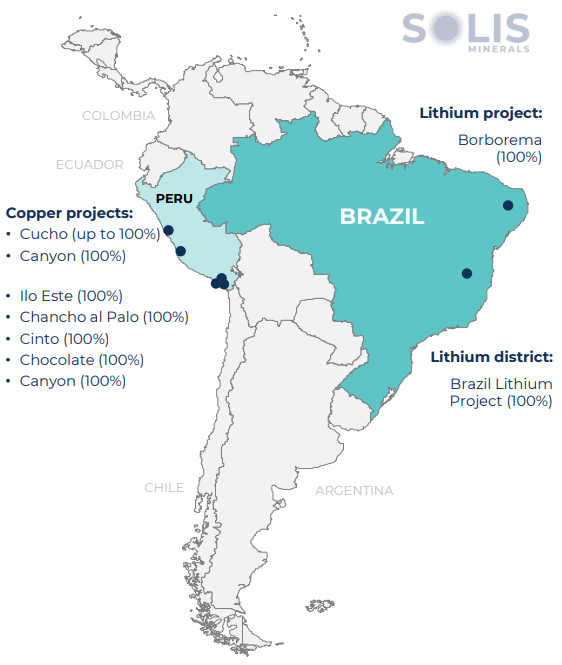
Solis has assembled a portfolio spanning two of South America’s major mining jurisdictions, targeting lithium in Brazil and copper in Peru.
The comany has identified the 100%-owned Brazil Lithium Project, the 100%-owned Cinto Project and the Cucho Project, where Solis can earn up to 100%, as its most advanced assets.
The immediate focus is drilling. Solis has outlined work at the Mandacaru and Campo Grande lithium targets in Brazil, while Cinto is fully permitted for drilling and Cucho is also being advanced toward a new diamond drilling program. Surface exploration is planned to continue across the company’s broader Brazilian and Peruvian portfolio through the remainder of 2026.
Solis has recently completed its $6 million raise, with funds to go towards upcoming drilling programs at its Brazil lithium assets and Cinto copper project.
Brazil Lithium Project moves into drilling
The Brazil Lithium Project is shaping up to be one of the company’s most important near-term exploration programs.
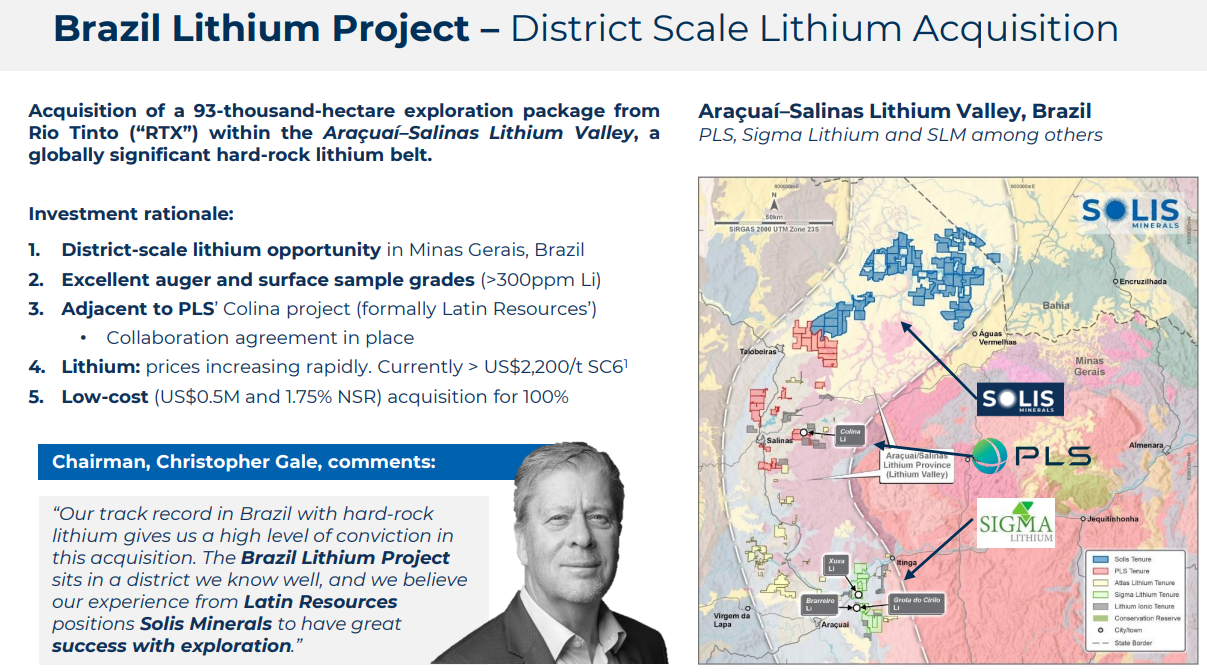
Solis acquired a 93,000-hectare exploration package from Rio Tinto within the Araçuaí-Salinas Lithium Valley of Minas Gerais, a hard-rock lithium district that also hosts projects operated by Pilbara Minerals and Sigma Lithium.
The acquisition gives Solis 100% ownership of the package for consideration described by the company as US$0.5 million plus a 1.75% net smelter royalty. The ground lies adjacent to Pilbara Minerals’ Colina project, formerly owned by Latin Resources, and Solis has a collaboration agreement in place with Pilbara Minerals.
Importantly for Solis, the project came with an extensive technical database generated by previous exploration.
Seven prospective areas have been identified, with soil geochemistry returning values of up to 362 parts per million lithium across multiple structural corridors. Magnetometry has also been used to identify geological relationships between S-type intrusions and prospective pegmatites, particularly around the Mandacaru and Campo Grande targets.
Large parts of the project remain underexplored due to shallow cover and, according to the company, no drilling had previously been completed within the project area.
That combination of existing exploration data and a lack of previous drilling has made Mandacaru and Campo Grande the company’s 2 immediate priorities.
Mandacaru first in line
Mandacaru is the most advanced lithium target.
Historical work completed by Rio Tinto included 18 auger holes yielding 124 samples, as well as 1,814 soil samples and 324 rock-chip samples. Solis says surface results from Mandacaru and Campo Grande compare favourably with early exploration results from targets that ultimately contributed to the discovery of Colina.
At Mandacaru, Solis has designed a 10-hole, approximately 2,000-metre drilling program across an approximately 800-metre-long lithium-caesium-tantalum pegmatite corridor.
The program is intended to test pegmatite continuity and geometry as well as the potential for spodumene mineralisation at depth.
Drill collar locations have been selected using several datasets, including geological mapping of pegmatite outcrops, soil and rock-chip anomalies, historical auger results, structural interpretation and high-resolution drone imagery. Multi-element geochemistry covering lithium, caesium, tantalum and beryllium has also been incorporated into the targeting model.
Campo Grande, around 18 kilometres from Mandacaru, represents the second advanced lithium target.
Historical Rio Tinto sampling defined coherent lithium anomalism of up to 276 ppm lithium in soils and 294 ppm in auger samples. Solis also reports an LCT geochemical signature, including elevated rubidium, caesium and tin, alongside a structural setting aligned with northeast-southwest-trending pegmatites at Colina.
Surface mapping has additionally identified pegmatite float and evolved aplites. Solis is advancing Campo Grande toward drill-readiness in parallel with the Mandacaru program.
Cinto offers near-term copper exposure in Peru
While Brazil provides the company’s principal lithium opportunity, Peru gives Solis exposure to porphyry copper exploration.
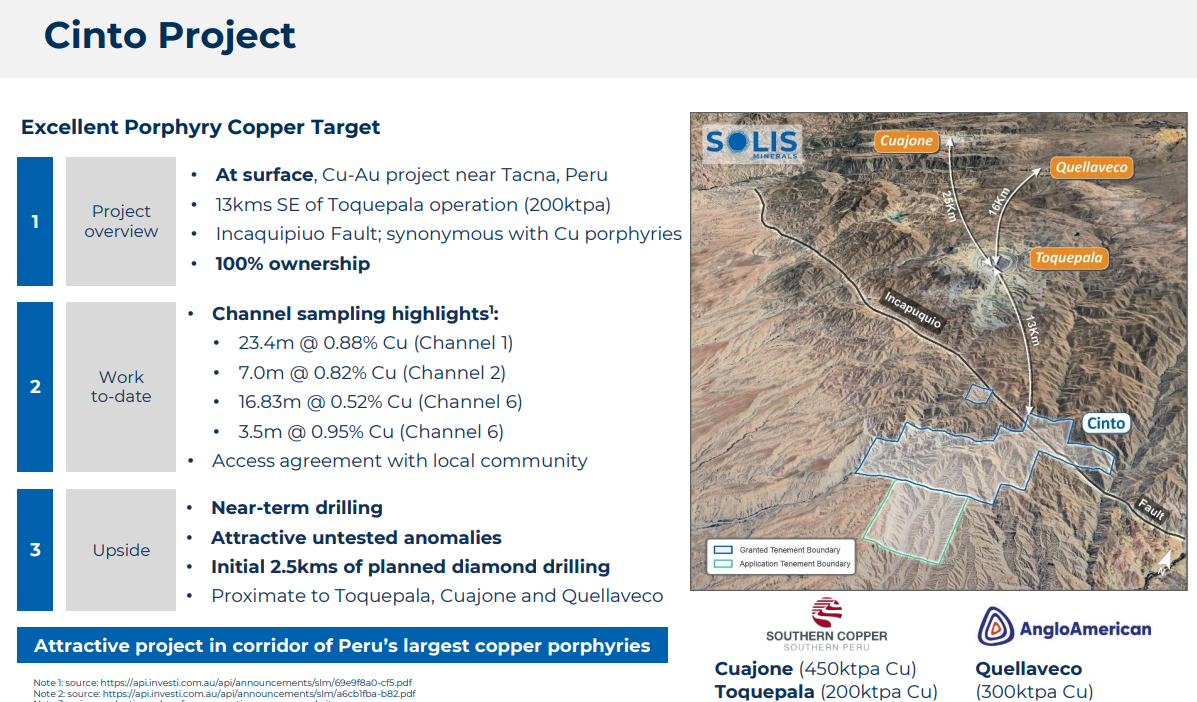
The 100%-owned Cinto Project near Tacna is around 13 kilometres southeast of the Toquepala copper operation and sits on the Incapuquio Fault, within a broader region containing major porphyry systems.
Previous channel sampling at Cinto included results of 23.4 metres at 0.88% copper, 7 metres at 0.82% copper, 16.83 metres at 0.52% copper and 3.5 metres at 0.95% copper.
Solis has secured an access agreement with the local community and describes the project as ready for near-term drilling. An initial 2.5 kilometres of diamond drilling is planned to investigate untested anomalies.
The project’s location is also notable. As illustrated by the map on page 14 of the presentation, Cinto sits within the same broad southern Peru copper region as the Toquepala, Cuajone and Quellaveco operations, giving Solis a defined geological context for its exploration strategy.
Cucho adds a second advanced copper target
Further north in Peru, the Cucho Project gives Solis another advanced copper exploration opportunity.
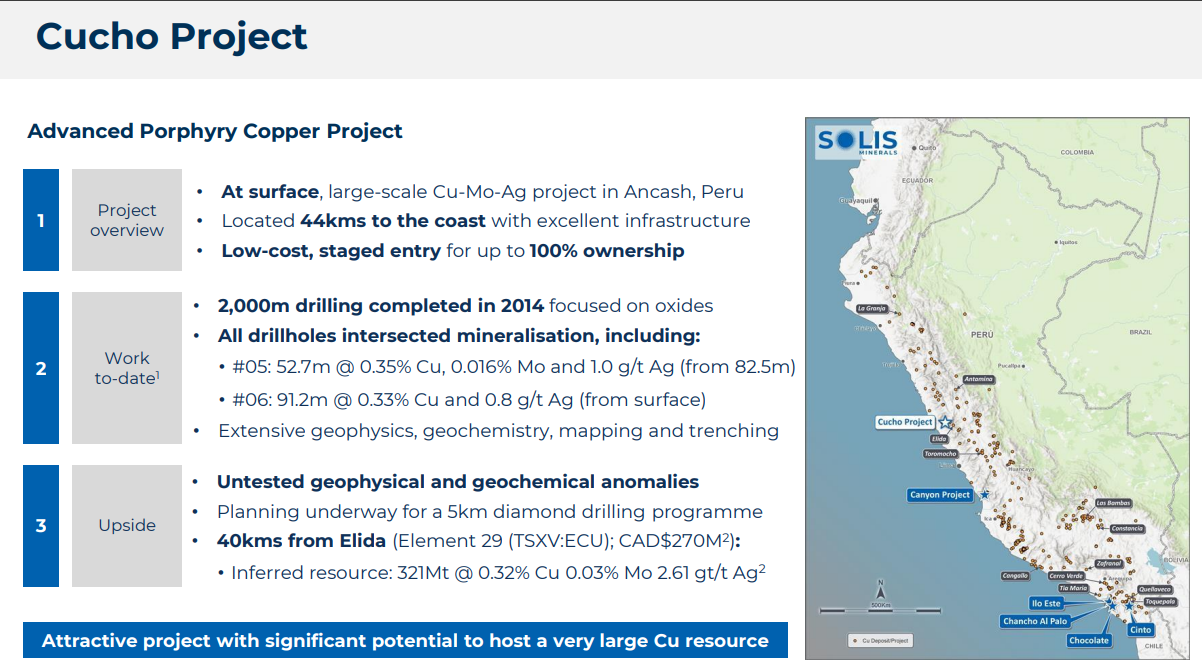
Cucho is a large-scale copper-molybdenum-silver project in Ancash, about 44 kilometres from the coast, where Solis has negotiated a staged entry arrangement that can increase its ownership to 100%.
Around 2,000 metres of historical drilling was completed in 2014, with the work focused primarily on oxide mineralisation. All holes intersected mineralisation, according to the company’s presentation.
Selected results include 52.7 metres at 0.35% copper, 0.016% molybdenum and 1.0 g/t silver from 82.5 metres, and 91.2 metres at 0.33% copper and 0.8 g/t silver from surface.
Solis says extensive geophysical, geochemical, mapping and trenching datasets have identified further anomalies that remain untested.
Planning is underway for a 5-kilometre diamond drilling program, giving the company another potentially significant copper campaign alongside Cinto.
Experienced South American team
Management experience is another element Solis is emphasising as it moves into this next phase of drilling.
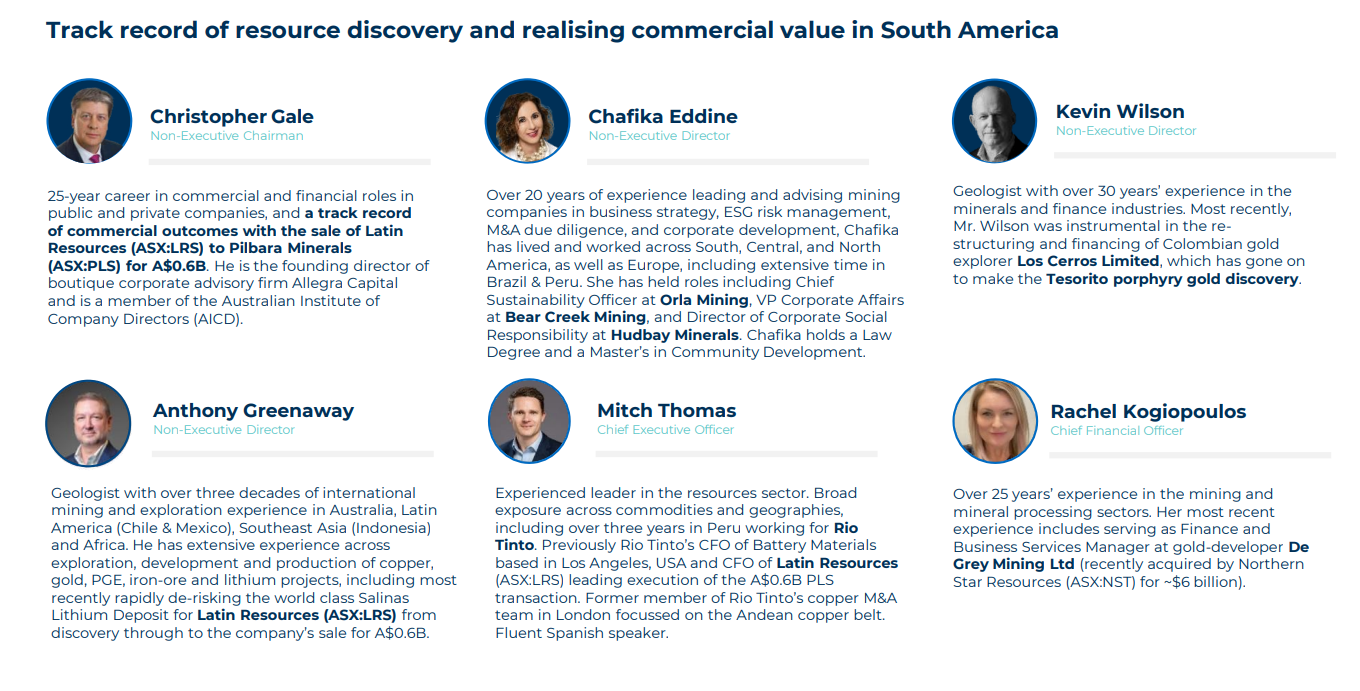
Chief executive officer Mitch Thomas previously spent more than three years in Peru with Rio Tinto, where his roles also included work in the company’s copper M&A team, and later served as CFO of Latin Resources during its A$0.6 billion transaction with Pilbara Minerals.
Non-executive director Anthony Greenaway also worked with Latin Resources and was involved in advancing the Salinas lithium deposit in Brazil from discovery through to the company’s sale.
Other board members bring experience across mining, finance, corporate development and Latin American operations, including chairman Christopher Gale, directors Chafika Eddine and Kevin Wilson, and chief financial officer Rachel Kogiopoulos.
The Latin Resources experience is particularly relevant to Solis’ strategy in Brazil. Latin Resources began drilling at Colina in January 2022, confirmed spodumene shortly afterwards and announced a binding A$0.6 billion sale to Pilbara Minerals in August 2024. The transaction completed in February 2025.
Solis acquired its adjacent Brazil Lithium Project in April 2026.
Next steps
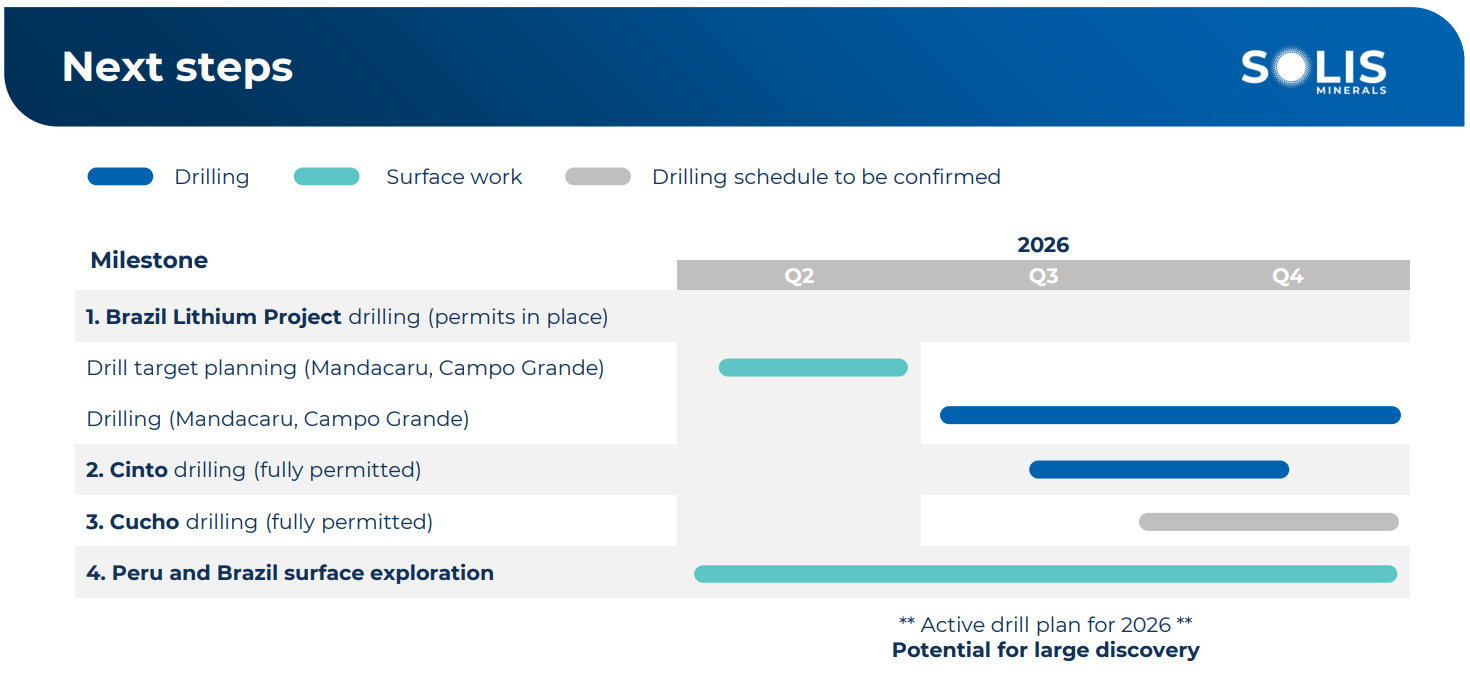
The remainder of 2026 is expected to centre on converting Solis’ exploration targets into drill-tested prospects.
At the Brazil Lithium Project, drilling is planned across Mandacaru and Campo Grande following target definition work, with permits already in place.
Cinto is also fully permitted for drilling, while drilling at Cucho is planned subject to confirmation of the schedule. At the same time, surface exploration is expected to continue across projects in both Peru and Brazil.
The immediate milestones therefore provide several potential sources of exploration news: first-pass drilling at Mandacaru, advancement of Campo Grande, initial drilling of the Cinto porphyry target and follow-up testing of the historically mineralised Cucho system.
About Solis Minerals
Solis Minerals is an ASX-listed exploration company focused on energy metals in South America, with projects targeting lithium and copper in Brazil and Peru.
Its core portfolio includes the 100%-owned Brazil Lithium Project, the 100%-owned Cinto copper project and the Cucho copper project, where it can earn up to 100% ownership. The company also holds other copper exploration assets in Peru and lithium exposure in Brazil.
Solis’ strategy for 2026 is centred on parallel exploration and drilling programs across its most advanced assets, supported by a management team with experience in South American mining and exploration and more than A$7 million in cash as of June 1, 2026.