

Should they stay or should they go? The United States is redefining its presence in the Middle East
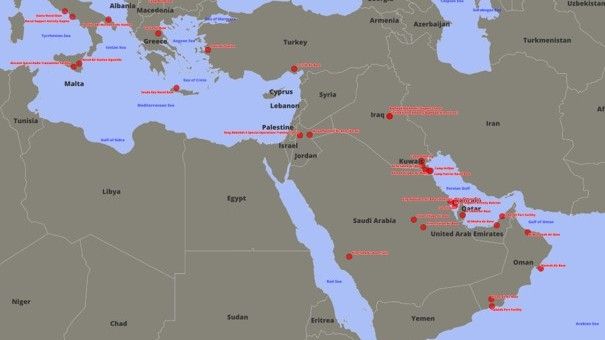
Photo. Wikideas1 / Wikipedia
The United States is currently conducting an assessment of its military presence in the Middle East, with a particular focus on potential force reductions. While Secretary of War Pete Hegseth has not ordered a formal review, the ongoing evaluation may serve as a basis for future decisions regarding the U.S. regional posture.
Why is Washington reconsidering its presence in the Middle East?
The assessment is being conducted by the Pentagon’s policy office, U.S. Central Command (CENTCOM) and the Joint Staff. They are analysing the future of 20 military facilities, including eight permanent bases, as well as the deployment of more than 40,000 American troops stationed across the Middle East.
As a consequence of the ongoing conflict, many of these facilities have been targeted by Iranian drones and missile attacks. The exact cost of reconstruction is still unknown, but as of today, 18 American service members have been killed and hundreds have been injured.
Nevertheless, the damage to these facilities is significant. With costs rising and the war still not over, the question is whether Washington will be able to rebuild every warehouse or ammunition depot that was struck during the attacks. Considering that the cost of the war already exceeds $37 billion, excluding the cost of repairing damaged facilities, it is highly possible that Washington will decide to reduce its presence in the region.
The U.S. currently houses troops and military infrastructure in several countries in the Middle East, including Kuwait, Bahrain, Qatar, and the UAE, while also maintaining access to military facilities in Jordan, Egypt, Iraq, and Oman.
It is worth mentioning that the headquarters of the U.S. Navy’s Fifth Fleet in Bahrain, which is responsible for operations across the Gulf, the Red Sea, the Arabian Sea, and parts of the Indian Ocean, was one of the most frequently targeted military facilities during the current war with Iran. Another frequently targeted facility was Al Udeid Air Base in Qatar, Washington’s largest military base in the region, which hosts approximately 10,000 troops.
Redefinition of the U.S. presence in the Middle East
Since the end of the Second World War, the United States has played two important roles there: hegemon and protector of medium and small powers. Kenneth M. Pollack described Washington’s role in the region until 2004 as follows: The United States became the ultimate guardian of the region’s oil flows, the mediator of many of its disputes, the deterrent to its worst threats. The true hegemon of the Middle East. The current American role in the Middle East differs significantly from its former position as the region’s hegemon.
Naturally, the United States is still perceived as one of the most powerful actors in the region. However, the present war has highlighted the vulnerability of U.S. military facilities in the Gulf and raised questions regarding the effectiveness of the current U.S. strategy in the region.
Consequently, discussions about a potential U.S. withdrawal from the Middle East have intensified in recent years. Nevertheless, this attitude should not be strictly related to the Trump administration. Originally, it can be partially attributed to the „Pivot to Asia” strategy popularised during the Obama administration.
Based on the current assessment, it is still too early to answer the question regarding the U.S. regional presence: Is America staying or going? These diverse and often conflicting perspectives were presented in a paper by F. Gregory Gause III, where he enumerated the points of view of Middle East experts. The president of the Middle East Institute wrote an article in early 2019 entitled „America’s Mideast Retreat”, suggesting a U.S. withdrawal from the region. At the same time, the experts of the Brookings Institution’s Middle East expressed that the perception of U.S. withdrawal from the Middle East overstates the reality, but American influence in the region is certainly on the decline. Finally, American Middle East specialists concluded that the conventional wisdom takes the retreat of U.S. power as a given.
Nevertheless, U.S. military engagement in the region has remained substantial. This argument is supported by troop deployment data from successive administrations. For example, at the end of the Obama administration, which was considered a period of significant decline in the U.S. commitment to the region, there were more than 58,000 American military personnel stationed in the region on land and sea, including more than 5,000 in the campaign against the Islamic State (ISIS) in Syria and Iraq and 8,400 in Afghanistan. It is a crucial indicator because, compared to 1995, four years after the First Gulf War, at a time when no one mentioned American abandonment, the number of American forces deployed in the region was just below 7,800. Similar to Obama’s presidency, the Trump administration did not significantly reduce the number of U.S. military personnel deployed in the region.
After the withdrawal from Afghanistan in 2021, the number of U.S. personnel decreased to approximately 34,000. Nevertheless, the situation changed after 7th October 2023, when the troop levels increased to between 40,000 and 50,000 personnel, which was strictly related to the war between Hamas and Israel and tensions with Hezbollah and Iran. Even though the presence in Syria and Iraq is expected to be reduced in 2026, Washington has simultaneously increased its overall military presence in the Middle East to more than 40,000 personnel.
Summary and perspectives for the future
Current developments should be viewed as part of the broader evolution of U.S. engagement in the Middle East. Barack Obama, Joe Biden, and Donald Trump, in both of his terms in office, articulated a desire to scale back the U.S. security posture in the Middle East. The defence strategy promotes expanding regional consultative mechanisms and deepening interoperability to share the burden of protecting U.S. allies and interests across the world.
The shift in U.S. involvement in the Middle East was driven by the rise of a more aggressive China and the growing economic importance of the Indo-Pacific region. Therefore, American decision-makers had to change the form of commitment in other parts of the world. This does not mean that the United States has completely abandoned the region – it has decided to share the burden of security with regional allies and partners. This approach is particularly evident now.
The long-standing U.S. involvement in the Middle East led to a situation where the Arab allies were accustomed to Washington’s presence. However, observing its incremental disengagement, regional policymakers understood that they needed to change their attitude toward cooperation with the United States. Therefore, additional regional partnerships involving actors such as Saudi Arabia, Türkiye, and Pakistan may emerge in the coming years.