

Shafaq News..Iraq’s disarmament deadline pits Baghdad against Iran-aligned factions
Shafaq News
Iraq is entering a period of heightened tension as September 30, 2026
approaches, the deadline set by the State Administration Coalition, which
brings together the country’s leading Shiite, Sunni and Kurdish political
forces, to bring all weapons under state control.
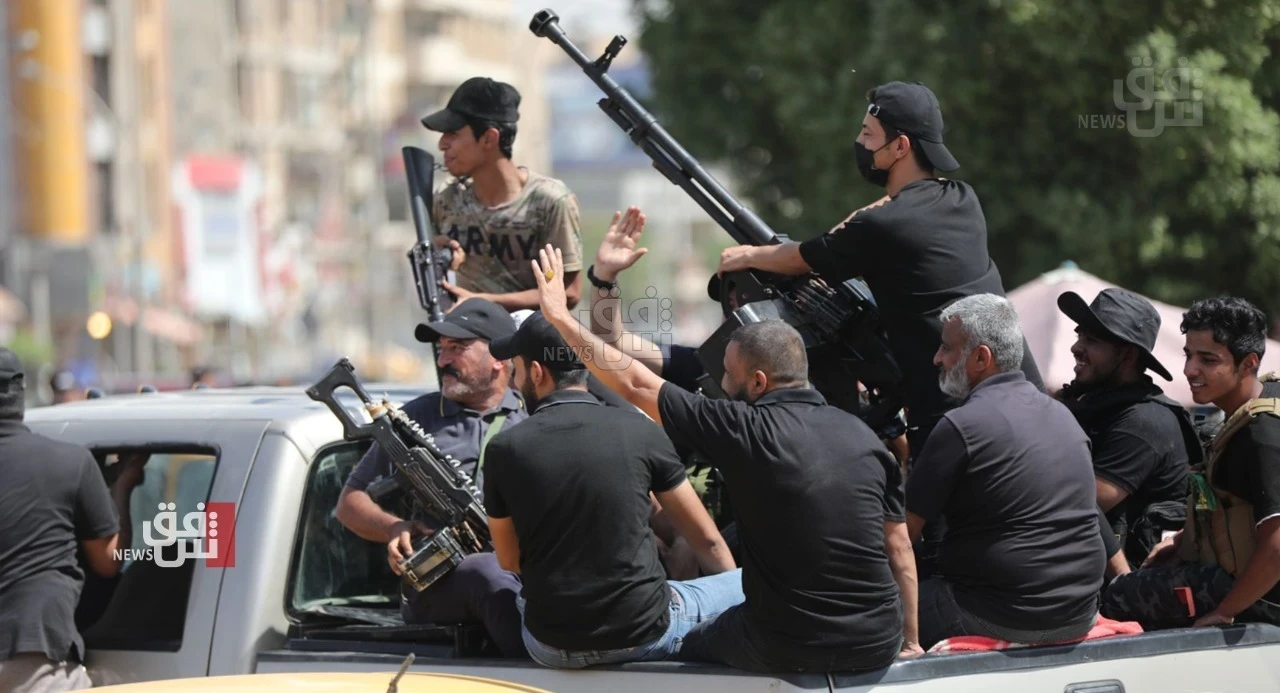
The deadline comes amid diverging positions among armed factions, with
some supporting the principle while others rejecting it. Tensions have also
intensified following increasingly sharp rhetoric from Kataib Hezbollah in its
latest statement against Prime Minister Ali al-Zaidi.
Two competing positions drive the crisis. Baghdad maintains that control
over weapons is a sovereign state responsibility, while several armed factions
insist that any discussion of their weapons must be tied to the withdrawal of
US and Turkish forces, the dissolution of the Peshmerga, and an end to
“foreign domination over Iraqi decision-making.”
Several questions remain unanswered in Iraq: Could the crisis move from
political tension to armed confrontation? And what impact will external actors,
from the United States to Iran, have on the dispute?
Former State of Law Coalition lawmaker Arif al-Hamami calls the
situation critical as regional and international pressure builds, calling for
the weapons issue to be addressed without “imposition or threats.”
In an interview with Shafaq News, al-Hamami says “everyone supports
upholding the law and placing weapons under state control,” but any
solution must weigh the range of security threats facing Iraq, among them the
activities of Iranian Kurdish opposition groups operating from Iraqi territory,
the presence of Turkish forces, and wider regional developments.
He proposes folding the armed factions into the Popular Mobilization
Forces (PMF), the state-linked security body —a step that would, in practice,
formalize much of their existing footprint, since most of the factions already
field brigades within the PMF.
Al-Hamami also expresses confidence in the “ability of the leaders
of the Coordination Framework to contain the crisis” and hopes the Shiite
religious establishment in Najaf, Ayatollah Ali Al-Sistani, will intervene
“to end the dispute.”
Read more: Jurf al-Sakhr and Iraq’s push to disarm factions
The Religious Establishment’s Position
Debate over a possible role for the religious establishment draws on
previous positions by al-Sistani regarding state control over weapons.
On April 11, 2024, during a meeting with the UN secretary-general’s
representative in Najaf, al-Sistani stressed the need to prevent foreign
interference, uphold the authority of the law, and place weapons under state
control.
On June 26, 2025, his representative in Karbala, Abdul-Mahdi
al-Karbalaei, renewed the call for the state to hold a monopoly on arms,
foreign interference to be prevented, and the law to be upheld amid the
military escalation between Iran and Israel at the time.
More recently, in May 2026, reports emerged that Patriotic Shiite
Movement leader Muqtada al-Sadr and Prime Minister Ali al-Zaidi had asked
al-Sistani to issue a new religious ruling titled “Placing Weapons Under
State Control.” According to those reports, the move sought to provide
religious cover for efforts to end the presence of weapons outside official
institutions.
No such ruling has been issued so far.
Read more: Iraq and the Mecca Defense Pact: Strategic neutrality orgrowing isolation?
Diverging Positions
The positions of the various parties remain complicated. The government
maintains that any armed activity outside the state framework after September
30 will be dealt with according to the Anti-Terrorism Law, while Iraq’s four
top state authorities remain committed to disarming groups outside the state.
In contrast, Kataib Hezbollah, Harakat al-Nujaba, and Kataib Sayyid
al-Shuhada insist on retaining their military capabilities. Other factions,
including Asaib Ahl al-Haq and Kataib Imam Ali, have taken steps to bring their
armed activities under state authority.
The government has also begun taking practical steps, including forming
a committee to address the situation in Jurf al-Sakhr in Babil province. The
panel includes representatives from the ministries of Interior, Justice and
Agriculture, as well as the PMF.
These moves have coincided with serious security incidents, most notably
a drone attack on 17 August targeting the private office of Kurdistan Region of
Iraq (KRI) Prime Minister Masrour Barzani, along with the residence of the
intelligence chief.
The KRI’s Counter-Terrorism Service said the two explosive-laden drones
were launched from Iranian territory, though it offered no supporting evidence.
Iran rejected the accusation: Foreign Minister Abbas Araghchi called the attack
“reckless” and warned Kurdish authorities against “false-flag
ploys” designed to sow discord between the two neighbors, affirming that
Tehran’s ties with the Kurdistan Region remain friendly. No Iraqi armed faction
claimed responsibility.
Read more: Days to disarm Iraq’s factions: deadline or negotiable ceiling?
Escalation and Factional Demands
The latest escalation also came when Abu Mujahid al-Assaf, a security
official with Kataib Hezbollah, warned that “patience is running out”
over the government’s “provocative and irresponsible actions,”
threatening a response based on the principle of “an eye for an eye, and
the aggressor is the wrongdoer.”
The group has set three conditions for any talks with the government
over the weapons issue: the complete withdrawal of US forces and guarantees
that they will not return; an end to what it describes as American domination
of Iraq’s political and economic decisions; and the withdrawal of Turkish
forces from northern Iraq and dissolution of the Peshmerga.
The conditions sharply widen the gap between the factions and Baghdad
and could complicate efforts to reach a negotiated settlement.
Kataib Hezbollah issued the statement days after an unannounced visit to
Baghdad by Esmail Qaani, commander of Iran’s Quds Force, on August 10. Iraqi
sources told Shafaq News that the visit addressed the weapons issue and that
Qaani urged the factions not to surrender their weapons for now, while avoiding
confrontation with the government and seeking a political settlement.
Meanwhile, some political forces have sought to keep the crisis within
the political sphere to prevent it from developing into an armed confrontation.
Signs of such a possibility emerged following the arrest of a PMF officer, who
was subsequently handed back to the PMF following rapid political intervention.
The Dialogue Track
Nouri al-Maliki, head of the State of Law Coalition, said the committee
formed by the Coordination Framework to address the issue of state control over
weapons would begin its work soon in coordination with the government to
establish appropriate mechanisms for implementation.
His position is significant partly because of its timing. During a
meeting with US Chargé d’Affaires in Baghdad Joshua Harris, al-Maliki stressed
that the issue should be addressed through “dialogue and
understanding,” while emphasizing that the state and its constitutional
institutions must remain the ultimate authority over security and military
affairs.
Hadi al-Ameri, leader of the Badr Organization, called on all sides to
exercise restraint and avoid inflammatory statements. He expressed confidence
in the “good intentions” of the prime minister and faction leaders
while warning against steps that could give external actors grounds to
interfere in Iraqi decision-making.
A US Perspective
In an interview with Shafaq News, Former US Department of Defense
official David Des Roches views the establishment of a deadline as “a
positive step,” but warns that resistance from factions “taking orders
from Iran” rather than Iraq could prove “potentially lethal.”
The central question, he argues, is whether the Iraqi state is prepared
to confront “the Iranian agents in its midst,” or whether it will
accept a compromise that amounts to “a new validation of an unacceptable
status quo.”
In Des Roches’ assessment, “Iraq is not a sovereign nation”
and does not appear ready to confront the internal forces he believes are
necessary to establish full sovereignty. He argues that maintaining “a
thinly-veiled Iranian presence” may be politically acceptable, but would
not be sufficient to lift restrictions on bank transfers and other mechanisms
Iran uses to evade international and US restrictions, particularly as “the
Iranian economy continues to crater.”
If armed factions refuse to disarm, Des Roches believes Iraq will either
“continue to be a partially sovereign nation” or face “a period
of civil war against Iranian proxies,” adding that “there really is
no other way.” He also expects the KRI to “continue to have its own
dynamic, separate from the rest of Iraq.”
Separating the Two Tracks
In August 2026, the State of Law Coalition reportedly proposed
separating the US withdrawal timetable from the process of disarming the factions,
according to a Coordination Framework source who spoke to Shafaq News. Under
the proposal, a transitional period would provide time to build confidence and
reassure parties opposed to disarmament.
These concerns coincide with the process of ending the Global
Coalition’s mission in Iraq, scheduled to be completed on September 30, 2026.
Factions determined to retain their weapons have cited this deadline as a
central justification for maintaining their military capabilities.
That raises a fundamental issue: Would confrontation at that point
become inevitable if the factions refuse to surrender their weapons?
Confrontation or Integration?
Independent politician Aaed al-Hilali describes the approaching deadline
as making the issue “highly complicated,” but does not believe armed
confrontation is inevitable.
Speaking to Shafaq News, al-Hilali argues that Iraq’s security
institutions are more experienced and capable of managing crises. He also
believes political forces understand that any internal confrontation would
represent a loss for everyone and could trigger economic and institutional
fallout.
“The real danger is not the weapons alone, but the crisis of trust
between the state and the factions and linking the weapons issue to the
question of the foreign presence,” he explains, stressing that “a
purely security-based approach could be a gateway to escalation, and armed
confrontation must be the last option, not the first.”
Political analyst Mujashaa al-Tamimi shares this assessment, considering
the risk of confrontation real but not inevitable. ” Iraq has the
institutional, legal, and security levers to contain escalation, provided there
is a unified government position and no rush to use force,” he told Shafaq
News.
For al-Tamimi, the core of the crisis lies in the state’s ability to
turn disarmament into a phased process negotiated through law and politics,
supported by broad backing. He also warns that rejection of the decision by
some factions, combined with rifts inside the government or the security
establishment, could turn the dispute into open fighting, threatening the
country’s stability.
Security expert Safaa al-Aasam almost completely rules out a
confrontation between the government and the factions.
“There is no armed faction prepared to harm the country’s security
because they are sons of Iraq,” he told Shafaq News, arguing that the
dispute is political rather than an indication of an impending armed
confrontation.
He regards placing weapons under state control as a “popular
demand” and points to the religious establishment’s position that there
should be a single authority holding weapons.
In his assessment, the dispute is likely to be resolved through
political agreements involving government positions, integration into state
institutions, or arrangements under which the weapons would be brought under
the authority of official security institutions.
Read more: Iraq’s September deadline undercuts armed factions’ case for weapons
Written and edited by Shafaq News staff.