

Sánchez Reveals Spain Summoned Morocco’s Ambassador Over Ceuta, Melilla Remarks
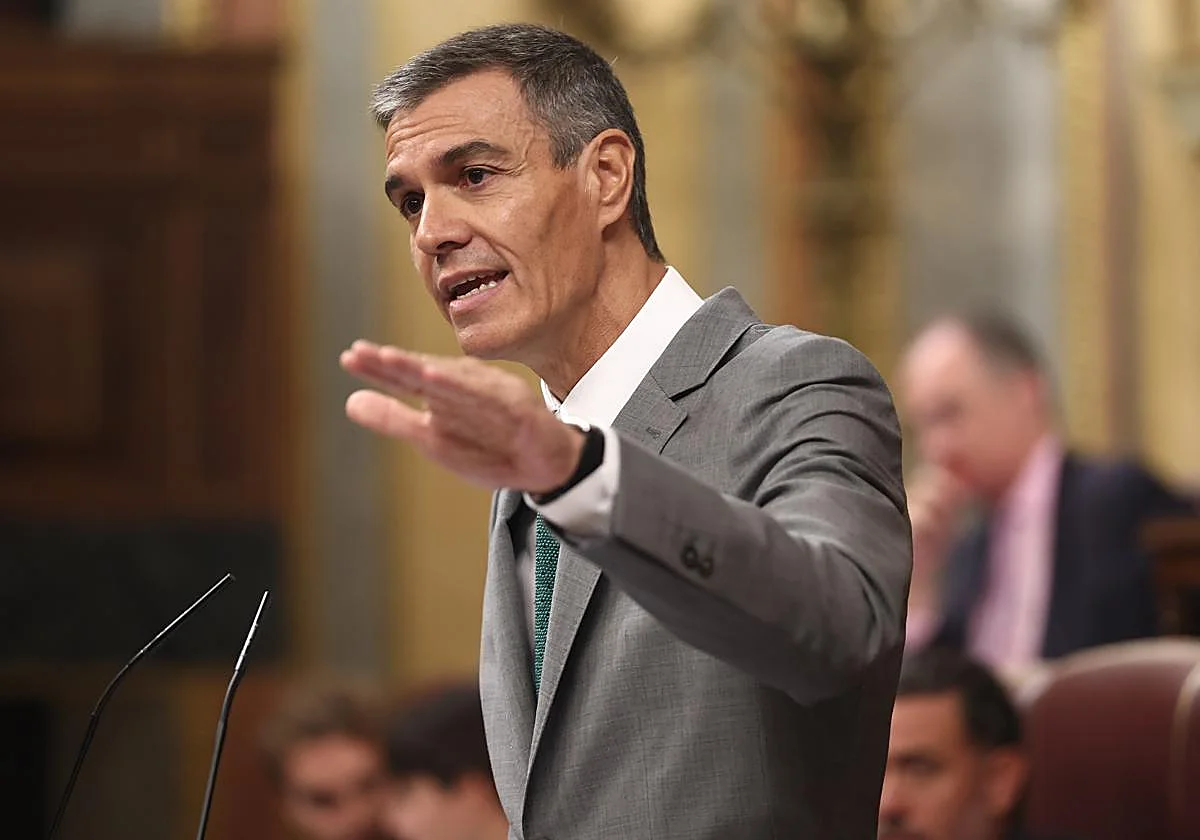
Marrakech – Spain’s Prime Minister Pedro Sánchez told the Congress of Deputies on Thursday that his government summoned Morocco’s ambassador in Madrid on August 21, disclosing a move Madrid had kept quiet for weeks.
The summons, he explained, came in protest at what he branded “unacceptable” declarations by two Moroccan ministers reaffirming the kingdom’s sovereignty over the occupied cities of Ceuta and Melilla.
The envoy in question, Karima Benyaich, is described in the Spanish press as a figure close to King Mohammed VI. Sánchez named the two ministers directly: Justice Minister Abdellatif Ouahbi and Minister of Islamic Affairs Ahmed Toufiq.
What the two ministers actually said
Ouahbi had made his remarks on August 21 on the public channel 2M. The sit-down was arranged to mark the entry into force of Morocco’s new statute on the legal profession, yet the minister steered it toward Madrid, hauling the enclaves back to the center of a file Spain pretends is closed. “Ceuta and Melilla will remain a subject of dialogue between us and Spain, and we will hold to our historical right and our geographical right,” he declared.
He pressed for a standing “dialogue commission,” warning that the matter “must be kept present, because it is a subject on which one cannot remain silent,” and demanded a “definitive solution” whose only terminus is the “return of Ceuta and Melilla to the bosom of the homeland.” It was no isolated outburst: on August 12, in an interview with Asharq Bloomberg, he had already placed the enclaves “on the table.”
Toufiq’s intervention came days later, on August 25, during the religious ceremony at the Royal Palace in Rabat marking the Prophet Mohammed’s birthday. In a passage laden with historical resonance, he invoked Qadi Ayyad, the eminent Moroccan jurist born in Ceuta. He traced part of the North African country’s religious and scholarly tradition through works “beginning with Al-Shifa by Qadi Ayyad, followed by Al-Durr al-Manzum by Al-Azafi, both scholars being from the city of Ceuta.”
He then widened the historical frame, turning to Imam al-Jazouli’s “Dala’il al-Khayrat,” which he noted had “become a symbol for Moroccans in their mobilization to liberate the occupied cities along the Atlantic coast at the beginning of the modern era.” The juxtaposition was notable: an explicit reminder of Ceuta’s place in Morocco’s intellectual and religious history, immediately followed by a reference to the mobilization of Moroccans for the liberation of occupied coastal cities.
For Moroccan author and political analyst Samir Bennis, the invocation carried its full weight. “Now we can finally say that Morocco has sent Spain a warning,” he wrote, reading a “tacit but forceful” message aimed at “the denigration of the country and its institutions” and “the falsehoods about its history and the colonial history of Ceuta and Melilla.”
Whatever Madrid’s custodians pretend, he argued, “for Morocco they are nothing more and nothing less than a vestige of European colonialism on Moroccan territory, whose historical situation remains unresolved.”
Sánchez’s appearance, more than a month after the late-July crisis, was meant to answer for the mass crossing of more than 70,000 people, according to figures reported by Spanish authorities, into occupied Ceuta on July 30 and 31. The question hanging over the chamber was whether Rabat engineered it.
Here the prime minister worked to exculpate Morocco while conceding the facts. He admitted the Moroccan Gendarmerie “permitted the crossing of the border” for roughly ten hours, exactly as a police report handed to National Court judge María Tardón had documented. That report describes an “active guiding” of thousands, a “strategic design,” and a plan meant to collapse Spain’s response capacity.
Yet Sánchez refused to call any of it proof. “To this day no one has provided the government with evidence allowing the conclusion that the mass entry into Ceuta was designed or executed by the Moroccan authorities,” he told deputies. He conceded only that the reasons behind the ten-hour lapse “will still have to be clarified.”
His posture toward Rabat carried a warning folded into caution. “If solid evidence existed, we would act accordingly, with total forcefulness,” he warned, adding that “this government is not afraid to confront other foreign powers when the situation has required it.” He acknowledged, too, that the relationship must shift, granting that “after what happened, that cooperation has to be different.”
Then came the announcements. Sánchez confirmed that King Felipe VI would travel to Ceuta and Melilla “in the coming weeks” to convey “the absolute commitment of the State.”
It would be the monarch’s first official visit to the enclaves, coming almost twenty years after his father Juan Carlos went in 2007 – a trip that itself triggered a diplomatic crisis with Rabat. The choreography is transparent: a royal descent on occupied soil, staged to dress up possession as legitimacy. Yet a king’s footfall on stolen ground confers no title, however solemn the pageantry Madrid wraps around it.
He promised a dossier of all the reports, faulted the border intelligence unit CENIF for burying its own findings, and vowed the state “will never renounce the sovereignty of Ceuta and Melilla,” cities he insisted would stay Spanish “until the end of times.”
The bluster settles nothing. Madrid, as ever, bolted the door, its Foreign Ministry answering the two ministers with a “categorical rejection” and repeating the worn formula that the cities form part of “the internationally recognized territorial integrity and sovereignty of Spain.”
The refusal is no novelty. For decades, Madrid has met Moroccan attempts to open the question with essentially the same answer. In 1987, King Hassan II formally proposed the creation of a joint Moroccan-Spanish “reflection cell,” composed of experts from both countries, to examine the future of Ceuta and Melilla and explore an eventual negotiated solution. Madrid rejected the proposal almost immediately; Hassan II would return to it repeatedly in the years that followed.
A title built on conquest
As the Spanish press has rendered the position in plainer language, the status of the cities “has not been discussed and never will be.” Yet the history is considerably less tidy than that formula suggests. Ceuta was seized by Portugal in 1415 and eventually passed under permanent Spanish control, while Melilla was taken by Castilian forces in 1497.
Spain’s territorial foothold was subsequently enlarged through agreements concluded under the pressure of military defeat, most notably the Treaty of Wad-Ras, signed in Tetouan on April 26, 1860, at the end of the Spanish-Moroccan War. The treaty expanded the territory under Spanish control around Ceuta and ratified the 1859 convention enlarging Melilla’s perimeter.
Writing in Le360, the Algerian-French novelist Boualem Sansal sharpened the irony at the heart of the dispute. In 1987, he recalled, King Hassan II asked for Morocco to join the European Economic Community (EEC), now the European Union (EU), and the request was waved away on the grounds that Morocco was not a European country.
That answer once seemed obvious. It seems far less so now, Sansal argued, because the same Europe that told Morocco it could not enter the club because it was African now insists that two cities sitting on African soil form its own frontier.
In 1987, Europe told Morocco, “you are in Africa, so you cannot come in”; in 2026, it says, “we are in Ceuta and Melilla, so Europe is in Africa.” Between those two claims, he wrote, something no longer holds. His conclusion was blunt: Europe’s borders should be in Europe, and Morocco lies fourteen kilometers away.
These are, in other words, African cities embedded in Morocco whose present territorial configuration bears the unmistakable imprint of conquest, war and nineteenth-century coercive diplomacy. Parliamentary indignation in Madrid may reaffirm Spain’s present position, but repetition alone cannot erase the historical circumstances through which that position was established.
Credit: Source link