

Russia: Why is the Yabloko party barred from the elections?
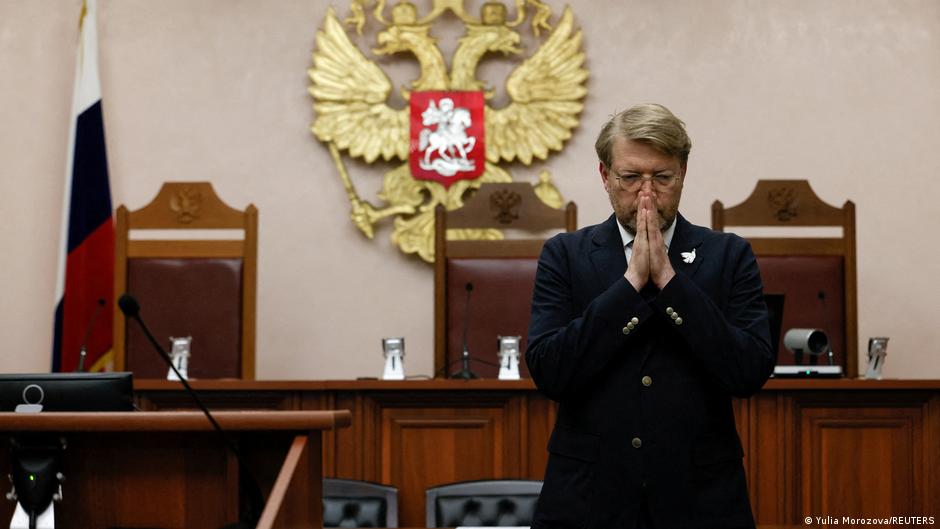
On Monday Russia’s supreme court upheld a lawsuit against the anti-war opposition party Yabloko. Its candidates will now be barred from taking part in the parliamentary elections on September 18 to 20.
The case against Yabloko was brought by the pro-Kremlin party Rodina, which accused it of infringing copyright with its election campaign materials. Rodina also made the claim that Yabloko had engaged in extremist activities and had received illegal financing from abroad.
The verdict was pronounced by presiding judge Vyacheslav Kirillov. This was the same judge who, in April, banned the Russian human rights organization Memorial and designated it an extremist organization. Kirillov also previously dismissed legal complaints against the Russian prison service filed by the prominent opposition politician Alexei Navalny. Navalny spent many years in Russian prisons prior to his death in jail in 2024.
At least 500 people gathered in front of the Supreme Court to show their support for Yabloko. They distributed apples and sang songs. The name Yabloko – “apple” in English – derives from the initials of the party’s three founders, Grigory Yavlinsky, Yury Boldyrev and Vladimir Lukin (YaBL). The apple is now well-known as a symbol of the party.
At the end of the nine-hour court session, security services threatened the people gathered outside the courthouse with arrest, also warning young men that they could be taken to an army enlistment office.
“You are mistaken if you believe that, with a stroke of a pen, you can write off millions of people who want peace, freedom and a normal future for their country,” Nikolai Rybakov, the leader of Yabloko, wrote on Telegram that evening.
He insisted that the party had not broken any Russian laws, and announced that he would appeal the judgement.
The Kremlin ‘got scared’
Grigory Yavlinsky, one of the founders of Yabloko, said those in power were afraid of Yabloko’s program, which calls for an election “for peace, freedom and a life without fear” – because, he said, “removing a party with a platform like this from the election, without any real grounds, is the political system exposing itself.”
The lawsuit came at the same time as an appeal by Russian opposition and cultural leaders living abroad for people to support Yabloko.
They include the politician Yulia Navalnaya, Alexei Navalny’s widow, as well as Lyubov Sobol, Ilya Yashin and Andrei Pivovarov. The writer Dmitry Bykov, human rights activist Oleg Orlov and other prominent people also voiced their support for Yabloko.
Navalnaya, who now leads the Anti-Corruption Foundation (FBK) her husband set up in 2011, responded to the verdict. The Kremlin was originally going to let Yabloko stand in the elections, she said, but those in power “got scared” and had the party blocked.
Navalnaya wrote on Telegram that the powers-that-be had observed a development they wanted to stop at any cost: People were starting to join forces. This, she wrote, was less about support for Yabloko than the possibility for millions of Russians to express how they really felt about Vladimir Putin and the war in Ukraine.
Andrei Pivovarov, a political activist who lives in exile in Germany and is a coordinator of the Russian Antiwar Committee, explained to DW that the opposition had not believed supporting Yabloko would bring about swift political change or an end to the war. The aim, he said, had been to make visible the extent of anti-war sentiment in Russia.
“There would have been a dozen parties on the ballot who are pro-war, and one that is pro-peace. The war wouldn’t end even if Yabloko were to get representatives into the State Duma. But we would have seen that a lot of Russians oppose the war,” said Pivovarov. This view, he added, would not simply disappear now Yabloko has been barred from standing.
What were the Kremlin’s plans for Yabloko?
The political scientist Ivan Preobrazhensky speculated in an interview with DW that the banning of Yabloko could be a consequence of a power struggle between different interest groups in the Kremlin. He suggested that the security bloc allied with the federal security service, the FSB, may have wanted Yabloko to act as a counterweight to the New People party. This is regarded as a project of Sergey Kiriyenko, the first deputy chief of staff of the presidential administration.
Another version of events is that Kiriyenko himself may have tried to create the impression of political rivalry, and underestimated the potential of anti-war feeling in the country.
Preobazhensky says the government underestimated the number of people in Russia who oppose the war and are ready to support a political force campaigning for an end to the war in Ukraine. Surveys, he says, indicate that there is substantial demand for such a political alternative. He also believes that the Kremlin initially intended to let Yabloko run in the election but changed its mind when it saw how much support the party was getting.
Another political scientist, Mikhail Vinogradov, thinks there was a different calculation behind the move. If Yabloko had scored very few votes in the election, the Kremlin could have painted a picture of a population solidly behind the war. A poor result would also have served to disillusion those who oppose it.
Barring Yabloko makes independent election monitoring more difficult. The party is now no longer allowed to send representatives to monitor polling stations. Roman Udot, a Russian specialist in electoral observation, explains that Yabloko has also enabled access for independent observers in the past.
Does the Kremlin have the situation under control?
The State Duma elections are taking place at a time of growing uncertainty in Russian society, says Margarita Zavadskaya from the Finnish Institute of International Affairs. She points to data from the Russian Public Opinion Foundation (FOM), which regularly records the population’s prevailing view of the situation in the country: optimism or alarm?
At the end of July, 57% of those surveyed said that they were worried. This is the highest level since mobilization in the autumn of 2022. FOM surveys should be taken with a grain of salt, but Zavadskaya says an increase like this in high summer indicates that “something is not going according to plan.”
She gives the increase in drone attacks, deaths, fires in warehouses and rumors of a fresh mobilization as the reasons, and comments that the summer of 2026 has been the most unsettling for the people in Russia since the beginning of the full-scale Russian invasion of Ukraine. She also believes the number of people who support the war is going down rather than up.
The Russian leadership therefore has good reason to be nervous.
“For the Kremlin, the ideal scenario would be a boring election with low turnout and no noteworthy events,” says Zavadskaya. “Right now, though, this seems unlikely, as the situation in the run-up to the election does not appear normal, nor does it give the impression that the government has the situation under control.”
This article was originally written in Russian.