

Russia and the logic of space denial – GIS Reports
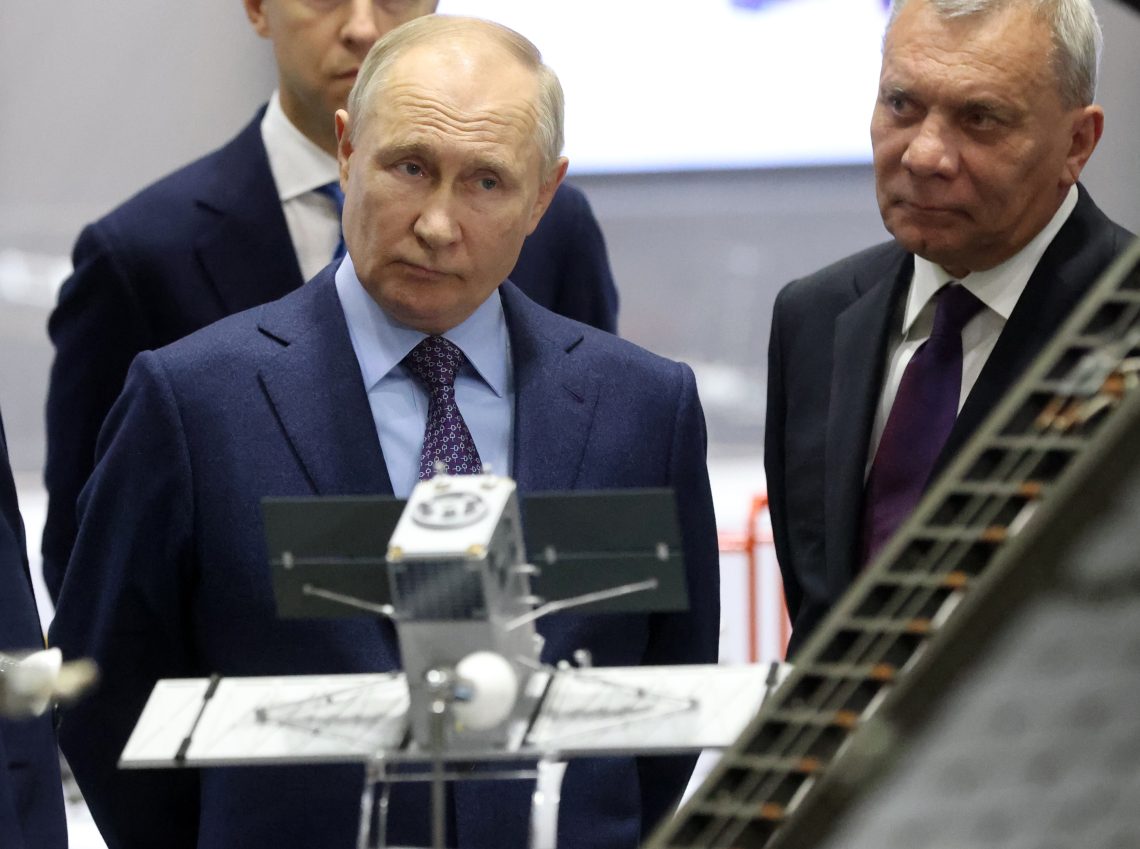
Unable to match Western and Chinese spacepower, Russia is pursuing a path of asymmetric orbital deterrence.
In a nutshell
- Russia prioritizes destroying enemy satellites over building its own
- Having fewer assets in orbit gives Moscow less to lose
- A Kremlin nuclear anti-satellite weapon threatens coercion, not dominance
- For comprehensive insights, tune into our AI-powered podcast here
This is the third installment in a GIS series on spacepower. Read about great power competition and China’s orbital ambitions.
Grand strategy works by keeping a state’s political purpose aligned with military power, economic realities, geography and raw national will over long stretches of time. Survival depends on this alignment. When great powers clash, what we actually see is the friction between these competing long-term blueprints. Today, astropolitics is crashing directly into traditional terrestrial geopolitics.
This shift has forced Russia to begin adapting its traditional strategic culture to the space domain in ways that differ sharply from China’s long-term expansionist approach. Beijing views the space domain as an arena for commercial launch networks, deep industrial footprints and permanent positioning.
Moscow operates on an entirely different wavelength, viewing space as a tactical arena for keeping stronger adversaries off balance through the constant threat of disruption. Russian spacepower hinges strictly on squeezing out strategic leverage. It prioritizes orbital denial, asymmetric deterrence and the creation of sudden chokepoints against rivals with massive technological advantages. It does not need to be the “ordermaker”; Moscow can trigger immense instability without ever dominating the future space order. The goal is clear: build the ability to instantly disrupt and destroy the space networks that competing militaries rely on.
Western powers have repeatedly underestimated Russia’s capacity for strategic endurance. Whether before Peter the Great, after the First World War or following the collapse of the Soviet Union, observers have repeatedly mistaken periods of Russian weakness for geopolitical irrelevance. History suggests a different lesson: Russia often becomes most dangerous when others conclude it is no longer capable of sustained competition.
Grand strategy and strategic culture
For leaders in Moscow, geography is not just lines on a map. Russian imperialism, Soviet expansionism and today’s Russian threats are part of a multi-century grand strategy. Territory is a physical shield. Building and aggressively holding onto buffer zones across Eastern Europe, the redoubt of the Urals, the snowy expanse of the Arctic and the rugged terrain of the Caucasus is the bedrock of its grand strategy. Modern Russian foreign policy is essentially an ongoing, aggressive scramble to secure strategic breathing room against what it perceives as a tightening ring of encirclement.
Over centuries, Russia has justified intervention by championing Russian and Slavic closeness, today calling such a doctrine the “near abroad.” This protective urge is deeply tied to a civilizational identity. Ideas rooted in the “Third Rome” doctrine, Pan-Slavism and a fierce Orthodox nationalism keep a firm grip on the Kremlin’s political rhetoric. Modern Russian strategy is driven not just by ideology, but pragmatic survival. Yet these deep-seated cultural traditions reinforce the belief that Russia is historically vulnerable, while simultaneously holding that it is destined to remain an indispensable great power regardless of material collapse.
Moscow acts with the supreme confidence of a historically destined empire, combined with the paranoia of a state under siege.
Russian strategic culture also draws upon a long tradition of military thought emphasizing endurance, denial and the concentration of force. Admiral Sergey Gorshkov demonstrated how a weaker power could challenge a stronger adversary through sea denial and strategic disruption rather than numerical superiority. Field Marshal Mikhail Kutuzov showed the value of strategic patience, trading space for time until conditions favored decisive action. Marshal Georgy Zhukov embodied centralized command and the overwhelming concentration of military power against existential threats. Together, these traditions continue to shape Russian strategic thinking, reinforcing a preference for asymmetric competition, strategic endurance and escalation management rather than direct attritional parity.
These historical blueprints dictate how modern Russia views the space domain and spacepower. It can rely on escalation, coercion and orbital competition. Its current doctrine of counterspace − capabilities that can be used against an adversary’s space objects or systems − is effectively an orbital copy of Soviet maritime sea-denial logic. It leverages cheap, asymmetric disruption to threaten sophisticated Western space networks that are highly vulnerable to localized interference.
Consequently, Russia’s strategic behavior appears deeply contradictory. The state displays clear indicators of systemic decline alongside sudden bursts of military resilience. It pairs profound internal insecurity with an incredibly high tolerance for dangerous escalation. Moscow acts with the supreme confidence of a historically destined empire, combined with the paranoia of a state under siege.
Spacepower and strategic insecurity
These exact fears shape Russia’s orbital architecture. While China views expanding into space as a key component of its “National Rejuvenation” and pours billions into a massive, industrial infrastructure program for deep space, Moscow treats orbit as an arena for raw deterrence, regime survival and coercive leverage during crises. Space is merely an extension of Russian foreign policy statecraft, driven by need and sometimes desperation.
Institutionally, Russia merged its Air Force and Aerospace Defense Forces in 2015 to create the Aerospace Forces, known as the VKS. This structure is often compared to the United States Space Force, but the comparison falls apart under scrutiny. Washington built an entirely independent military branch dedicated strictly to space. Moscow did the opposite. It locked space operations directly inside a massive aerospace-defense matrix that bundles strategic warning, air defense, missile interception and orbital warfare under a single, unified command line. This was not only a bureaucratic move – it also mirrors the Russian leadership’s attitudes toward the concentration of military power and leadership.
This setup reveals how Russia views the space domain. The military establishment handles air, missile, nuclear, cyber and orbital weapons as a single, seamless strategic continuum. Every asset is tied directly to homeland defense and strict escalation management.
Despite crippling industrial bottlenecks and a hollowed-out economy, Russia still fields significant military hardware in space. The U.S., in particular, should remember the time when, for nine years, starting in 2011, NASA had to rely on the Russian Soyuz spacecraft to transport American astronauts to and from the International Space Station. Moscow maintains reliable launch vehicles, electronic warfare units, anti-satellite platforms, early-warning constellations and the GLONASS navigation network.

Nevertheless, Russia’s civil and commercial space sectors are falling further behind Western and Chinese capabilities every year. Western sanctions, severe technological isolation and an aging aerospace workforce have crippled Russia’s long-term manufacturing base.
Ironically, this industrial weakness accelerates the logic of denial. Because Russia holds very few commercial or civilian assets in orbit, it has far less to lose. It sees minimal risk in threatening the sprawling orbital architecture that supports the Western military and global economy.
Moscow has long been fascinated by the use of unpredictable orbital paths for coercive blackmail. During the Cold War, the Soviet military developed the Fractional Orbital Bombardment System, or FOBS. This weapon was designed to bypass American radar by launching nuclear warheads into low orbit through unexpected southern approaches.
FOBS dates back to an earlier era of the Cold War. Yet the underlying concept lives on. Its current focus on co-orbital maneuver, nuclear signaling and electronic disruption proves that Moscow still believes in asymmetric escalation to freeze a stronger adversary. Russia also argues that FOBS does not violate the Outer Space Treaty since the weapon does not complete a full orbit.
Modern Russian military investment focuses heavily on technologies designed to blind, jam or completely disable enemy satellites. This includes mobile electronic warfare trucks, offensive cyber tools, maneuverable killer satellites, direct-ascent missiles and localized jamming of global navigation signals. These are not the actions of a state that lacks a stake in space as a warfighting domain.
Amid the war in Ukraine, Russia’s ongoing attacks on tactical satellite communications, network hubs and GPS signals have shown that modern combat cannot function without space-based data. At the same time, the Kremlin received a harsh lesson in the power of commercial constellations. The resilience of networks like Starlink caught them completely off guard. Many Western analysts view the war in Ukraine as an unmitigated disaster for Russia, and there is some truth in that. However, in the long arc of history, will Moscow’s struggles in Ukraine serve as a clarion call for Russian military reform and greater professionalization that could threaten NATO?
Russia is now trying to build out sovereign orbital resilience through projects such as the Rassvet constellation, its version of Starlink, while doubling down on specialized weapons designed to exploit vulnerabilities in non-Russian commercial space supply chains.
The emerging astrography of denial
Moscow views the emerging astrography through a Russian lens that reflects Soviet strategy in World War II. It is entirely different from that of Washington or Beijing. China sees cislunar space − from Earth up to and including the Moon − as economic real estate, raw materials and manufacturing hubs. Russia looks at that same terrain and sees vulnerability, targets and tactical leverage.

This mindset translates terrestrial geopolitics into orbit. Just as the Russian Empire sought mountain passes and deep rivers to protect its borders, modern Russian planners treat cislunar junctions as avenues for strategic blackmail or physical protection.
The Arctic offers a perfect historical parallel. Russia’s strategy in the high north blends an aggressive military presence, heavily fortified bases, strategic denial and the locking down of transit routes across a contested frontier. Expect this exact behavioral pattern to repeat in space.
These conditions do not make an orbital war inevitable. However, astropolitics and terrestrial geography are now permanently locked together. Space is no longer a passive background domain that merely supports ground armies. It is an active operational theater that can dictate geopolitical victories on Earth. Russia, like the U.S. and China, sees space as a warfighting domain.
Military competition and strategic positioning
Russia’s military approach to orbit is defined by aggressive asymmetry. It has abandoned any attempt to match the U.S. satellite-for-satellite. Instead, Moscow focuses on building weapons that can kill the specific space systems that Western forces rely on to fight. Counterspace technology is the absolute center of this strategy. The Russian defense ministry has poured immense funding into advanced jamming arrays, co-orbital interception platforms, direct-ascent anti-satellite missiles and proximity operations designed to shadow Western military hardware.
Russian doctrine locks space warfare directly into multi-domain operations. An orbital strike is never viewed in isolation; it is coordinated alongside massive cyber incursions, electronic jamming, long-range missile salvos and explicit nuclear signaling. This is the operational reality of Russian hybrid warfare and escalation management. It holds dire consequences for those who believe that a space conflict can be easily compartmentalized and managed.
The invasion of Ukraine provided critical operational data. Russian electronic warfare attacks on satellite networks proved it can temporarily blind the informational foundations of a modern military. However, the struggle against massive commercial networks revealed a glaring vulnerability in their strategy. They realized that destroying a handful of exquisite military satellites does not work against a distributed constellation of thousands of small commercial nodes.

This has resulted in a shift of its counterspace posture. Russian planners understand that kinetic missiles are too slow and messy to defeat a proliferated constellation. Consequently, the Kremlin is redirecting its focus to mass cyberintrusion, localized spoofing, wide-area jamming and attacks on ground-station service chains that link satellites to users on Earth.
Western intelligence agencies are increasingly alarmed by Russia’s nuclear counterspace developments. Reports that Moscow is designing an orbital nuclear anti-satellite weapon have heightened fears of a worst-case scenario: a detonation that would simultaneously fry military, commercial and civilian electronics across low Earth orbit.
The value of such a weapon is not only the actual detonation. It is the terrifying coercive leverage it provides. Russia views the vulnerability of Western space systems as a massive psychological lever to force concessions during a terrestrial crisis. Just as in the case of FOBS, Russia has used lawfare regarding the Outer Space Treaty to justify any state’s ability to have a nuclear-powered device (not a weapon) in space, and to justify the ability to “test” components as opposed to “stationing” or “placing” a weapon.
Strategic access and the Earth-Moon system
Russia’s long-term blueprints for cislunar space are far less developed than China’s. Nevertheless, Moscow refuses to be locked out of the emerging Earth-Moon logistical network. The Kremlin’s decision to join Beijing’s International Lunar Research Station initiative is a calculated move to preserve relevance. The Russians lack the capital to build independent deep-space infrastructure, so partnering with China ensures they maintain a seat at the table as the lunar economy develops. This further knits Chinese and Russian interests together.
Read more on space and humanity
This is a page from the classic Russian playbook: maintaining great-power status through opportunistic partnerships and asymmetric positioning, despite severe structural weakness at home. Moscow wants the capability to shadow transportation routes, monitor surveillance architectures and threaten deep-space logistics hubs without needing to build the infrastructure itself. The logic mirrors its historic frontier strategies across Eurasia. Simply being present on the frontier is a form of power, especially when that presence is backed by a known willingness to disrupt the domain.
Competitive endurance and future trajectories
Ultimately, Russia’s actions in space reflect a deep cultural belief in competitive endurance. The Kremlin knows it cannot match the combined industrial, financial and technological engine of the U.S. and its corporate allies. Therefore, Moscow remains relevant by being exceptionally dangerous, unpredictable and highly resilient.
The threat does not stem from a Russian bid for total space dominance. It stems from its ability to generate massive instability and impose crippling costs across multiple domains simultaneously.
This does not mean Russia has abandoned its space program, nor does it imply it wants an immediate war. However, its strategic culture, historical memory and military doctrine naturally favor coercion and the management of escalation over slow, systematic building. If China’s goal is to construct the future infrastructure of space, Russia’s goal is to hold a knife to its throat. The real danger is not that Moscow will build an empire in space. It is that it will decide no one else should be allowed to use it safely.
Scenarios
As the global economy ties itself deeper to orbital data, space friction and terrestrial warfare are merging into a single, highly volatile system of escalation.
Most likely: Sustained gray-zone competition
The most likely path is a permanent gray-zone conflict: An unending cycle of orbital jamming, cyber raids, proximity shadowing and aggressive strategic posturing stays just below the threshold of open war. Space becomes a deeply paranoid environment defined by constant harassment and strategic ambiguity. Commercial networks, communication constellations and global positioning systems face relentless operational friction without ever triggering a clean article-five response. Russia sets the terms and others must follow.
Likely: Escalation to space following terrestrial conflict
A sudden territorial flashpoint in Eastern Europe, the Baltics or the Arctic could easily trigger an immediate spillover into orbit, with Russian units targeting Western navigation and intelligence networks to blind NATO commanders. Russian forces launch immediate kinetic, electronic and cyber strikes against Western intelligence, communication and commercial satellite arrays to paralyze Allied command and control. Orbit is fully integrated as a frontline combat zone in a multi-domain war.
Less likely: Space-driven escalation
An opposite scenario is becoming just as plausible. A misunderstanding or an aggressive intercept in deep space – a co-orbital maneuver or an anti-satellite test destroys a critical strategic warning platform, creating total uncertainty regarding intent – spills back down to Earth and triggers a rapid escalation including immediate nuclear signaling, blinding panic in command centers and rapid retaliatory strikes that devastate critical terrestrial infrastructure. Space ceases to serve as a support domain and becomes the direct catalyst for a global terrestrial war.
Contact us today for tailored geopolitical insights and industry-specific advisory services.

Sign up for our newsletter
Receive insights from our experts every week in your inbox.