
Revealed: EU agreement to expand deadly migration cooperation with Libya’s eastern forces
Topic
Country/Region
28 May 2026
A document leaked to Statewatch confirms that the EU has begun collaborating with Libya’s eastern forces on migration control. This collaboration includes training, support and the development of a regional migration coordination centre based in Benghazi. The ‘technical arrangement’ shows clearly that, rather than listening to civil societies’ calls to end or suspend a deadly externalisation partnership, the EU is only interested in expanding it further.
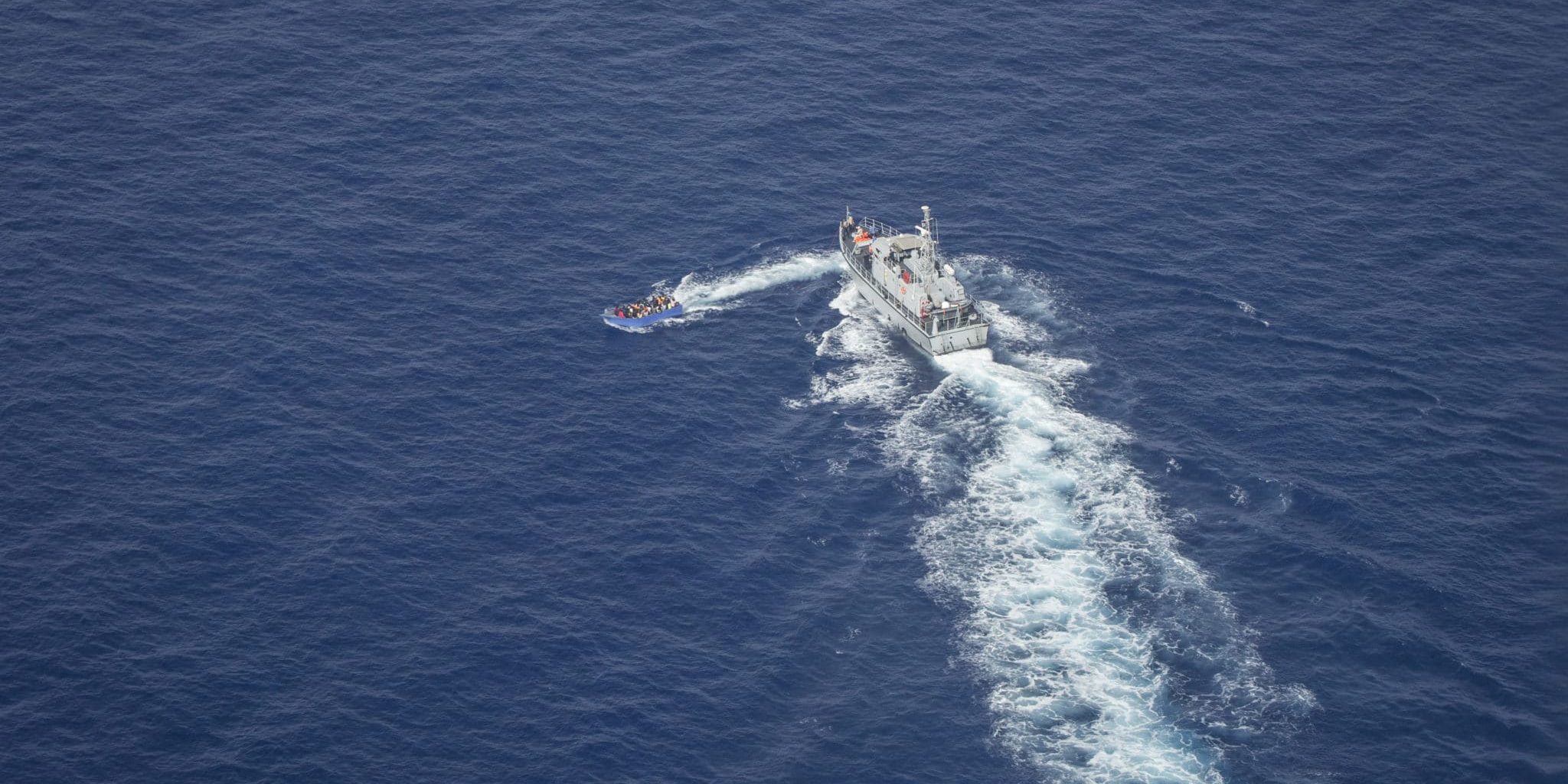
Image credit: Sea-Watch.
The document leaked to Statewatch, dated 20 May 2026, is a ‘technical arrangement’ between the EU’s naval mission Operation Irini and ‘Libyan institutions responsible for law enforcement and search and rescue at sea’. It provides for capacity building and the training of coastal authorities based in the north-east of Libya. In other words, the EU will provide material support to expand the ability of Libyan forces to intercept, pull back and detain people attempting to leave Libya for Europe.
The EU teams up with Libya’s eastern forces
It was already known that the EU was planning to begin working with Libya’s eastern forces. In January 2026, a report by German journalist Matthias Monroy, published on the German news site nd, revealed the plans for an EU-funded Maritime Rescue Coordination Centre (MRCC) in Benghazi, in the eastern region of Libya controlled by General Khalifa Haftar.
Up to this point, the EU has refrained from collaborating officially with Haftar and the eastern forces in Libya, choosing instead to partner with the Tripoli-based ‘western’ Government of National Unity under Prime Minister Abdul Hamid Dbeibeh. That said, EU agencies such as Frontex, as well as individual member states, are believed to have informally collaborated with eastern forces on maritime migration control. (See a Statewatch summary of the nd article here for further background).
General Haftar, along with his two sons who occupy powerful positions in the military forces under his command, are known to be complicit in widespread abuses against people on the move, on land and at sea. Haftar is also opposed to the internationally recognised western government, and despite some meetings, the EU has been careful not to offer Haftar and his rival government any diplomatic recognition. In recent years, however, there has been an increase in people leaving from the eastern part of Libya. This has apparently increased the EU’s appetite for formal collaboration.
The ‘technical arrangement’ published by Statewatch has provisions for what is known as ‘capacity building’, which is to say building up the eastern forces’ ability to better restrict migration across the Mediterranean. It includes extensive details about training, but also “the enhancement, refurbishment, equipping or operational enabling of maritime coordination structures, including but not limited to Maritime Rescue Coordination Centres (MRCC), communication facilities or other operational infrastructures”.
An MRCC is an important step in establishing eastern forces’ migration control in the region. Under international conventions, a recognised MRCC gives legitimacy to maritime operations, allowing eastern forces to effectively take control, in the eyes of the international community, over the ‘search and rescue zone’ around that stretch of the coast. To put it simply, an MRCC allows eastern forces to restrict migration at the EU’s request but avoiding official EU complicity.
While not mentioning any specific funding, the arrangement makes mention of “infrastructure, equipment or support” provided by the EU. It also references the potential for other financial support not specified in the arrangement, including from individual EU member states:
“Any additional financial aspects not explicitly covered in this Arrangement will be subject to mutual understanding between the Participants and, where relevant, to separate technical arrangements.”
Expanding a regime of mass atrocities
The EU has been collaborating with Libya’s coastal authorities – collectively known as the ‘Libyan Coast Guard’ – for well over a decade. In that time, those forces have been implicated in the widespread abuse, detention, kidnapping, exploitation, torture and murder of people on the move. In recent years, the so-called LCG has also begun attacking NGO rescue ships, harassing, threatening and shooting at them in order to deter them from rescuing people in distress at sea.
NGOs, civil society and MEPs have long called for the EU to end, or at the very least suspend, this deadly cooperation. The European Commission, the EU’s executive arm, has declined to do this, meaning that the EU remains at the very least complicit in the LCG’s abuses. A document published by Statewatch in May 2026 revealed discussions among member states about expanding cooperation with Libya further. Now, this arrangement with Libya’s eastern forces confirms that, in the eyes of the EU, this deadly partnership only has room to grow further.
“This marks a deeply alarming escalation in what was already a troubling and dangerous partnership between the EU and Libya,” said Alamara Khwaja Bettum, executive director of Statewatch. “What is presented as an investment in ‘capacity building’ is, in reality, support that enables the abuse, detention and exploitation of migrants. By outsourcing migration control to third countries, the EU is effectively paying others to carry out policies it seeks to distance itself from politically and legally. Beyond being morally indefensible, this approach perpetuates racialised and colonial power dynamics that continue to shape European migration policy.”
Further reading

Every year the European Commission produces a report summarising the state of external migration cooperation. Divided by regions and then countries, the report offers insight into the latest projects, spending and diplomacy the EU is using to pursue its goal of keeping people from reaching Europe. The January 2026 edition – covering activity in 2025 – reveals the EU continues to put significant effort into securing deportation agreements with African nations. It is also working to re-establish a diplomatic presence in the Sahel region, with an eye to restricting people moving through the region.

In August 2025, the humanitarian vessel the Ocean Viking was shot at in international waters north of Libya. The attackers were part of what is known as the Libyan Coast Guard – a collection of militias and other actors funded by the EU to prevent irregular migration to Europe. A new report reveals the financial ties between the EU and the so-called Libyan Coast Guard. It also shows how, despite clear evidence of mass violence waged against migrants and humanitarians, the EU plans only to extend the cooperation.
Credit: Source link