

Reckoning with 20 Years of UN Counterterrorism
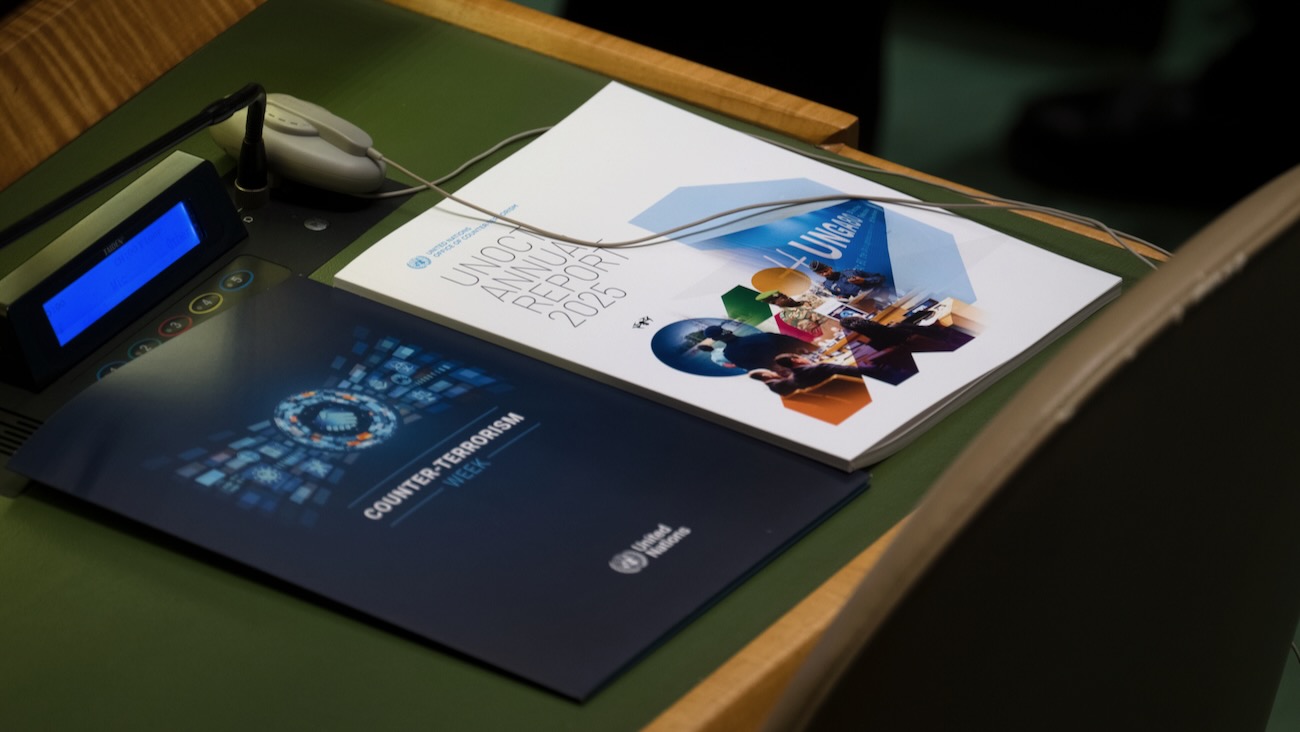
A view of pamphlets on a desk in the General Assembly Hall during the 4th High-Level Conference of Heads of Counter-Terrorism Agencies of Member States, June 29, 2026. UN Photo/Mark Garten.
For the first time in the history of the United Nations Global Counter-Terrorism Strategy, consensus has fractured. On July 1st, the General Assembly adopted the Strategy’s ninth review resolution by a vote rather than by consensus, with 141 member states voting in favor and the United States, Israel, and Argentina voting against. As the Strategy approaches its 20th anniversary this September, and against the backdrop of a global epidemic of counterterrorism-related human rights abuses, the breakdown of consensus raises a larger question: With geopolitical consensus around counterterrorism becoming increasingly fragile, what can be done to realign the UN’s most expansive area of policy coordination with the principles the United Nations was created to uphold?
When the General Assembly adopted the Strategy by consensus in 2006, it sought to embed international counterterrorism cooperation within a rules-based framework. Its four pillars reflected an important balance: effective security measures are predicated on commitments to human rights, the rule of law, and addressing the conditions conducive to violence and terrorism. The premise was straightforward. Security and human rights are mutually reinforcing, not competing objectives.
Two decades later, even minimal references to human rights norms within multilateral counterterrorism efforts are contested both by member states and within the UN counterterrorism architecture.
Locating Human Rights in the UN Counterterrorism Agenda
Since the adoption of Security Council Resolution 1373 in 2001, the UN’s counterterrorism agenda has evolved from a set of targeted security measures into one of the most far-reaching peace and security frameworks in the international system. Governments around the world employ a diverse range of counterterrorism measures to curb violent acts and actors, as well as those providing financial and material support. Too often, however, these measures are wielded to intimidate and silence journalists, human rights defenders, lawyers, humanitarian organizations, community groups, workers, students, and nonviolent political movements. In some contexts, entire ethnic, religious, and racialized communities have been subjected to sweeping counterterrorism measures.
The consequences are far-reaching. Wars fought in the name of countering terrorism, together with abuses committed under expansive counterterrorism laws, have contributed to enormous human suffering, including genocide, mass killings and displacement, and the erosion of fundamental rights and civic space across the globe. Between June 2023 and June 2025, UN special procedures mandate holders issued 232 communications raising concerns about human rights violations linked to counterterrorism laws, policies, and practices. These communications referred to more than 17 million alleged victims of counterterrorism-related abuses by member states, regional organizations, and private corporations.
The scale of the challenge warrants far greater scrutiny by the United Nations than it has received. The Global Center on Cooperative Security’s recent report “Beyond Incremental Reform: Right-Setting Counterterrorism at the United Nations” argues that the UN’s counterterrorism architecture requires more than incremental adjustments. The expansion of the UN counterterrorism architecture has been dramatic. Since 2006, investments in UN counterterrorism efforts have increased by more than 350%. Moreover, 46 UN and non-UN entities now participate in counterterrorism-related work through the Global Counter-Terrorism Coordination Compact, making it the largest cross-cutting coordination framework in the UN system. Yet this institutional growth has not been matched by comparable investment in human rights protection, oversight, and accountability.
Is the UN Counterterrorism Architecture Fit for Purpose?
This imbalance reflects a deeper structural problem. Although the promotion of human rights is one of the three foundational mandates of the United Nations, the UN’s counterterrorism programming has overwhelmingly concentrated on providing technical assistance and capacity building to national security actors and supporting national efforts to counter violent extremism. Efforts to ensure that human rights and the rule of law are the fundamental basis of member-state efforts to counter terrorism—Pillars I and IV of the Strategy—continue to receive only a small fraction of overall resources and political support. Across the system, human rights and gender expertise, leadership, oversight, independent monitoring, and efforts to evaluate whether UN-supported counterterrorism programming is actually preventing harm or inadvertently reinforcing it all remain insufficient.
The reasons are institutional as much as political. Reliance on extrabudgetary funding, member states’ preference for operational capacity building, and the political sensitivity of scrutinizing counterterrorism practices have all encouraged expansion while discouraging accountability. Success is often measured by the number of laws drafted, trainings delivered, or institutions supported rather than by whether rights have been protected, abuses prevented, or member states held accountable.
Despite long-standing concerns around the impact of counterterrorism on human rights and civic space, member states have yet to agree on what many would consider a minimum baseline for protections within the UN counterterrorism architecture. As the UN special rapporteur on the promotion and protection of human rights and fundamental freedoms while countering terrorism, Ben Saul, observed in his first report after assuming the mandate in 2023, “Regrettably, the UN has been part of the problem, by encouraging authoritarian regimes to strengthen counter-terrorism laws in the absence of a rule of law culture or human rights safeguards.”
These weaknesses matter precisely because the architecture continues to expand. Yet at the very moment stronger safeguards are needed, institutional reforms risk moving in the opposite direction. The UN80 reform process is undermining the already limited human rights and gender expertise available across the system, raising concerns that existing safeguards could be weakened rather than strengthened.
The negotiations over this year’s ninth review of the Strategy demonstrated just how difficult meaningful reform has become. Geopolitical divisions constrained efforts to strengthen affirmations of human rights protections throughout the negotiations. The eventual breakdown of consensus is significant not simply because of the vote itself but because it reflects a weak commitment to the normative foundations of the Strategy, as well as to the United Nations. For two decades, consensus signaled at least a shared commitment—however imperfectly implemented—to balancing security cooperation with human rights and the rule of law. Today, even that nominal baseline appears increasingly contested.
Toward Right-Setting Counterterrorism at the UN
A genuine reckoning with the past 20 years requires more than incremental reform. It requires recognizing that protecting human rights is a prerequisite for effective counterterrorism. At a minimum, capacity-building and technical assistance priorities need to shift from an overwhelming focus on developing exceptional counterterrorism-oriented capacities to developing core security- and justice-sector oversight and accountability and human rights and civic space protection capacities. Stronger human rights transparency, oversight, and accountability must be institutionalized across all counterterrorism entities and programs, and political, financial, and human resources must be shifted to expand human rights and gender expertise and decision-making power within the counterterrorism architecture.
The United Nations cannot prevent every abuse committed in the name of counterterrorism. But it can ensure that its own assistance is subject to meaningful scrutiny and that human rights are treated as a measure of success rather than an afterthought. The organization’s greatest comparative advantage is not its operational capacity but its legitimacy as a guardian of international law and universal rights. Every time the organization builds the counterterrorism capacity of member states that systematically abuse this capacity to suppress nonviolent movements, restrict civic space, silence political opponents, or commit mass atrocities, that legitimacy is diminished.
Twenty years after the adoption of the Strategy, the question is no longer whether reform is necessary; it is whether the United Nations—and the next secretary-general—are prepared to confront the consequences of the system they have helped build and ensure that the next 20 years of UN counterterrorism are guided as much by accountability as by security.
Franziska Praxl-Tabuchi is Director of Civic Space and Multilateral Security Policy for the Global Center on Cooperative Security. Matt Schwartz is Chief of Staff and Organizational Learning for the Global Center. They are the lead co-authors of the Global Center’s independent assessment of the UN counterterrorism architecture, “Beyond Incremental Reform: Right-Setting Counterterrorism at the United Nations,” published in June 2026.