

Printing Money, Missing Investment: What Nine Years of Data Show About Sierra Leone’s Economy
By Aboubakr Kaira Barry, CFA, Managing Director, Results Associates, and Chair of the Omou Financial Literacy Center
Every year, Sierra Leoneans watch prices climb. The Leone weakens. Government debt grows. Roads, schools, and hospitals barely improve. This isn’t bad luck. It’s the predictable result of two decisions, repeated year after year. Government creates too much money. It also takes on debt that too often isn’t matched by investment.
What is “broad money,” and why does it matter?
Broad money is the total money circulating in an economy — cash plus savings and checking account balances. Sometimes the central bank or banking system creates money faster than the economy produces goods and services. Then more money chases the same amount of stuff, and prices rise. That’s inflation, in its simplest form.
A healthy economy lets money supply grow roughly in step with real output — what the country actually produces, adjusted for prices. When money grows much faster than output, the gap goes into higher prices.
The numbers: money grew far faster than the economy
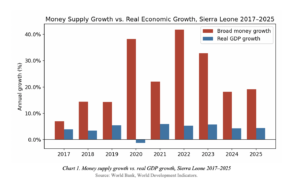
Between 2017 and 2025, Sierra Leone’s broad money supply grew at a compound annual growth rate (CAGR) of about 22.6% a year. Relative to its 2016 baseline, that’s a cumulative 526%. The real economy — actual goods and services produced, adjusted for prices — grew far slower, at a CAGR of only 4.1% a year, a cumulative 44%. Money supply grew roughly five times faster, every year, than the economy did.
Chart 1 shows this, year by year. Money growth, in red, consistently dwarfs real growth, in blue. The gap is widest from 2020 onward.
That gap didn’t disappear — it’s a major reason prices climbed. Chart 2 tracks three lines, indexed to 100 in 2016: money supply, price level, and real GDP. Money and prices climb together. Both far outpace real output, which barely moves. This isn’t a precise one-to-one relationship. Other forces also fed inflation, including imported food and fuel price shocks, and currency depreciation — itself driven partly by the same money creation. Still, the pattern is unmistakable. Consumer prices rose as high as 47.6% in a single year, 2023. The price level roughly quadrupled over the period.
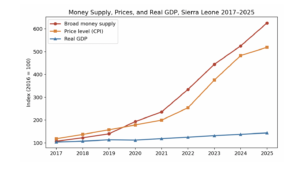
Chart 2. How the money-growth gap became inflation, 2017–2025 (2016 = 100). Source: World Bank, World Development Indicators (price index compiled from annual inflation rates).
The result for ordinary people: real GDP per person — a rough measure of prosperity — grew only 17% over nine years, a compound annual growth rate of just 1.8% a year. Meanwhile, money and prices exploded. Almost none of the new money bought prosperity. It bought higher prices.
Debt grew fast too — but investment didn’t keep pace with it
Government debt is measured here in Leones — the currency it’s actually spent and repaid in. It grew from Le 18,994 billion in 2017 to Le 78,997 billion in 2025. That’s a cumulative 316%, a CAGR of about 19.5% a year. This is independently verifiable: the implied Leone/US$ rate matches the Penn World Table’s independent series to within 0.2%, for every year the Table has published so far (2017–2023; 2024 and 2025 aren’t out yet). The check accounts for Sierra Leone’s 2022 redenomination, when three zeros were dropped from the old Leone.
What did government buy with all that borrowed money? Chart 3 compares the debt stock to investment spending, or capital formation, both in Leone billions.
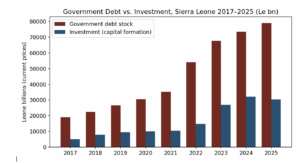
Chart 3 tells the broad story: debt has consistently outpaced investment, and the absolute gap keeps widening. The year-by-year figures behind it tell a sharper one. Of every 100 Leones the government borrowed between 2017 and 2025, only about 40 went into investment. That means roads, power, schools — spending that builds future capacity to repay debt and grow the economy. The other 60 financed something else: salaries, recurring costs, debt service, or gaps that simply needed filling. 2017 and 2021 were the sharpest years. New borrowing ran roughly nine to ten times new investment in each.
An independent assessment confirms the same pattern
This is the finding of Sierra Leone’s Public Financial Management assessment, or PEFA — a standardized diagnostic run by independent assessors, not government officials. It’s sponsored by the World Bank, IMF, European Commission, and other donors. Sierra Leone’s 2021 round was EU-funded. PEFA grades each area from A, best practice, to D, below the minimum standard.
Debt management scored B+ — good, sound performance. Public investment management scored only D+ — four grades lower, below the minimum standard.
The report states this plainly. Sierra Leone’s “framework for public investment management, where investment projects are poorly analysed, selected and costed, does not support efficient service delivery.” The assessment was repeated in 2021. Investment management hadn’t improved since 2017 — the same weaknesses were flagged both times.
Why this doesn’t change on its own
This isn’t a training gap. Sierra Leone has had legislated PFM reform for two decades — the Government Budgeting and Accountability Act (2005), replaced by the PFM Act (2016), now in its third reform strategy (2023–2027) — plus sustained IMF engagement. Yet the pattern persists. Analysts call this “isomorphic mimicry”: governments adopt reform’s paperwork — acts, frameworks, strategy documents — without the underlying function changing, because those with power to change it don’t benefit from doing so.
An independent central bank is insulated from pressure to print money for government. That closes the inflation channel. It also forces a harder budget constraint. Without the printing option, covering a deficit means real taxes, real cuts, or real market borrowing. Strengthening investment selection, costing, and monitoring is a separate fix. It doesn’t follow automatically from central bank independence alone.
The data points to two distinct but related failures. One is monetary policy that consistently outpaced the real economy. The other is a public investment system that consistently underperforms its own borrowing. Neither persists for lack of technical capacity — Sierra Leone’s own PEFA assessments show the same weaknesses uncorrected across two assessment cycles. What sustains both is that they serve identifiable interests. Monetary discretion benefits whoever needs a shortfall covered, without the friction of taxes or cuts. Weak investment screening benefits whoever profits from projects that would not survive independent scrutiny. An independent central bank and a stronger public investment management framework would remove both forms of discretion. That’s precisely why, despite years of diagnosis, neither has been adopted.
Credit: Source link