

President Diaz-Canel Denounces U.S. Suffocation Plan Against Cuba
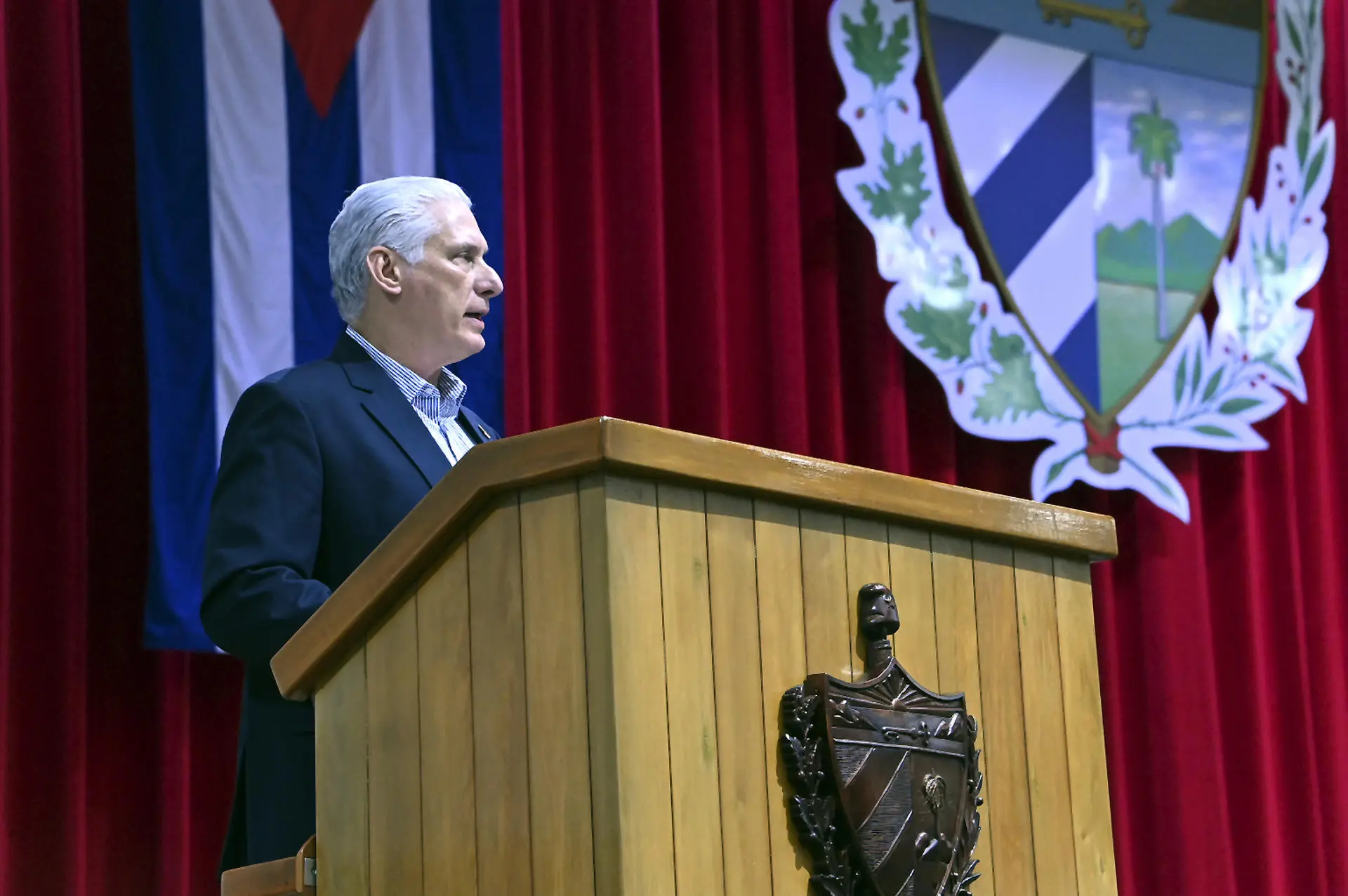
The Cuban President ratified a package of economic reforms to protect the socialist system from financial asphyxiation and threats of military aggression. Photo: EFE.
July 31, 2026 Hour: 3:52 pm
-
-
-
-
-
-
PDF
🔗 Comparte este artículo
Cuba’s President Miguel Díaz-Canel denounced a U.S. “collective suffocation plan” against the Cuban people, warning that an energy siege seeks to trigger economic collapse while the government ratifies 176 reforms to protect the socialist system.
The Cuban head of state condemned that the United States has intensified pressure measures against the island through an energy siege that seeks to provoke economic collapse and social unrest, comparing the strategy with the starvation extermination methods applied during the Spanish colonial era at the end of the nineteenth century.
During the closing speech of the 17th Ordinary Period of Sessions of the National Assembly of People’s Power, President Diaz-Canel stated that the Caribbean nation has received only one fuel vessel in the last seven months, a direct consequence of the Executive Order signed by the U.S. administration in January 2026, which threatens sanctions against countries and shipping companies that transport hydrocarbons to the island.
RELATED: Cuba’s National Assembly Approves New Labor Code
The Cuban President emphasized that the shortage of diesel and fuel oil has severely impacted the National Electroenergetic System, removing more than 1,400 megawatts of distributed generation and causing prolonged blackouts that affect the daily life of Cuban families.
“Without the genocide on Gaza having fully ceased, they are trying to reissue it against more than nine million Cubans through an economic blockade and an energy siege that have brought suffering to extreme levels. … The U.S. plan against Cuba is only comparable in its perversity to the Weyler reconcentration that, through hunger, decimated the population at the end of the nineteenth century,” the President asserted.
Diaz-Canel detailed that the energy deficit has paralyzed water pumping systems, interrupted agricultural harvests, affected the operation of health centers and hit tourism and industrial infrastructure. Added to this is the blocking of accounts and the persecution of medical cooperation and foreign investment through regulations issued by Washington in May.
Sovereignty and Reforms
In the face of the deep financial crisis and diplomatic and military threats in the region, Diaz-Canel ratified the implementation of 176 measures for the Economic and Social Transformation approved by the Cuban government, specifying that more than 120 of these regulations are already ready for application.
The reforms seek to release the productive forces, grant greater autonomy to municipalities and state enterprises, and encourage alliances between the public sector and private management forms. However, the Cuban President categorically stressed that these transformations do not respond to external demands nor will they mean a return to capitalism.
“There will be no privatization of health, education, science, culture or strategic services for the nation. What exists is the political will to recover them all and generate wealth to take them to higher quality levels,” he pointed out.
The parliamentary session, held at the Palace of Conventions in Havana within the framework of the “Year of the Centenary of the Commander in Chief Fidel Castro Ruz,” began with a tribute to Commander of the Revolution Ramiro Valdés Menéndez for his historical trajectory and his uninterrupted presence in Parliament since 1976.
The Cuban President’s words consolidate the government’s position before a scenario of multidimensional pressure. The combination of economic reforms with the defense of sovereignty outlines the strategy of the island to face the tightening of the U.S. blockade, while the call to preserve the social conquests of the Revolution remains the axis of official discourse.
Author: Laura V. Mor
Source: Cuban Presidency / Agencies
Comments are closed.