

Poisonous Datura plant sparks warnings in Iraq’s Al-Anbar – Shafaq News
2026-07-28T14:10:42+00:00
Shafaq News- Al-Anbar
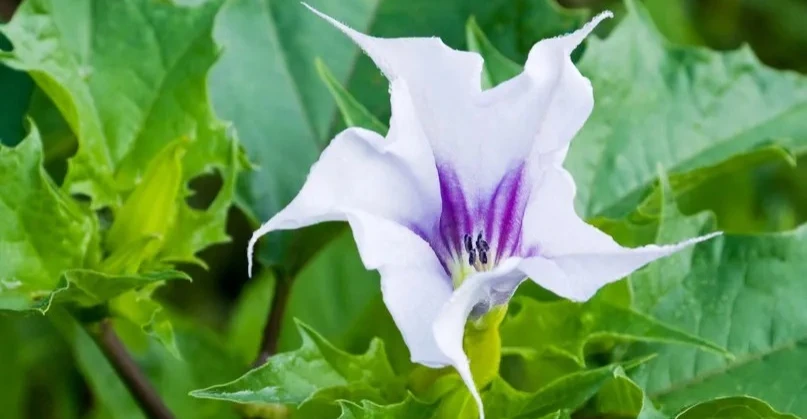
The toxic Datura plant, commonly known as“Devil’s Apple,” has reappeared in Al-Anbar province, western Iraq, prompting
authorities to warn residents about its dangers to humans and animals.
Omar Abdulmunim Al-Mashhadani, head of the Media Division at
Al-Anbar’s Agriculture Directorate, urged residents on Monday not to handle the
Datura and to report its locations so authorities can remove it safely. He
noted that the directorate coordinates with local agencies and security forces
whenever the species is detected.
Datura is an invasive species first recorded in Al-Anbar
after 2003, likely spreading through the dispersal of its seeds, although the
directorate has no precise information on how it first reached the province.
Al-Mashhadani cautioned that limited public awareness remains one of the main
challenges, as some residents and farmers mistake the toxic plant for an
ornamental species because of its trumpet-shaped flowers, which range in color
from white to purple and typically bloom in the evening.
He also recalled a 2019 poisoning case involving a young
girl who consumed part of the plant. She was taken to hospital and remained
under observation and treatment for 24 hours before recovering.
According to the environmental expert Ali Al-Fahd, tackling
Datura requires more than field removal, calling for a comprehensive strategy
combining eradication efforts with public awareness campaigns.
Speaking to Shafaq News, he pointed out that the plant
produces large quantities of seeds that can remain dormant in the soil for long
periods, increasing the likelihood of renewed outbreaks unless regular
monitoring is carried out.
He called for intensified field surveys, particularly in
abandoned land, roadsides, riverbanks, and agricultural areas, alongside
broader awareness efforts targeting residents, farmers, and school students,
while urging the public to report sightings immediately to enable authorities
to respond quickly and contain its expansion.
The plant should not be dumped in farmland or waterways,
where its seeds could spread to new areas, but uprooted before flowering and
seed production and destroyed by burning or through approved environmental
disposal methods, Al-Fahd added.
A similar outbreak was reported in Al-Anbar last year,
affecting Al-Habbaniyah, Al-Baghdadi, Ramadi, and Haditha. Authorities launched
campaigns to uproot and burn the invasive species after alerts of its presence
in orchards, farmland, and along public roads.