

PNG government divided over Taiwan office closure: official
-
By Fang Wei-li and Fion Khan / Staff reporter, with staff writer
Papua New Guinea’s unilateral decision to close Taiwan’s representative office in the country was largely driven by its foreign minister, which might not reflect a consensus within the government, a Taiwanese foreign affairs official said today.
Differing views remain within the Papua New Guinea government, with some officials continuing to support cooperative ties with Taiwan, the official said on condition of anonymity.
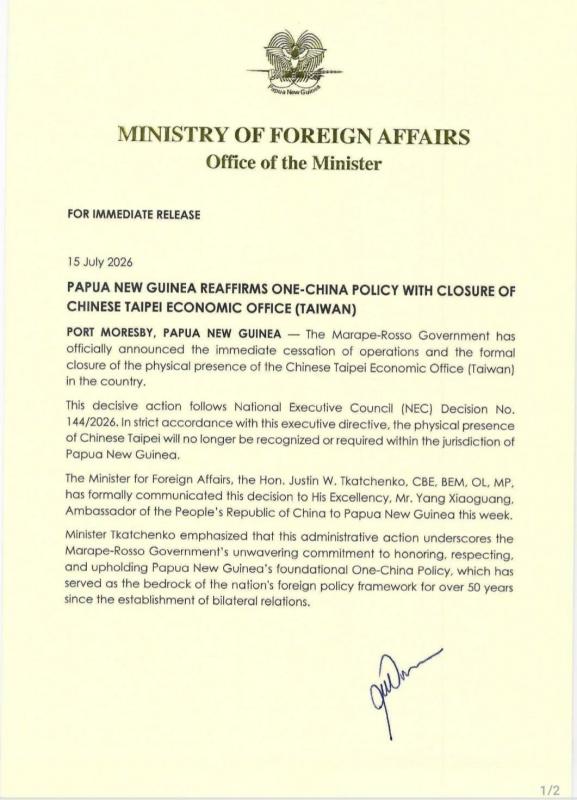
Papua New Guinea Foreign Minister Justin Tkatchenko in a statement on Wednesday said that “the physical presence of Chinese Taipei will no longer be recognized or required within the jurisdiction of Papua New Guinea.”
Photo from Papua New Guinea Foreign Minister Justin Tkatchenko’s Facebook
The minister earlier this week formally communicated this decision to Chinese Ambassador to Papua New Guinea Yang Xiaoguang (楊曉光), the statement said.
The immediate cessation of operations and the formal closure of the physical presence of Taiwan’s representative office was an “administrative action” to “reaffirm Papua New Guinea’s one China policy,” it said.
The statement called Taiwan’s representative office the “Chinese Taipei Economic Office” instead of its formal name, the Taipei Economic and Cultural Representative Office in Papua New Guinea.
The Ministry of Foreign Affairs lodged a formal protest after Tkatchenko said that Taiwan’s office would be closed, saying the decision was made unilaterally and without consultation with Taipei.
The ministry said Taiwan does not accept the decision and that its representative office would continue normal operations.
The ministry added that it has contacted like-minded countries to seek international support and has convened an interagency response meeting to review bilateral cooperation and trade with Papua New Guinea, with appropriate measures under consideration to protect Taiwan’s overall interests and dignity.
Papua New Guinea is classified by the IMF as a “fragile state,” the foreign affairs official said.
The nation faces urgent development challenges, political and social instability and limited governance capacity, they said, citing a report released by the IMF last year.
Over the past decade, natural disasters and multiple external shocks have not only hindered its economic growth, but have also led to a significant surge in public debt and severe foreign-exchange shortages, they said.
In recent years, the country has sought Chinese capital, loans and cooperation on large-scale infrastructure projects, some of which have raised concerns over procurement transparency, financial sustainability and long-term operational viability, they said.
Citing the National Data Centre, which was financed by a loan from the Export-Import Bank of the Republic of China and built by Huawei Technologies Co as an example, they said the facility was found to have major cybersecurity and equipment flaws shortly after its launch.
However, repayment obligations for the loan remain the responsibility of the Papua New Guinea government, they added.
Vice President Hsiao Bi-khim (蕭美琴) today said that Taiwan faces an extremely difficult diplomatic situation as China is suppressing the nation everywhere.
“For us, this is a setback, but we will still continue to strive — to strive for opportunities, whether for our overseas compatriots or to continue expanding our cooperation with the international community,” she said.
Taiwan has formal diplomatic ties with only three Pacific Islands nations — Palau, Tuvalu and the Marshall Islands — but has maintained a de facto embassy in Papua New Guinea. It also has a similar office in Fiji.
In 2020, a Taiwanese diplomat ended up in hospital in Fiji after two Chinese diplomats stormed into a reception trying to gather information on who was attending.
Papua New Guinea had replaced its Taiwan trade mission with an economic office in 2023, citing financial challenges.
Only 12 countries maintain formal diplomatic ties with Taiwan.
Additional reporting by Reuters
Credit: Source link