

Plumbing, infrastructure, and imperialism — Conceding to the U.S. will not fix Cuba’s problems
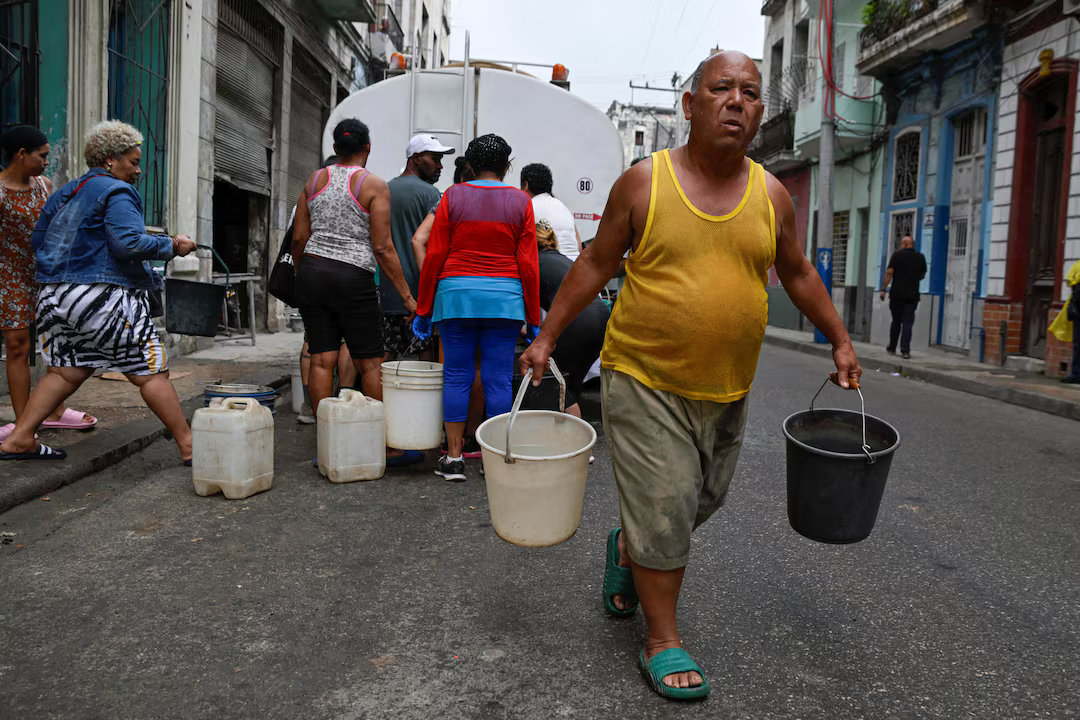
While we were in Cuba, my comrade Sharon made an excellent point in an update to our comrades back home.
“If conditions were like this in Baltimore City,” she wrote, referring to the water and electricity shutoffs and complete oil blockade, “there would be all out revolt. And it’s a credit to the revolutionary Cuban government and their mass support among the Cuban people that they do not.”
I thought our living conditions in Baltimore had prepared us for this time in Cuba. We also can’t flush our toilet paper (yes, this is still a reality in the U.S., for more people than you’d think), we don’t have air conditioning, and one of our toilets doesn’t flush quite right.
That’s a little bit of preparation, sure. But we mitigate our lack of air conditioning with electric fans. We mitigate our toilet problems with reliable running water. But without those mitigating factors in Cuba, what do we have? Backed-up toilets cooking in the still, stifling Caribbean heat.
The Cuban people have a system for this. When the water is on, they prepare by filling buckets to manually flush the toilets. The Cuban government is able, as much as possible, to provide rooftop water collection tanks that can be used for flushing. Much of Cuba’s architecture is built to allow air to circulate naturally through a building. We, of course, had no such preparations. But for whatever inconvenience this was for us, this is daily life for the Cuban people.
This is not a problem created by Cuba’s socialist system. It is a problem manufactured by U.S. imperialism. Over 200 Cuban entities added to a U.S. restricted list in January 2025; a fuel blockade in force since January 2026; ships filled with food and fuel, already paid for in full, sitting miles off Cuba’s shores — all in a deliberate, genocidal act by the U.S. ruling class to starve 10 million Cuban people.
Conceding to U.S. imperialism solves none of these problems. There is no reality in which surrendering the Cuban Revolution even stops the shutoffs, much less fixes the plumbing.
Look no further than Puerto Rico and the Philippines to understand how the United States treats its colonies and neocolonies.
While in Cuba, I met Julio, a Puerto Rican activist who was visiting at the same time. I interviewed him about infrastructure in Puerto Rico.
“You have to remember that the energy grid was built for industrial corporations that no longer exist,” said Julio. “It’s old and built on expensive, polluting methane gas. When the electricity goes out, unless you own specific converters, it can short circuit anything you have plugged in.”
“We have to spend an inordinate amount of money on all manner of appliances — fridges, freezers, microwaves — because of the daily blackouts.” As always, it is expensive to be poor.
Puerto Rico’s power lines now belong to LUMA Energy, a Canadian-U.S. consortium that holds a monopoly over the island’s grid. The power plants belong to Genera PR, a subsidiary of New York’s New Fortress Energy. Neither company loses money when the lights go out.
In late July 2026, Puerto Rico’s government declared a state of emergency as the island’s reservoirs near depletion. The puppet governor Jenniffer González claims the situation is “out of our hands,” but the Puerto Rican people know better — it is a manufactured crisis, born of deliberate austerity and under-resourcing of Puerto Rico’s infrastructure — austerity dictated by a federal control board, and under-resourcing carried out by the private companies that now run the grid.
In the Philippines, I experienced it myself. My family’s home in Bulacan had no flushing mechanism whatsoever. One of my uncles who I’d just met had to use a bucket to flush my waste — it was humbling. Outside of the mansions of the big landlords and compradors, the company towns, and the mega malls, this is the reality for most of the Filipino people.
Being inside the borders of the United States doesn’t guarantee running water and electricity.
As of Aug. 22, more than a quarter of Gary, Indiana, was still without power following severe storms on Aug. 11, 2026. That’s almost two weeks without electricity. NiSource, parent company of the area’s utilities monopoly, NIPSCO, boasted a half-billion dollars in profit in the first six months of 2026. The same company is spending billions on new power plants to feed data centers for Amazon and Alphabet — but somehow cannot fix the lines over Gary’s streets. Gary is nearly 80% Black, the only majority Black city in Lake County, Indiana.
The Cuban people understand that allowing the U.S. to re-colonize them could never solve their problems. They remain united and dignified even under a genocidal blockade, much like the people of Palestine. They continue to work around the effects of the blockade both creatively and scientifically. Both government and non-government entities continue to build solidarity among the peoples of the world.
The Cuban people are doing their part. Revolutionaries in the U.S. must continue to build a fighting mass movement that is capable of ending the genocidal blockade of Cuba.
Join the Struggle-La Lucha Telegram channel