

Petro bids solitary farewell as Colombia shifts course
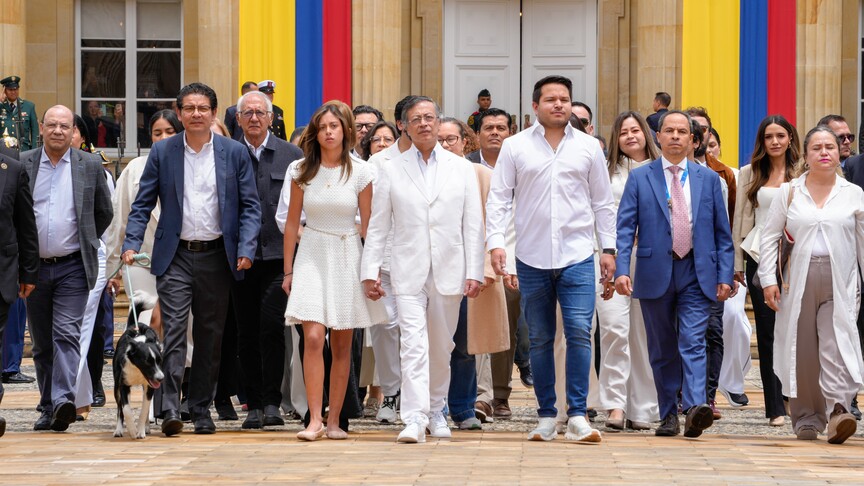
The final moments of Colombia’s first progressive presidency unfolded with austere, quiet solemnity.
On Aug. 7, Gustavo Petro took one last brisk walk across the stone courtyard of the Plaza de Armas. Accompanied by members of his family, all dressed in unadorned white, and a tight circle of remaining Cabinet ministers, Petro walked flanked by the Presidential Guard battalion as it marched out of the presidential palace.
It was a strictly institutional ceremony. There was no cheering audience, no sea of waving banners, no formal handling of executive symbols, and no pompous presidential attire. The solitude of the scene stood in sharp, dramatic contrast to the bustling, high-security spectacle unfolding simultaneously almost 500 kilometers (300 miles) away in Cali. That was where Abelardo de la Espriella assumed the presidency before foreign dignitaries and packed stands. It was a stark, symbolic staging that articulated the profound polarization defining Colombia.
The protocol for the farewell was reduced to what was strictly required by the Constitution. The traditional handover of the presidential sash was bypassed. Until the very last hours before the transition, Petro had openly hesitated to recognize the election results, describing the incoming administration as an “illegitimate government” and alleging systematic vote tampering at more than 1,600 polling stations.
Even as he exited the palace gates, Petro made it clear that he was not retiring from political life, but rather stepping straight into the streets to lead a formidable opposition campaign from outside the halls of power.
Promises, perils of a historic mandate
When Petro took office in August 2022, his inauguration was hailed as a monumental turning point in Colombian history. A former member of the M-19 guerrilla movement and a veteran senator, Petro won the presidency on an ambitious, transformative platform. He promised to dismantle the country’s traditional economic model, redistribute wealth, lead a global transition away from fossil fuels, and achieve comprehensive “Total Peace” in a country battered by generations of rural conflict.
But as his four-year term drew to a close, Petro’s presidency left behind a deeply controversial legacy, caught between grand ideological rhetoric and the realities of governance.
Stalled social reforms, legislative gridlock
Petro’s flagship agenda targeted three primary pillars of public life: a drive to eliminate private Health Promotion Entities (EPS) in favor of a state-managed, universal primary care system; plans to expand state pension coverage for low-income seniors; and ambitious parallel negotiations with remaining armed groups, including the National Liberation Army (ELN), FARC dissident factions and powerful criminal cartels.
Despite initial momentum, most of this structural agenda collapsed or stalled. In early 2023, Petro’s broad legislative coalition dissolved amid disputes about the health care bill. Lacking an enduring congressional majority, his key initiatives were repeatedly blocked, delayed or heavily diluted.
Simultaneously, political analysts and security experts pointed to “Total Peace” as the administration’s single greatest failure. Attempting to negotiate with multiple armed illegal entities at once exceeded the state’s institutional capacity, allowing criminal organizations to expand their territorial control and military posture.
He nonetheless achieved measurable progress on poverty and unemployment while expanding access to the presidency for a more diverse population, in a shift that had been impossible before 2022.
High-profile corruption scandals
Despite campaigning on a fierce anti-corruption platform, Petro’s administration was repeatedly shaken by controversies that severely damaged his credibility.
Disaster relief funds were embezzled and allegedly redirected to bribe congressional leaders in exchange for votes on reform bills. In 2023, the president’s son, Nicolas, was arrested on money laundering charges following allegations about illicit campaign contributions during the 2022 race.
National electoral authorities also launched audits into alleged spending cap violations during the 2022 presidential campaign, triggering years of institutional friction.
Right up until his final weeks in office, controversies continued to touch the president’s inner circle, including public criticisms from family members and former allies about governance and political appointments.
Deepening polarization
Throughout his term, Petro’s governing style deepened social and institutional divides. He frequently engaged in public spats with the high courts, the attorney general’s office and major business associations, framing institutional opposition as an attempt to orchestrate a “soft coup” against his mandate.
While he maintained strong support among rural communities, labor organizations and marginalized populations, his confrontational approach alienated middle-class urban voters and traditional political sectors.
Sunset of progressive mandate
In one of his final photos online, Petro posed in his office alongside a portrait of Simon Bolivar, referring to it as his “companion of struggles in the discarded presidential office,” a nod to his successor’s announcement that he would not reside in Casa de Nariño.
Petro succeeded in reshaping Colombia’s national discourse around economic inequality, climate action and social justice, but unable to translate his sweeping vision into lasting legislative achievements, his term ended in isolation.
As the car carried the outgoing president from the silent plaza in Bogota, the applause in Cali welcomed a new chapter, leaving behind a nation as divided by its political visions as its leaders were by geography.