

Opinion: Serbia Is Not a Russian Province, and Lavrov Has No Right to Decide Its Future
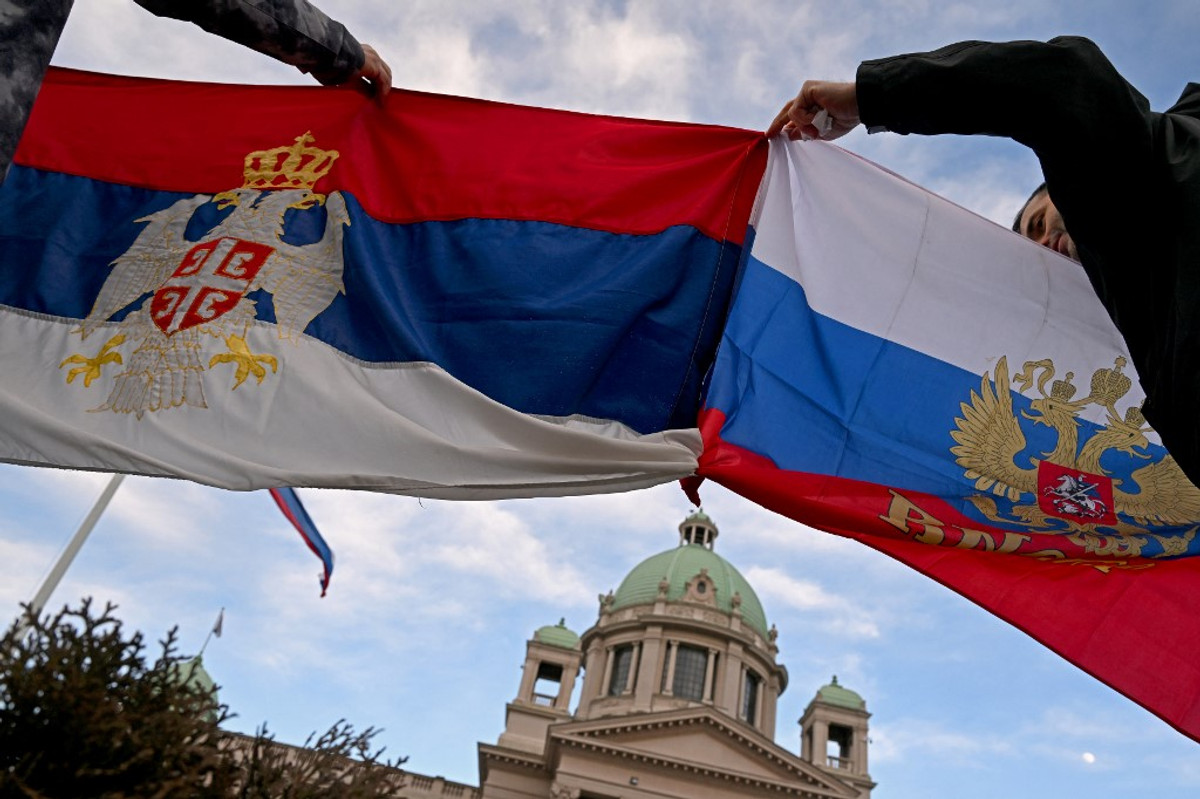
On Sept. 3, at the Eastern Economic Forum in Vladivostok, Sergey Lavrov said: “Out of inertia, countries continue; our Serbian friends and now our Armenian colleagues are seeking to join the EU.” He added that he was confident “this desire will disappear very soon.”
There is neither friendship nor respect for Serbia in those words. What they reveal instead is an old Kremlin reflex: treating countries it deems close to Russia as places where Moscow is somehow entitled to interpret their interests, judge how serious their decisions are and predict when they will abandon them. Lavrov was not commenting on a passing decision by a Serbian government. He reduced Serbia’s entire strategic course to a temporary weakness from which, in his view, the country will eventually recover, and such contempt deserves an answer stripped of diplomatic euphemism.
JOIN US ON TELEGRAM
Follow our coverage of the war on the @Kyivpost_official.
Sergey Lavrov has no right whatsoever to decide what Serbia should want, how long it is permitted to want it or where Serbia belongs. Vladimir Putin has no such right either, nor does a state that has demonstrated its understanding of sovereignty by sending tanks across the internationally recognized borders of another country.
A Russian foreign minister cannot announce that Serbia will soon “get over” its own policy, as though it were merely passing through a phase Moscow expects to cure.
Serbia is not a Russian province, not Moscow’s political property, and not a country over which the Kremlin possesses some historical, moral, or political title. Nobody in Moscow has been given a mandate to treat Serbia as part of a Russian sphere of influence, to dismiss its foreign-policy choices as a temporary mistake, or to decide how much independence Serbia may exercise before Russian interests take precedence. Serbia owes Russia neither its future nor its foreign policy, neither its alliances nor its right to decide where it belongs. Any attempt by the Kremlin to behave as though Serbian independence ends where Russian interests begin is not friendship, but imperial arrogance.
Other Topics of Interest
British Journalist: In Ukraine, the Nation, Not Its Leaders, Drives History
British journalist and commentator Peter Dickinson argues that Ukraine’s historical development is unique because its driving force has been the people themselves rather than political leaders, setting the country apart from much of Europe.
If Serbia wants to negotiate membership in the European Union, that is Serbia’s decision. If Serbia one day decides to abandon that course, that decision must also belong to Serbia. A Russian foreign minister cannot announce in advance that a sovereign country will soon “get over” its own policy, as though Serbia were merely passing through a phase that Moscow expects eventually to cure. That is not the language of an equal relationship between sovereign states, but of political guardianship that Serbia has granted to no one.
The arrogance is all the more grotesque because it comes from today’s Russia, a rogue state that attacked Ukraine, seized parts of its territory and attempted to alter internationally recognized borders by force. Russian armed forces and authorities have committed war crimes in Ukraine. The UN Independent International Commission of Inquiry has documented willful killings, attacks on civilians, unlawful confinement, torture, rape, and the unlawful transfer and deportation of children. The UN has also documented the widespread and systematic torture of Ukrainian prisoners of war and civilian detainees held under Russian control, as well as executions of captured Ukrainian soldiers. Russian attacks continued to strike Ukrainian cities and energy infrastructure throughout 2026, and in July the monthly number of civilians killed reached its highest level since May 2022.
None of this is incidental background to Lavrov’s remarks about Serbia. It is the record of the state he represents and of the aggression he has spent years defending before the world.
Ukraine has already lived through the consequences of the doctrine behind Lavrov’s contempt for Serbia’s choices. Moscow spent years insisting that it understood Ukraine better than Ukrainians themselves, that it knew where Ukraine belonged, which alliances it was entitled to pursue, and how real its independence could be if its chosen direction conflicted with Russian interests.
When political pressure failed to secure obedience, the Kremlin resorted to force. Russian troops entered Ukraine, occupied its territory, destroyed its cities, and, through annexation, attempted to turn the spoils of war into Russian land. In occupied areas, Russian authorities imposed Russian citizenship, Russian law, and the Russian education system, while people considered disloyal were subjected to intimidation, detention, torture, deportation, and forced displacement.
This is the ultimate destination of a policy that begins with the belief that a neighboring or “friendly” country does not possess the full right to choose against Moscow’s wishes.
Lavrov’s presumption that he can pronounce upon Serbia’s future is not merely offensive; it is obscene.
Among the most repugnant elements of Russia’s occupation policy has been its treatment of Ukrainian children. Russian authorities have transferred children from Russian-occupied parts of Ukraine to the Russian Federation and to other areas under Russian control, in numerous cases separating them from the families and communities to which they belong. The International Criminal Court has issued arrest warrants for Vladimir Putin and Maria Lvova-Belova, Russia’s Commissioner for Children’s Rights, for the war crime of unlawfully deporting and transferring Ukrainian children. Putin is therefore the president of a state waging a war of aggression and a man subject to an international arrest warrant over crimes involving children taken from the occupied territory of another country. Against that record, Lavrov’s presumption that he can pronounce upon Serbia’s future is not merely offensive; it is obscene.
Lavrov is no peripheral figure in this regime, and there is no reason to indulge the fiction that he is simply a professional diplomat carrying out somebody else’s policy. He has been Russia’s foreign minister since 2004 and is one of the longest-serving senior figures in Putin’s system. He was foreign minister when Russia went to war with Georgia, when it annexed Crimea, when it tore into Ukrainian sovereignty in Donbas and when, in 2022, it launched its full-scale invasion of Ukraine.
Throughout those years, his role has been to give diplomatic vocabulary to what Russian power does on the ground: aggression recast as defense, occupation dressed up as historical correction, and another country’s freedom of choice portrayed as a threat to Russian security. Lavrov understands perfectly well what the UN Charter means, what internationally recognized borders mean and what the prohibition of aggression means. That knowledge does not diminish his responsibility; it makes his role more damning. He has spent years consciously representing and defending a policy that has brought war, occupation and war crimes back to Europe.
In 2022, the European Parliament recognized Russia as a state sponsor of terrorism and as a state that uses terrorist methods, citing deliberate attacks and atrocities against Ukrainian civilians, the destruction of civilian infrastructure and other grave violations of international and humanitarian law amounting to war crimes. Describing today’s Russia as a rogue state is not rhetorical inflation. It is an entirely fitting description of a government that has trampled the fundamental rules of the international order while demanding the protection of those same rules for itself. The Kremlin insists that Russia’s borders are inviolable while changing Ukraine’s borders by force, invokes sovereignty whenever it wants to keep others out of Russian affairs and discards the sovereignty of its neighbors when their policies cease to suit Moscow. That double standard has left dead civilians, devastated cities, and occupied land in its wake, and Lavrov consequently has no political or moral standing from which to prescribe the limits of any other European country’s freedom of choice.
His phrase “our Serbian friends” sounds all the more cynical for that reason. Serbia is useful to the Kremlin as a “friend” only for as long as it refuses to impose sanctions on Russia, allows space for Russian political influence and keeps European Union membership sufficiently distant for Moscow to treat it as unfinished and ultimately unattainable business. Whenever Serbia reaffirms EU membership as a strategic goal or supports the territorial integrity of Ukraine, Moscow explains those decisions away as the product of Western pressure, a failure by Serbia to understand its own interests or, as Lavrov now puts it, mere “inertia” that will soon pass. That has nothing to do with a relationship between equals. It is an expectation of political obedience.
Serbia has been a candidate for European Union membership since 2012 and has conducted accession negotiations since 2014. The process has lasted far too long and has been burdened by mistakes in Belgrade, slow reforms and the indecision of the European Union itself, but all that belongs in a debate between Serbia and the EU. Lavrov has no place in that debate. Serbia may change its policy, alter the pace of negotiations or even change its ultimate objective, but it can do so only through its own sovereign decision. There is no Russian veto over Serbia’s European future, however much the Kremlin might wish otherwise.
The deepest insult in Lavrov’s statement is not his contempt for the European Union, but his assumption that Serbia still belongs to a category of countries to which Moscow feels entitled to explain what they really want. The Kremlin has never received a mandate from Serbian citizens to determine the strategic direction of their country. No episode of diplomatic alignment between Moscow and Belgrade gives Russia any claim over Serbian sovereignty. Russia holds no title deed to Serbian foreign policy and possesses no historical license to invalidate Serbia’s decisions whenever they displease the Kremlin. If Moscow understands friendship as an entitlement to Serbian obedience, the problem is not some supposed Serbian failure to appreciate Russia, but Russia’s refusal to accept Serbia as a fully independent state.
Putin’s Russia possesses neither the political nor the moral authority to lecture Serbia about its future. The boundary the Kremlin must accept could hardly be clearer: Russian state power ends at the borders of the Russian Federation, beyond which lie other countries, other peoples and decisions that belong to neither Putin nor Lavrov. That includes Serbia’s right to decide for itself whether it will one day become a member of the European Union. Serbia does not have to prove the depth of its European commitment in order to state the obvious fact that Moscow will have no say in that decision. It need only behave as a sovereign country and answer Sergey Lavrov’s prediction in the only terms appropriate for a man speaking on behalf of a rogue state that has already written its claim to decide the future of other nations in Ukrainian blood: the Kremlin must keep its hands off Serbia.
The views expressed in this opinion article are the author’s and not necessarily those of Kyiv Post.