

Opinion| Old dogs: From the people’s perspective!!
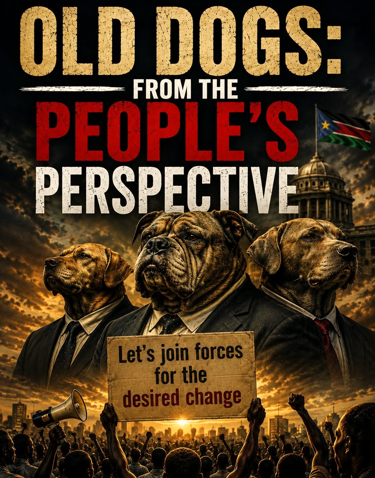
The recent remarks by Senior Presidential Advisor Gen. Kuol Manyang Juuk, which have circulated widely on social media, have drawn attention after he acknowledged the failure of the older generation of leaders and called for young people to take over the country’s leadership. In the widely circulated remarks, Kuol speaks of the failures of his generation and expresses shame over what has become of South Sudan, while urging a generational change in leadership. These remarks echo positions Kuol has expressed previously, including calls for the older generation to relinquish power and give way to young people.
His admission deserves praise because, at the very least, he dared to speak the truth at a time when old dogs’ tails are moving right and left in search of a miracle from the hill of their failure to run the state. He is among the few old dogs who have been awakened by the suffering of our people and the inability of the old dogs to stop its exacerbation, whether sooner or later.
Confessing guilt is a virtue. However, mere admission is insufficient to restore rights to their rightful owners, bring smiles back to faces, and establish lasting peace in our country, especially since this admission aims to pressure for the transfer of power to the young dogs. This is where the real danger lies in Gen. Kuol Manyang’s admission, which cannot be justified by feelings of shame or anything similar.
This confession, in its essence, is a malicious deception. Retired Gen. Kuol Manyang has demonstrated, with unparalleled contempt for the intelligence of our people, knowing full well that our people cannot be swayed by confessions that appear superficially appealing but are, in reality, deadly poison.
Old dogs, from the people’s perspective, are the architects of death, helplessness, and destruction who sold their consciences and compromised their honor for a handful of dollars stained with the blood of innocents – the leaders of the SPLM, who are fully prepared to plunge the country into bloodbaths to cling to power. They are the ones destroying the future of our youth and fueling tribal conflicts. They care about only one thing: power. As for the people, to hell with them.
When Gen. Kuol Manyang speaks of shame after all these years of destruction, we wonder if he is suffering from early dementia, especially since we do not expect those he fought against in the past to pose his hypothetical question to him. They are, after all, the happiest people with how things have turned out today in our country under the Sudan People’s Liberation Movement regime, which has proven to the whole world the validity of what the old separatists were trading on in international and regional forums: that southerners cannot govern themselves.
Gen. Kuol should rest, since we do not expect those he fought against in the past to ask him a question, unless the opposite is true. And that is one of the seven impossibilities, given the presence of old and new dogs, fat rats, and J1 cats who, if they agree, steal the crops, and if they disagree, spoil them.
To be honest, the failure of Gen. Kuol and his unpopular movement is not due to those he fought against in the past; that was undoubtedly a legitimate right. Rather, it is due to their involvement in the ongoing killing of innocent people from our nation, in addition to the displacement and impoverishment of many others, the plundering of the country’s resources, and the failure of state institutions to fulfil their national role, as evidenced by the existing tribal-based republic.
Today, South Sudan does not need another trick from the Sudan People’s Liberation Movement (SPLM), the kind retired Gen. Kuol Manyang wants to teach the younger dogs. Driven by a hidden desire to avoid serious accountability in the future as a strategic objective, he believes that the old dogs cannot undo the damage they have done, no matter how long it takes. Therefore, in his view, the solution lies in handing the reins to the younger dogs so the older ones can provide them with new tricks.
It appears from Gen. Manyang’s admission that the era of the old dogs, after being the old guard, is gone forever. However, the million-dollar question remains: can the new generation of “dogs” achieve what the old guard failed to accomplish in fulfilling the people’s aspirations for freedom and a dignified life?
Analyzing this question from the perspective of historical precedents will bring us closer to the magnitude of the malicious conspiracy that retired Gen. Kuol Manyang is trying to market to the general public, carefully selecting his phrases like “old dogs.” When I use it here, I do not intend to offend anyone; rather, it is an analytical effort to broaden the understanding of the content of Gen. Kuol’s admission in the context of the political crisis that is sweeping the country.
We commend retired Gen. Kuol Manyang Juuk for his courage and willingness to step aside and make way for the younger generation. At the very least, our people will remember him for this gesture.
In conclusion, the way forward cannot simply lie in passing oppressive authority, exploitation, and conflict to a younger generation under the guise of “youth empowerment.” Rather, it lies in rebuilding the state around the core principles, aims, and objectives for which our people took up arms in the 1950s.