

NZ star track: A watch on space from Beijing to Tehran, Paris to Somalia
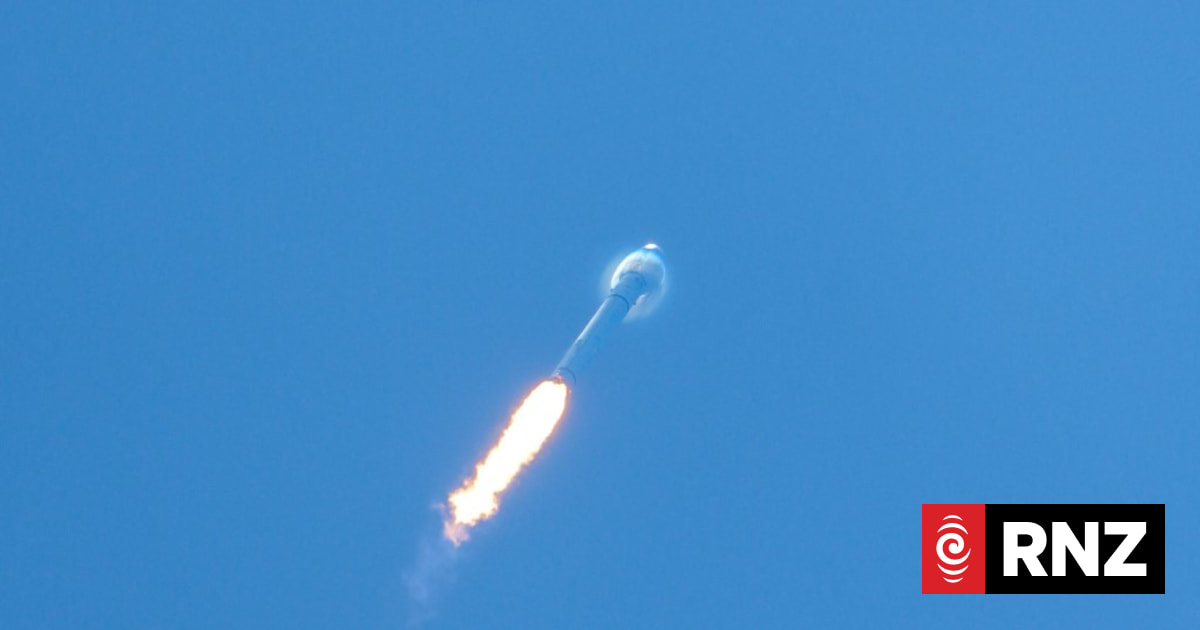
New Zealand is helping track satellites, including from Iran and the Chinese military, in a network that also watched over the Paris Olympics, United States and New Zealand government documents show.
The Auckland space-watching hub – set up in 2023 and largely funded by the Pentagon – tracked an Iranian TV broadcasting satellite in February during a launch from Russia the hub called “a significant milestone for Iran’s space program and continued Russian-Iranian cooperation in space activities”.
Iran also has some military satellites.
That same month the hub at Whenuapai Air Force base tracked a Chinese satellite as it moved close to a French satellite. Beijing said it was an experimental spacecraft but the West suspects it was a “military test satellite” that has in the past manoeuvered near US satellites to get a look.
The satellite operations are revealed in reports from the NZ Defence Force released under the Official Information Act.
They were generated within a US-led global space-and-ground-based network that makes upto 800,000 observations of space every day.
Other operations over Paris and Somalia have been revealed in US Space Force reports that show how the network has been “rapidly expanding into new mission areas”.
Whenuapai Air Force base.
RNZ / Cole Eastham-Farrelly
New Zealand, the US and UK host one hub each of the Joint Commercial Operations or JCO network, which coordinates 24 countries to give 24-hour round-the-world coverage.
The network has been pulling in more and more data from over 400 ground-based and space sensors operate by private companies.
While most of it is nonclassified, the US documents show the JCO also had “secret” and “top secret” channels and was increasing what it shared with military commands and with the US spy agency, the National Reconnaissance Office.
There had been a “significant increase in successful tracking” of Chinese and Russian launches, said one network report in April.
Its civilian-side work was vital, tracking solar flares and space debris, and helping rescue missions.
But the network’s core task was clear: “Adversary satellite tracking”, “maneuver detection” and “predict adversary behaviour”, said an August 2025 US report.
The network’s operators – local military personnel in their home countries – hone their proficiency by practicing “kill-chains” and rehearsing “realistic threat scenarios”.

A solar flare captured by NASA in 2010.
NASA/ Goddard Space Flight Centre/ Solar and Heliospheric Observatory
Jamming in Somalia
The JCO network guarded the Paris Olympics in 2024 from GPS disruptions, said a US Space Force report titled ‘Watch, Warn, Win’. A small map showed two “jammers” near Rouen.
The Olympics task came within days of the network getting new powers for positioning, navigation and timing for situational awareness (PNT-SA) powers on 1 July, 2024.
Around the same time the network took over a big US Tactical Surveillance, Reconnaissance, and Tracking (TacSRT) programme, as well as taking on board electromagnetic spectrum operations which could be used against people trying to interfere with GPS location data.
The NZ Defence Force last year denied taking part in this broad expansion of JCO activity, saying NZ had sovereignty over what its hub did. RNZ has asked again about that.
Cabinet papers said the defence minister must be in the loop on any change to what the JCO did.
The new tactical and electromagnetic powers were used in Somalia, said the April report.
US military commanders had asked the network to find where radio-frequency interference was coming from. They used elecro-optical imagery, synthetic aperture radar from satellites that could see at night and through clouds, and radio frequency scans to find a jammer near Mogadishu international airport.
Five times more launches
Space-watching is only becoming more important as space traffic and dual military-commercial use of it ramps up.
US President Donald Trump last week signed a memo aiming to boost rocket launches by more than fives times, to a thousand a year by 2030. Last year he signed an order for integrating commercial space capabilities with US national security much more.

US President Donald Trump.
SAUL LOEB / AFP
The first confirmation of the US-Israel operation Epic Fury against Tehran in February was from commercial not government spacecraft.
New laws required the US military to “buy before build … requiring agency heads to search for commercial solutions before building their own”.
“Modern warfare depends heavily on these kinds of commercial, dual-use space systems,” said a local expert.
The JCO network uses commercial sources to augment the monitoring done by the much older US Space Surveillance Network that makes 800,000 observations of 45,000 objects a day.
The goal is higher still: The Pentagon wants its new Space-WATCH programme to track every object in low earth orbit by tapping an “enormous volume” of cheap sensors in space; the JCO document mentioned Elon Musk’s Starlink and 24,000 sensors.
The US space commander who hadoversight of 2026’s ‘Year of Integration’ with allies, Lt Gen Dennis Bythewood, said recently, “Space as a warfighting domain has been established.”
He also noted the US could not do it without the teamwork of the JCO, and it was fed from at least 17 companies.
One such tracker is in New Zealand, a ground-based radar in central Otago run by US company Leolabs. It tracked almost 100 percent of satellites and over 98 percent of space debris, and recently signed a JCO contract to feed the central repository, the UDL.
The UDL served thousands of users across more than two dozen countries.
A new project called Atlas aims to expand and speed up access to UDL using technology from data-crunching firm Palantir.
Low cost, high benefits
The deal to set up the Auckland hub with eight personnel in 2023 was celebrated by defence for the “operational and diplomatic benefits it provides at a small operating cost” – just $180,000 last year for New Zealand.
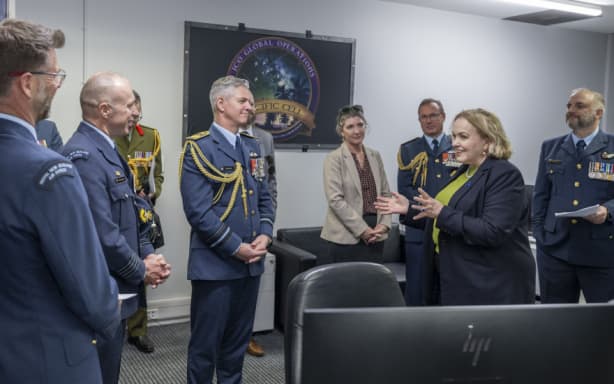
Space and Defence Minister Judith Collins reestablishes No 62 Squadron as NZ’s first space unit in 2025.
NZDF / supplied
It coordinated and trained operators in Australia, South Korea and Japan to US standard.
The hub was cemented last year as a core part of the NZDF Space Squadron. Cabinet papers have stressed the aim was to help keep space safe and secure.
The JCO was an extension of the National Space Defense Center set up in 2018 to improve collaboration between military and intelligence communities to respond to attacks in space.
An NZDF spokesperson on Monday said its involvement in the JCO network was focused on understanding the space environment and contributing to collective awareness, “consistent with our policy settings”.
Its role in the space domain was centred on awareness, information sharing, and cooperation with partners.
“This includes participation in selected multinational activities and exercises, and partner-led engagements for learning, planning, and interoperability purposes.
“Future participation in exercises or initiatives referenced by partners remains subject to government approval and resource considerations, and future NZDF contributions are expected to remain modest in scale and focused on capability development.”
It did not directly address whether it was now involved in the network’s expanded range of operations, such as tactical reconnaissance, or not.
Credit: Source link