

Nicolas Sarkozy’s smoke and mirrors defence as Libyan funding appeal trial ends
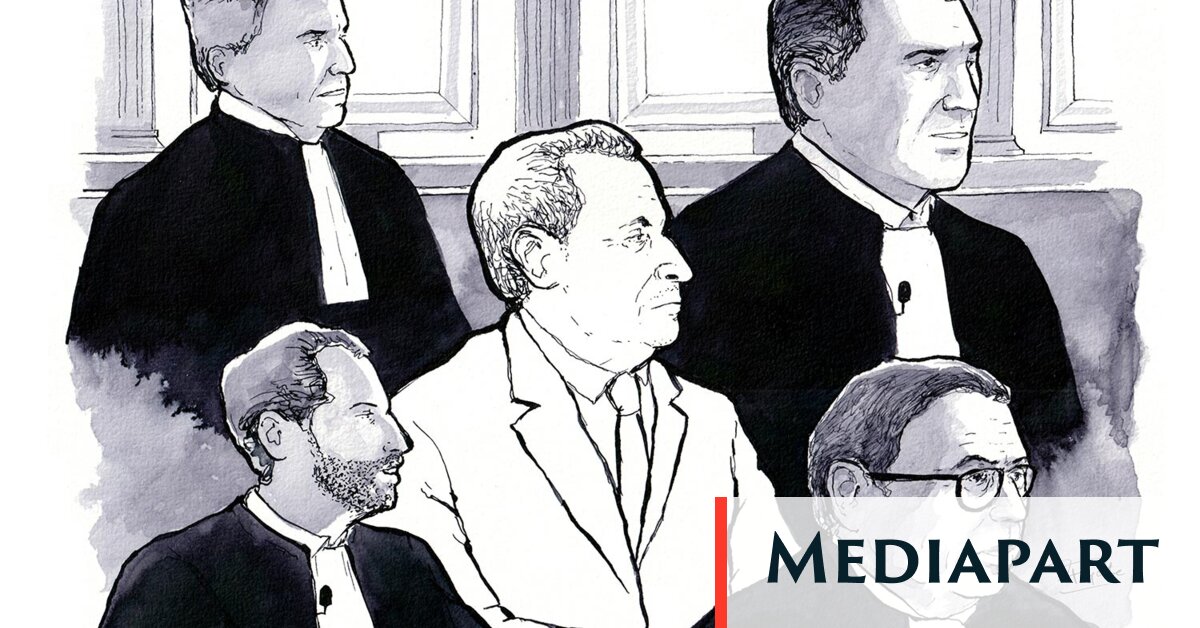
The appeal trial in the Libyan financing affair came to a close on May 27th after a full day devoted to arguments by the defence team for the case’s main defendant, Nicolas Sarkozy.
Last year the former president was found guilty at first instance of being part of a “criminal conspiracy” to get funding for his 2007 election campaign from Muammar Gaddafi’s regime, and was sentenced to five years in jail.
But he was acquitted of the three other charges brought against him; corruption, receiving the proceeds of the misappropriation of Libyan public funds, and the illegal financing of an election campaign. After serving 20 days behind bars, Sarkozy was released after lodging an appeal against his conviction and sentence.
At the Paris appeal court, in what has in effect been a retrial, the ex-head of state has once again faced all four charges, and is seeking a full acquittal. At the end of the hearing on Wednesday presiding judge Olivier Géron announced that the appeal court would deliver its verdict on November 30th.
Earlier, and for more than six hours, the former French president’s four lawyers took turns to address the courtroom, competing with each other in expressions of indignation as they attacked the prosecution’s case.
The phrases they employed included: “outlandish accusations”, “grotesque fiction”, “imaginary story”, “rhetorical window dressing”, “hollow and artificial construction”, “fabrications designed to smear”, “bad faith”, “flimsy theories”, “nonsensical” and a “weak and biased investigation”.
Nicolas Sarkozy himself, who was given the final word in the proceedings, which had begun on March 16th, spoke of a case that “started with lies and a conspiracy”. He continued, as he has done for the past 15 years, to portray himself as the victim of a vast plot hatched in Tripoli and then extended into the French police and judiciary.
“I ask to be judged like anybody else. I ask to be judged for what I have done, not for who I am,” he added, his voice choking with anger. The former head of state said he had been “insulted” by the prosecution’s submissions, which called for a seven-year prison sentence. “So in 2007 voters were deceived by Gaddafi money that you never found?” the defendant asked, misleadingly, glaring at the three prosecutors with a look of defiance bordering on intimidation.
“My name is Sarkozy, I didn’t go to ENA [editor’s note, France’s elite École Nationale d’Administration], and I won’t let anyone say my election was rigged,” he thundered again, insisting he had never been under the influence of Muammar Gaddafi. As proof, he pointed to the deadly war he waged against the Libyan dictator and his regime in 2011, a military offensive which, he claimed, lies at the root of all his current legal woes.
“I will spend the coming months waiting, asking myself every day, every morning when I wake up and every night when I go to bed: ‘Am I going back?” added the former president, referring to the three weeks he spent in prison after being sentenced at first instance in September 2025. “People often ask me how I keep going. I keep going because I’m innocent and because I love my country. I cannot conceive that in 2026 a man can be sentenced to seven years in prison for crimes he didn’t commit,” he concluded.
That was also the line taken by his lawyers, led by Jean-Michel Darrois, who argued that “doubt must prevail” in favour of his client in this case. His closing argument followed those of fellow defence lawyers Christophe Ingrain, Tristan Gautier and Sébastien Schapira, who put all their energy into this epic trial, at times giving the impression – as in Edgar Allan Poe’s The Murders in the Rue Morgue (1841) – of “denying what exists and explaining what does not”.
The Sarkozy ‘circles’
The first of Nicolas Sarkozy’s defence lawyers to speak, Christophe Ingrain, initially tried to put some – legal – distance between his client and the other defendants in the case (there are nine others in total), whom prosecutor Damien Brunet, during his submissions, had portrayed as occupying the central rings of an alleged criminal conspiracy dating back to 2005.
Former minister Brice Hortefeux? Yes, he has been Sarkozy’s friend since adolescence and followed him like a shadow throughout his political career, the lawyer conceded. But “Nicolas Sarkozy neither requested nor demanded Brice Hortefeux’s appointment to the interior ministry [editor’s note, in 2005 when Sarkozy himself was interior minister],” he insisted. According to him, it was then-president Jacques Chirac who more or less imposed the appointment on him.
Claude Guéant? When he became Sarkozy’s chief of staff in 2002, “Nicolas Sarkozy didn’t really know him”, according to Christophe Ingrain.
Sarkozy’s old friend Thierry Gaubert, who received Libyan money in early 2006 through a Bahamas bank account? “A friendship that has faded,” the lawyer insisted, while acknowledging there had been a “few meetings” with his client, even though Sarkozy had claimed during the investigation that he had had no contact whatsoever with Gaubert after 1996. Christophe Ingrain criticised in particular Thierry Gaubert’s bad habit of “doing everything possible to make it look” as though he had maintained a much closer relationship with Sarkozy. “A minor sin, and quite a common one,” the lawyer reassured the court.
As for the close ties those three men maintained with alleged corruption middleman Ziad Takieddine – the key figure in all the Sarkozy team’s covert dealings with Libya during the period under investigation – “Nicolas Sarkozy was not a part of this”, Christophe Ingrain declared, as though Claude Guéant, Sarkozy’s chief of staff, and Brice Hortefeux, his junior minister, had no institutional, political or legal connection to the minister they served.
The court will rule whether this attempt to distance Sarkozy from them is undermined by one of the new facts that emerged during the appeal trial. Questioned by presiding judge Géron, Nicolas Sarkozy was forced during proceedings to admit that he had known about contacts between Claude Guéant, Brice Hortefeux and Ziad Takieddine in 2003 and 2004, and that he himself had met Takieddine twice at the Ministry of the Interior headquarters in Paris.
Sarkozy also acknowledged that he had approved a trip by his two closest aides and the intermediary to Saudi Arabia – where they represented him personally – and that he was briefed on their return about negotiations linked to a seven-billion-euro arms contract.
That deal, known as “MIKSA”, had already aroused suspicions over possible financial kickbacks for Sarkozy’s forthcoming 2007 presidential campaign, as the press reported at the time. As is now known, the MIKSA contract never went ahead, after the Élysée under Jacques Chirac halted negotiations out of fear they could fuel a possible election “war chest” for Sarkozy, as a senior civil servant admitted to Mediapart in 2011.
This “war chest” theory was a “fiction”, Christophe Ingrain argued. It amounted to “groundless allegations” fuelled by the Chirac camp, the lawyer continued, while taking the opportunity to mock “Jacques Chirac’s honesty”. The prosecution’s theory is in fact entirely different: namely that the failure of the Sarkozy team’s Saudi venture gave rise, a year later, to the beginnings of the Libyan affair.
Meetings with Senussi
Sometimes it is important to pay attention to what is not said. From that perspective, the very limited time devoted by Sarkozy’s four lawyers to the secret meetings held by Claude Guéant (in October 2005) and then Brice Hortefeux (in December 2005) with Abdullah Senussi – the Libyan regime’s number two, head of military intelligence, and a man sentenced in absentia by France to life imprisonment in 1999 for organising the bombing of the UTA DC-10 flight that killed 170 people – was telling.
Those two meetings took place without the knowledge of French diplomats, who were informed neither before nor afterwards. Someone who did attend the meetings, however, was the ever-present Ziad Takieddine.
According to Abdullah Senussi and Ziad Takieddine, it was during these clandestine meetings – described by Hortefeux and Guéant as set-ups – that financial backing for Sarkozy’s 2007 campaign and at least one quid pro quo were discussed. “Yes, the meetings took place, but Nicolas Sarkozy neither authorised them nor was informed about them,” Christophe Ingrain simply stated, implying that while Guéant and Hortefeux told Sarkozy everything about Saudi Arabia 18 months earlier, they told him nothing at all about Libya.
Most importantly, written statements submitted to the court by Claude Guéant – who was excused from attending the proceedings on health grounds – indicate that he did in fact brief Nicolas Sarkozy, albeit at an uncertain date, on his Tripoli meeting with Abdullah Senussi and Ziad Takieddine. Prosecutors argued, with the support of documentary evidence, that the meeting could not reasonably be described as a “trap”.
Brice Hortefeux’s meeting with Abdullah Senussi had been revealed by Mediapart in 2012 with the publication of the famous Koussa note, which Sarkozy’s lawyers still claim is fake, even though French courts have ruled three separate times that it is neither a forged document nor false in substance. Despite this, lawyer Sébastien Schapira argued: “Behind this fake are forgers.” And he pointed the finger – without any evidence at all – at Saif al-Islam Gaddafi, the late dictator’s second son.
The meetings between Sarkozy’s two closest allies and Abdullah Senussi lie at the heart of the prosecution case because they were followed, within weeks, by a series of financial transfers from the Libyan regime in 2006 to an offshore company called Rossfield that was controlled by Ziad Takieddine. Two of those transfers, totalling five million euros, correspond exactly to entries found in the handwritten notebooks of former Libyan prime minister Shukri Ghanem, who recorded Libyan payments intended for Sarkozy’s 2007 campaign, as the initial trial had already noted.
As with the secret Senussi meetings, Sarkozy’s lawyers said very little in their arguments about the Ghanem notebooks. They seemed to challenge if not their authenticity then at least their truthfulness, without offering much in the way of proof. Lawyer Sébastien Schapira merely suggested, more with rhetoric than conviction, that the notebooks concealed a “cover-up” by Shukri Ghanem after the war, a cover-up intended to hide embezzlement by Libyans for their own benefit.
The Rossfield funds
In order to break the link between the Rossfield transfers and the Ghanem notebooks, lawyer Tristan Gautier sought to show that the money received by Ziad Takieddine could not have been tied to any plan to finance Sarkozy’s 2007 campaign. According to him, the payments were simply “payment for Ziad Takieddine’s activities in Libya”.
That version of events is very much at odds with the one put forward the previous day by Claude Guéant’s lawyer, who argued that Takieddine had in fact convinced the Libyans that the money was destined for Sarkozy’s campaign, before allegedly keeping it for himself. Sarkozy himself had floated that theory during the investigation before backing away from it at the first trial, perhaps realising the legal danger such a claim posed.
In fact, under French law the final destination of allegedly corrupt funds is irrelevant to proving the corruption pact from which they originated. In short: prosecutors do not need to prove that money paid to finance a campaign actually funded that campaign in order to establish the existence of a corruption pact.
“You can’t simply brush aside these legitimate questions,” defence lawyer Tristan Gautier told the court, before attempting to show that every euro received by Takieddine through Rossfield served purely personal ends. This, incidentally, could reinforce the veracity of the Ghanem notebooks, which suggested that all or part of the money intended for Sarkozy’s campaign had been siphoned off by middlemen.
“As soon as we shed a little light on Ziad Takieddine’s murky accounting, we move further away from campaign financing,” the lawyer insisted, while taking certain liberties with dates and figures in support of his argument. He claimed, for example, that a one-million-euro transfer into Rossfield in May 2006 came from Abdullah Senussi’s intelligence services, even though according to the findings of the investigation itself this was not the case.
Elsewhere, he cited a memo sent by Takieddine to Senussi in early October 2005 complaining that a transfer had not arrived, while failing to mention that it could not possibly concern Rossfield, which was only created on November 15th 2005.
Likewise, in an attempt to neutralise the legal threat posed by Rossfield, Sarkozy’s lawyers continued to cling to the theory that Takieddine was involved in kickbacks benefiting Abdullah Senussi’s son. But as Mediapart has already reported, not only were the financial ties between Takieddine and Senussi’s son already well known, they were not financed through Rossfield transfers, as the banking evidence in the case file shows. Added to that were the numerous calculation errors – some of them glaring – that Sarkozy’s defence team had to correct during the hearings.
Tristan Gautier also played another card. The millions received by Takieddine through Rossfield, he argued, were linked to a contract between French defence company Sagem and Libya, a deal allegedly discussed during Claude Guéant’s dinner with Abdullah Senussi in October 2005. The problem is that the Sagem contract never materialised at the time, and Claude Guéant never once mentioned it during the ten-year investigation or at either of the two trials.
Quid pro quos
Claude Guéant did, however, acknowledge that Abdullah Senussi personally raised his legal troubles with him – the Libyan has been the subject of an international arrest warrant since his conviction in the UTA bombing case – and that Guéant looked into the matter as soon as he returned to Paris. According to the prosecution, the promise made to the Libyans that Senussi’s legal situation would be examined constituted one of the quid pro quos in the alleged corruption pact.
While in police custody in 2018, Nicolas Sarkozy admitted that Gaddafi had told him in October 2005 of his obsession with having the arrest warrant against Abdullah Senussi lifted. And indeed, a month and a half later, in November 2005, two well-known French criminal lawyers – one of whom, Thierry Herzog, Sarkozy described to police as his “best friend” – flew to Tripoli to propose a legal strategy aimed at making the warrant unenforceable.
No need to make a big deal of this.
Yet Sarkozy’s lawyers insisted in court that the trip took place without his knowledge, painting a picture of an interior minister remarkably unaware of what his closest friends and aides were doing within his own political sphere. According to the defence, Thierry Herzog and fellow lawyer Francis Szpiner had in fact been acting on Jacques Chirac’s instructions, another sign that the late president was being asked to shoulder more and more responsibility in this Libyan trial.
“I did not help Mr Senussi, directly or indirectly,” Nicolas Sarkozy swore again during his closing remarks. That sharply contradicts Claude Guéant’s own written statements, in which he told the court, using what has already become a famous phrase, “Claude, look into this”, that Sarkozy personally instructed him in July 2007 to examine Senussi’s case. “No need to make a big deal of this,” Sébastien Schapira sought to argue during his submissions, instead portraying Claude Guéant as a “bitter man”.
As far as fellow defence lawyer Christophe Ingrain was concerned “Nicolas Sarkozy was not informed of the discussions under way” concerning Senussi. Yet that claim is contradicted by Guéant’s written testimony, which states that in May 2009 he held a meeting at the Élysée with Ziad Takieddine about Senussi’s legal situation. Guéant also said in his written statements that, whether serving as Sarkozy’s chief of staff at the Ministry of the Interior or later as secretary-general at the Élysée, he always acted on Sarkozy’s “instructions” and always reported back to him.
Another alleged quid pro quo, according to prosecutors, was Muammar Gaddafi’s controversial visit to Paris in December 2007. Sarkozy’s explanations for the visit have shifted considerably over time as evidence emerged. He initially claimed it was a quid pro quo for Gaddafi releasing imprisoned Bulgarian nurses in July 2007. But confronted with testimony before France’s National Assembly from his own diplomatic adviser, who said that was untrue, Sarkozy later changed tack: the nurses’ release, he said, had merely been a precondition for the visit.
That latter explanation was put forward again by the defence on the appeal trial’s final day, though the distinction is not without danger. An official phone call from May 2007 between the newly elected Sarkozy and Gaddafi proves that the idea of a visit to Paris had already been proposed while the nurses were still imprisoned in Libya.
“I’d be very happy if you yourself were to make a visit [to Paris],” the French president told the Libyan dictator as early as May 28th 2007, in a conversation marked by striking obsequiousness on Sarkozy’s part.
The judicial investigation also showed that Ziad Takieddine, whom prosecutors describe as the organiser of the alleged 2005 corruption pact, worked closely with Claude Guéant on arranging Gaddafi’s December 2007 visit. According to prosecutors, that is further evidence linking the visit to the alleged quid pro quos.
The court will now decide whether it accepts that interpretation of events, beyond the difficult legal questions surrounding the case (see box below). Whatever the outcome, however, if one accepts the defence argument that Ziad Takieddine kept all the Libyan money for himself, then the Gaddafi regime still obtained what it wanted: the red-carpet treatment from France – itself a victim of Libyan terrorism – and a promise that terrorist Abdullah Senussi’s legal situation would be reviewed.
No motive?
In an attempt to undermine the prosecution’s case, the defence finally sought to pick at the apparent absence of any motive. “You would have to be mad to enter into a Faustian pact when you’re on the threshold of the Élysée,” Sébastien Schapira said. In other words: why would Nicolas Sarkozy have gone to Tripoli in 2005 to negotiate the granting of funds to finance his campaign when, by then, he was certain to have the backing of his party at the time, the UMP (now Les Républicains)?
That perhaps overlooks the fact that being sure of the support of a powerful party does not rule out illegal campaign financing, as shown by the Bygmalion election funding scandal, during which it was revealed that the 2012 campaign fought by Sarkozy, the sitting president and candidate, cost 45 million euros instead of the 20 million permitted by law. Christophe Ingrain described as “ridiculous” the idea that Sarkozy needed, or would have sought, Libyan money.
“Not everything is permissible, even when it comes to convicting Nicolas Sarkozy,” Christophe Ingrain repeated several times. He then closed by citing Crime and Punishment (1866): “From a hundred rabbits you can’t make a horse, a hundred suspicions don’t make a proof.” The lawyer did not go on to point out that in Fyodor Dostoevsky’s novel, the hero, Rodion Raskolnikov, is in fact guilty.
——————————————————————————–
- The original French version of this article can be found here.
English version by Michael Streeter
Credit: Source link