

Next in Line, or Dodging the Bullet? Regime Survival in Nicaragua amid US Pressure | Georgetown Journal of International Affairs
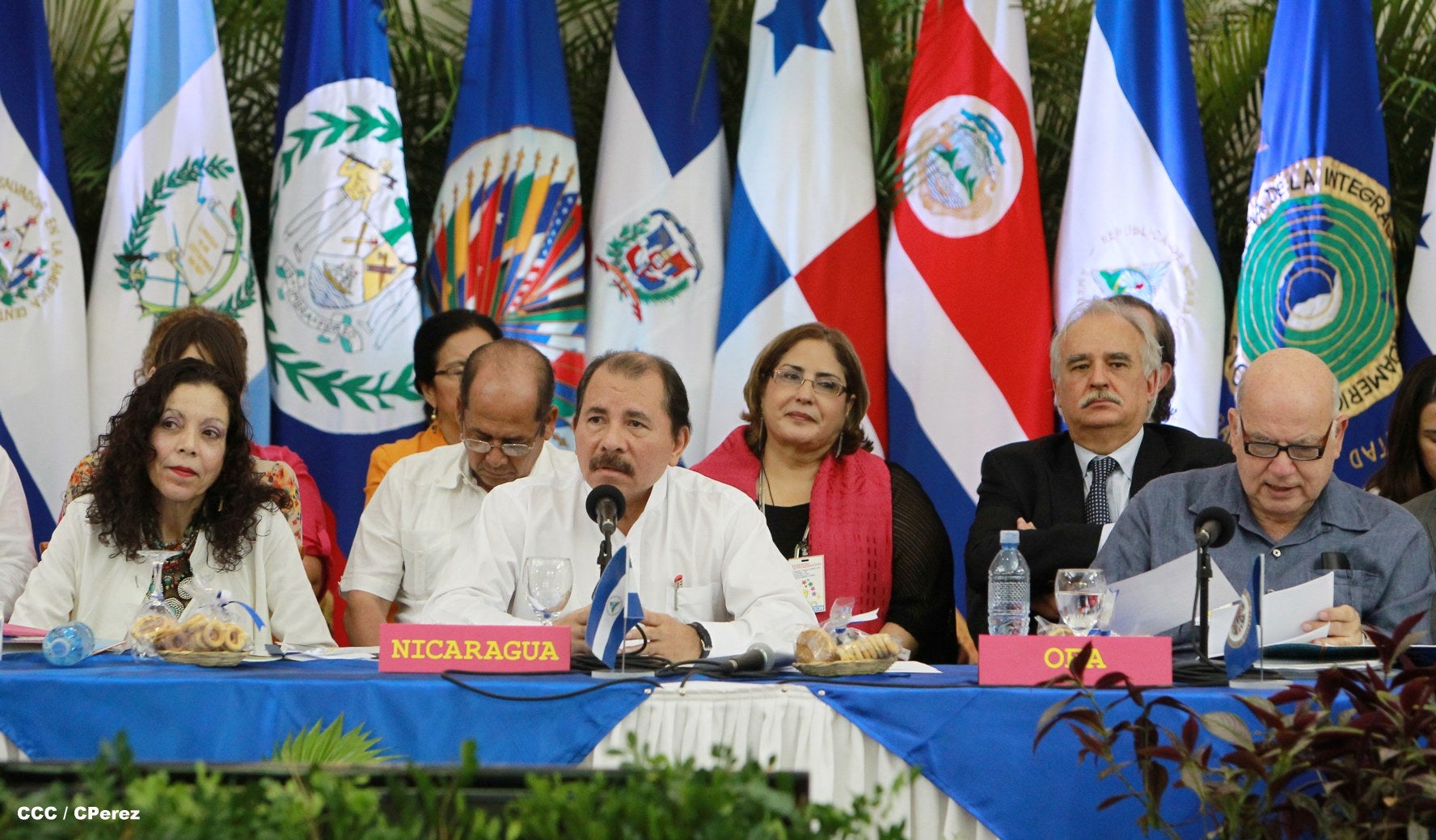
The United States began 2026 by capturing Venezuela’s president and blockading Cuba. Nicaraguan dictators Daniel Ortega and Rosario Murillo have been close Venezuelan and Cuban allies, leading to suspicions they might be the next US targets. US-led regime change, however, appears unlikely. Ortega and Murillo have personalized their regime around their family, eliminating potential alternative leaders, in contrast to Venezuela. Nicaragua lacks Venezuela’s attractive natural resource wealth, and it has long been a lower US political priority than Venezuela and Cuba. Rather than a blunt pressure campaign, international actors should work to empower and unify Nicaraguan civil society and opposition groups, while supporting international investigations and accountability efforts. Eroding Ortega and Murillo’s remaining domestic legitimacy and heightening the regime’s internal contradictions offer a more viable pathway to change in Nicaragua.
Is Nicaragua Next?
After the seizure of Venezuelan President Nicolás Maduro in January 2026 and with the United States under the Trump administration blockading Cuba and demanding new leadership and economic reforms, Nicaragua may seem like the natural next target in the Western Hemisphere. Daniel Ortega, a leftist revolutionary leader in the 1970s and 1980s with the Sandinista National Liberation Front (FSLN), has been in power since 2007, alongside his wife Rosario Murillo who became vice president in 2017 and was officially made the co-president in 2025.
Having steadily eroded democracy in the 2010s, Ortega and Murillo’s regime looked like it was on solid footing until unexpected mass pro-democracy protests in 2018 threatened to topple it, but the couple’s subsequent crackdown ensured their iron-fisted grip on power. The US, European Union, and other countries have consistently condemned the regime’s authoritarianism and repression, and sanctioned government officials and allies. Nicaraguans are hungry for political change, but despite widespread hopes that the US could force a shift toward democracy, this is currently unlikely for several reasons.
First, Ortega and Murillo’s personalization of power means leadership change in Managua may be harder than in Venezuela or Cuba. Second, Nicaragua’s leaders have proven adept at navigating U.S. pressure in the past. Third, the country lacks Venezuela’s natural resource wealth or Cuba’s powerful exile political lobby, making Nicaragua a less politically attractive target. New leaders in Nicaragua, and any potential return to democracy, appear far more likely to emerge due to contradictions within the regime rather than pressure from Washington. The focus should therefore be on strengthening Nicaraguan media and civil society, supporting international investigations, and building opposition unity to continue undermining Ortega and Murillo’s remaining legitimacy and domestic support.
Personalization and Regime Survival
The FSLN is officially Nicaragua’s ruling party, and Ortega and Murillo play up the regime’s revolutionary roots, but after losing power in 1990, the party began fracturing. Ortega consolidated personal control and turned the FSLN away from the left. Trying to win back power, he embraced big business and built alliances with conservative Christian leaders, adopting an anti-abortion stance.
In 1999, Ortega cut a deal with right-wing then-President Arnoldo Alemán of the Constitutional Liberal Party to control state institutions together. Most consequentially, this infamous pact lowered the victory threshold for presidential elections so that 50% was no longer needed to avoid a runoff, allowing Ortega to win in 2006 with only 38% of the vote.
Once in office, Ortega built genuine popularity. Alliances with business elites helped ensure macroeconomic growth, while Venezuelan aid and loans supported increased social spending, maintaining the FSLN’s lower-income base. Police were corrupt and harassed urban youths and racial minorities, but Nicaragua had far lower levels of violent crime and gang activity than its northern neighbors. Despite diminished political competition and Murillo being made vice president in the 2016 elections, the regime’s balancing act seemed stable.
In April 2018, however, the government repressed initial demonstrations against cuts to social security benefits. Hundreds of thousands of Nicaraguans took to the streets calling for new elections and new leaders, and it looked like the regime might fall, as even former FSLN supporters turned. By the end of July, however, police and pro-government paramilitaries had crushed open resistance with a campaign of terror, killing over 300 Nicaraguans and wounding, imprisoning, torturing, or threatening many more.
Since then, Ortega and Murillo have eliminated independent political and civil society actors within Nicaragua and strangled dissent. Economic incentives and coercion, not loyalty, keep many government employees and nominal supporters in line, and Ortega and Murillo’s own inner circle has also narrowed, with family members now in prominent roles. Yet despite this shrinking support base, cracks have yet to appear in the regime.
Murillo has positioned herself to succeed Ortega. Especially since 2025, anyone deemed a threat to her or insufficiently loyal has found themselves on the chopping block. Bayardo Arce, the last FSLN revolutionary-era leader to stick with Ortega, has been imprisoned since July 2025. Arce was convicted in January 2026 of money laundering, despite years spent building up the regime’s finances as the chief economic advisor. Some Nicaraguan analysts saw Arce’s conviction as a “sacrifice” to deflect post-Maduro US pressure, but Murillo seeing him as an obstacle to her power is the more likely cause.
Without any clear successors outside of the Ortega-Murillo family, it is hard to see a Delcy Rodríguez figure emerging as happened in Venezuela. Nicaragua’s military has been coopted, reducing any possibility of a coup. Leadership change without regime change, as the Trump administration has pursued in Caracas and Havana, therefore appears unlikely.
Keeping the Eagle at Bay
US politicians and officials opposed Ortega’s return to power, but since 2007 he has skillfully managed relations with the US. Even as he eroded democracy, Ortega limited US pressure while banking on Nicaragua remaining a lower priority in the hemisphere, especially compared to northern Central America’s gang violence and emigration, and Venezuela’s openly anti-US regime. Ortega’s outreach to business interests and embrace of trade with the US assuaged doubts about socialism. While cozying up to Venezuela and using ‘anti-imperialist’ rhetoric, Ortega cooperated with the US on anti-narcotics efforts. In 2015, Nicaragua closed its southern border to stop Cuban migrants seeking to continue north to the US, and it maintained this policy through 2017 for migrants from around the world. Nicaragua, in fact, proved a more reliable security partner than nominal US allies in the region.
Since 2018, the US has adopted a more aggressive stance. Ortega and Murillo have often taken measures to relieve immediate pressure but followed them up with further moves to reinforce their power, offering concessions with little cost to their control. In late 2020 and early 2021, Ortega and Murillo signaled that they would let opposition candidates contest the 2021 elections, and opposition leaders began returning to Nicaragua. Once leading contenders began campaigning, however, the regime tightened the noose again, arresting potential rivals and forcing others to flee.
The regime released 222 political prisoners to the US in February 2023 after negotiations with the Biden administration, but followed the release by stripping them and other opponents of their citizenship and assets in Nicaragua. New arrests have often followed political prisoner releases since then.
One of the latest ostensible concessions has been on migration. Ortega and Murillo from 2021 through 2025 opened Nicaragua’s doors to migrants from the Americas and beyond. Nicaragua dropped entry visa requirements for dozens of countries and collaborated with companies in Asia and Africa to fly migrants to Managua to then head to the Honduran border and northward, in exchange for fees that boosted regime coffers.
Following Maduro’s capture, Nicaragua reimposed entry visa requirements for over 100 countries, including Cuba. Yet this came after migration toward the US had collapsed, meaning transit migration was no longer a significant revenue source and so visa barriers were a cheap, easy ‘concession’ to make.
A Lower Priority for the US
The US State Department in March 2026 said “all options are on the table” regarding Nicaragua’s government. Indigenous leader Brooklyn Rivera’s death in custody on May 30, just hours after the US called for his release, could renew US attention to Nicaragua. Since 1990, however, Nicaragua has not been a major focus of US foreign policy, and it lacks the political attractions of leadership or regime change in Venezuela and Cuba. Ortega and Murillo’s efforts to blunt US pressure may be weak, but still sufficient, since Nicaragua is of secondary interest to key US policymakers.
Venezuela’s Bolivarian regime was a thorn in the side of US policy toward Latin America. Expropriating US firms, supporting leftist political actors throughout the region, generating a massive refugee crisis, and facilitating drug trafficking aggravated US governments for over two decades.
Despite a nominal focus on anti-drug issues, Trump administration pressure on Venezuela in 2025 and early 2026 concentrated most firmly on Maduro’s perceived insubordination to the US and on access to Venezuelan oil. Nicaragua, while a drug transshipment point where officials have colluded with traffickers, is a far smaller player in narcotics trafficking than Venezuela. The country has a growing gold industry, and Nicaragua’s government allegedly expropriated a US firm to sell its local assets to a Chinese company. After new US sanctions in April 2026, the Nicaraguan government returned the mine. Potential profits from Nicaraguan gold, however, are orders of magnitude smaller than Venezuela’s oil industry, let alone Venezuela’s own gold reserves, making Nicaragua less of a target.
Regime change in Cuba has remained a central US policy aim, thanks to the large, committed Cuban exile population in the US, who have formed a powerful lobby, producing figures such as Secretary of State Marco Rubio and members of Congress. Although thousands of Nicaraguans fled to the US after the 1979 revolutionary takeover, they established far less influence. Nicaraguan migration until 2018 also tended to be to Costa Rica, keeping the Nicaraguan-American community smaller and the country lower on the US agenda.
Despite Rubio and other US politicians discussing Nicaragua alongside Cuba and Venezuela, the current US focus on Venezuela’s economy, Cuba’s regime, and war in Iran means Nicaragua may be able to stay out of the crosshairs. Ortega and Murillo seem to be betting on that, even daring to insult Trump, confident they can offer superficial concessions and escape unscathed.
A Path Forward
There is a centuries-long history of US intervention in Nicaragua. Trying to force out Ortega and Murillo might fall in line with that history, but seems unlikely right now.
There is no clear alternative leadership left in Nicaragua, and the exiled opposition remains divided. President Trump, as in Venezuela, has said he wants to “take the oil” from Iran, a pattern that highlights the importance of natural resource wealth—which Nicaragua lacks—to current US political calculations. Cuba’s regime remains intact and US pressure there has fluctuated. Ortega and Murillo can reasonably hope that the Trump administration has too little bandwidth for a major campaign against them, and that they can cut low-cost deals as needed.
Sanctions should not be expected to truly undermine the regime. Trade restrictions may have more bite, but the Trump administration has not moved forward with them, and other countries lack the US’s economic leverage.
What, then, can or should be done about Nicaragua’s dictatorial duo? Nicaragua’s political future is more likely to continue resting with Nicaraguans themselves, and so international efforts should concentrate on aiding Nicaragua’s civic opposition. First, amid US cuts to foreign aid and attacks on international organizations, the European Union and other international actors should step up their support for Nicaraguan civil society groups and media outlets in exile.
Second, they should further back international human rights and anti-corruption investigations and accountability efforts. The regime’s personalization and unpopularity, especially with Murillo grasping more power for herself, means Ortega’s death or another domestic shock could destabilize the already fragile foundations. Investigative work further erodes Ortega and Murillo’s self-serving veneer of revolutionary ideals and popular support. It lets government opponents still in the country see that they are not alone, makes leaders’ corruption and cruelty clearer to state employees and FSLN supporters, and offers a focal point for opposition unity.
Finally, building a unified opposition is critical for taking advantage of regime fragility and forging a democratic Nicaragua. Special forces raids or naval blockades may seem like the most acute threats to Ortega and Murillo’s power. As the couple’s crackdown in 2018 made clear, though, their greatest fear remains the Nicaraguan people massed against them.
. . .
Kai M. Thaler is Assistant Professor of Global Studies at the University of California, Santa Barbara and the author of When Rebels Win: Ideology, Statebuilding, and Power after Civil Wars (Cornell University Press, 2025). He has published extensive academic and public writing on Nicaraguan politics and international relations.
Image Credit: OEA – OAS, CC BY-NC-ND 2.0, via Flickr