

New Delhi in the context of India-China thaw, Russia, US, Canada
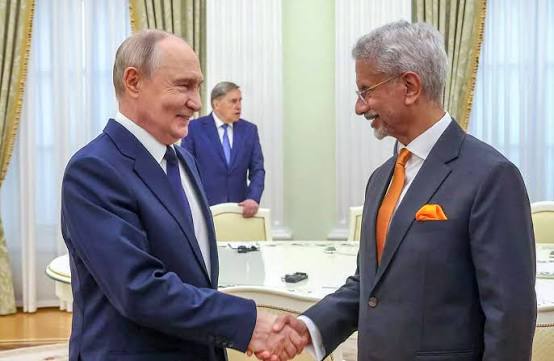
Two noteworthy events this past week spell out how India is now assessing the global context in which it operates. In Beijing, India’s National Security Advisor, Ajit Doval, met China’s Vice President Han Zhang, and Foreign Minister Want Yi. In Moscow, Foreign Minister S. Jaishankar met Russia’s President Vladimir Putin and First Deputy Prime Minister Denis Manturov.
Several significant recent events are spelling out the changes to the context. The emerging limits to US power are gradually coming to the surface in the Middle East, and within the American continent itself.
The new Turkey-Saudi Arabia-Pakistan alliance, the constrained positions of both the UAE and Qatar, the willingness of Oman to discuss the future of the Strait of Hormuz with Iran, the limits to economic sanctions on Iran without China’s acquiescence, and the inability to contain the Russia-Ukraine war – all must now be read in conjunction with the Canadian move to step away from trade discussions and slap counter tariffs on the US.
Assessed individually, these do not signal any definitive end to Washington’s power. Collectively, they mark ominous moments.
If the direction of the statements emerging from Doval’s Beijing’s talks was about building “normalcy” and a long-term strategic outlook for the India-China relationship, the talks in Russia were about optimizing an already strong relationship even in the face of US pressure.
From an Indian perspective, the message that comes through is that India is actively assessing a changing distribution of power globally and adjusting its priorities, capabilities, and relationships accordingly.
Rather than tying its fate to a single superpower, New Delhi is actively navigating a series of overlapping strategic partnerships – conceptualized as flexible parabolas of security and interest – to secure its national sovereignty and economic future.
As China extends its revisionist muscle across the Sub-continent and the South and East China Seas, India is finding common ground with Tokyo and Canberra, expanding mutual logistics access, swapping critical maritime tracking data and hardening regional supply chains.
Japan underpins this arc by funnelling high-tech defence and industrial investments into India, while Australia secures vital pipelines for critical minerals and energy alternatives.
Crucially, this alignment also forms the bedrock of the Quad, which is at once a strength and a risk, given Trump’s demonstrated inconsistency.
The Russia dilemma
Simultaneously, India retains its highly strategic relationship with Moscow. Recent high-level engagements underscore a bilateral partnership that is demonstrating resilience amid today’s incredibly complex global landscape.
Despite Western sanctions aimed at isolating the Kremlin, India-Russia bilateral trade has continued unabated, driven primarily by India’s purchases of Russian crude oil. India’s calculated engagement with Moscow provides the vital diplomatic breathing room necessary to manage its most volatile and dangerous relationship – the structural rivalry with China.
However, there are risks hovering over the relationship, not all of which originate in Washington or Brussels. Media reports indicate that CIA Director John Ratcliffe’s trip to Moscow last week was about either a highly likely threat to NATO member-states or Vladimir Putin’s use of some kind of nuclear weapon in Ukraine. Either event would bring India’s Russia position under immense pressure.
From a US perspective, as things stand today, this is a relationship that’s not easy to factor in unless Washington’s planners are ready to concede that the globe is now a far more complex system than the unipolar years of recent memory. Washington will also have to concede that its inability to arm Ukraine adequately and put pressure on Putin are the primary reasons why the Russia-Ukraine war persists.
Beyond Ukraine, multiple threads intertwine:
One, US strategic planners will know that if India completely severs its ties with Moscow in the present circumstances, Russia will have little choice but to fall entirely into a subordinate embrace with China. India’s severance will also destabilize the global oil and gas markets. China, however, will continue buying Russian oil and further entrench itself in the Russian economy.
Two, if Washington genuinely wants to cripple Russia’s economy and minimize the emerging complexities of the Russia-Ukraine war or even end the war, the security, economic and military uncertainties arising from Trump’s actions in the Middle East raise major questions over the US ability to exercise global power across multiple geographies and geo-economic dimensions.
Three, by the deepening architecture of the Quad, Washington is conceding that India is a major player to counter China in the Indo-Pacific, diversifying its networks of leverage.
The China thaw
The gradual thaw in India’s relationship with China augurs a new level of predictability and stability – a delicate pursuit of competitive coexistence, designed to lower immediate risks such as a multi-front war on India’s northern frontiers. However, China’s defense links to Pakistan will continue to cause worry.
Yet, any stabilization arises today from India’s and China’s intersecting economic interests rather than newfound geopolitical alignment or real trust. Slower domestic demand, a punishing property sector crisis and rising Western trade barriers are forcing Chinese firms to seek alternative production centres and product markets to diversify their industrial production capacities.
India, with its massive consumer base and expanding manufacturing ecosystem, presents a highly lucrative destination for a Chinese-led iteration of the global value chain diversification strategy. The deep economic fractures emerging in China’s domestic economic structure, coupled with its global constraints, might well transform Beijing’s internal vulnerabilities into a powerful incentive for India’s multi-alignment.
The paradox of this economic reality is that while India fiercely rejects China’s geographic revisionism, its industrial structure is increasingly dependent on Chinese manufacturing might. More concerning than the trade deficit number is the composition of the trade – electronics, machinery, active pharmaceutical ingredients, renewable energy components, etc.
To navigate this vulnerability, India is executing a multi-pronged policy. It is carefully calibrating a relaxation of restrictions on selective Chinese investments where inputs are completely irreplaceable, while aggressively utilizing that temporary space to build up its own domestic capacities.
It’s also focused on deepening its manufacturing and trade alliances with other industrial powers like Japan and the EU. The EU relationship will grow based on changing global economic realities, driven by both Washington and Beijing despite Brussels’s qualms about New Delhi and Moscow, albeit under the shadow of Putin’s threat.
Simultaneously, New Delhi is projecting power into China’s traditional sphere of influence by emerging as a key defense exporter to Southeast Asia, supplying BrahMos missiles to the Philippines, Vietnam and Indonesia to help them diversify their own security dependencies away from Beijing.
An inconsistent Washington
However, this strategy of strategic hedging and multi-alignment is not without risks. The volatile and often incoherent nature of Washington’s trade and foreign policy is the key among these risks.
The passage of aggressive US legislative measures, such as secondary sanctions bills empowering the American presidency to slap crushing tariffs on major importers of Russian energy, potentially brings Washington and New Delhi into direct economic conflict.
The US is also tightening its scrutiny over global supply chains, meaning that any substantial Chinese or EU firm-level participation in Indian manufacturing networks will be tracked intensively by this Trump administration.
If the Trump administration continues to aggressively use coercion to force compliance with its latest whims, it risks accelerating the creation of parallel financial and energy networks entirely outside Washington’s system, a signal that’s emerging from Canadian Prime Minister Mark Carney’s pushback against Washington’s trade policy.
These are developments that would severely test the maturity of Washington’s global strategic partnerships. They will cause dilemmas in New Delhi, too.
However, India’s moves, the changing contours of the Middle East and Carney’s snubs are early signals that an era of uncontested superpower dominance is gradually ending. By positioning itself at the intersection of competing geopolitical arches, New Delhi’s quest for strategic autonomy in a fragmenting world is not about isolating oneself from global rivalries, but rather is about managing inevitable dependencies without singular, dominating alliances.
Comments are closed.