

Morocco’s Fresh Strawberry Exports Collapse to a Record Low • EastFruit
Morocco’s fresh strawberry exports have plunged to their lowest level on record, marking the fourth consecutive season of decline and the most dramatic contraction yet, according to EastFruit. Between October 2025 and April 2026, exporters shipped just 8,700 tons abroad, half the volume recorded a year earlier, putting the current season on course to register a historic minimum for the crop.
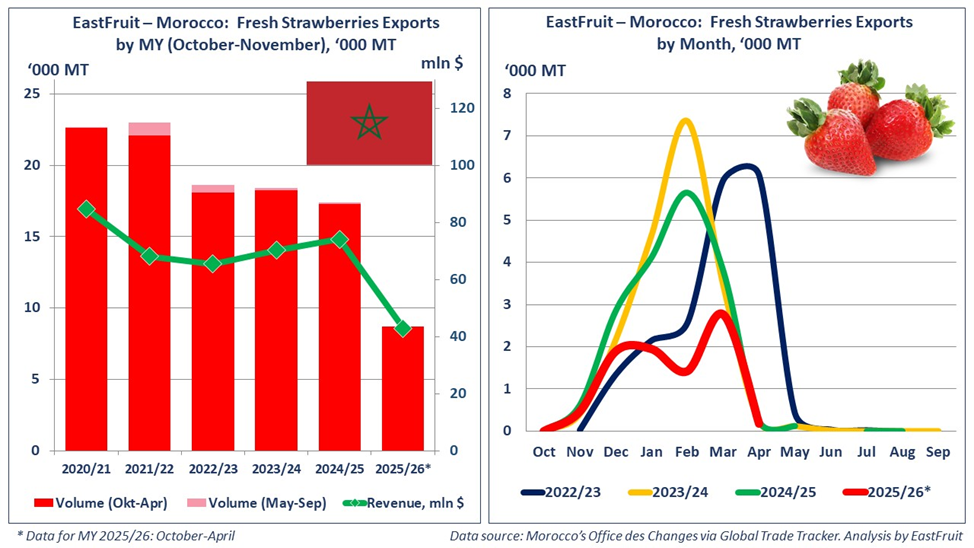 While blueberries and raspberries continue to expand their footprint in global markets, strawberries have been caught in a deep structural and climatic crisis in Morocco. The turning point came when Morocco lost the price war with Egypt. Egyptian growers rapidly expanded their acreage and flooded the market with cheaper fruit, making it increasingly difficult for Moroccan producers to compete. As margins collapsed, growers began shifting land toward more profitable crops.
Water scarcity has intensified the pressure. Strawberries are highly water‑dependent, and years of drought have pushed groundwater levels in key production regions to critical lows. Coastal areas have begun to suffer from salinization. Farmers trying to preserve their crops have had to invest heavily in desalination systems, further undermining profitability.
Labor shortages have added yet another constraint. Seasonal workers are leaving for Spain, where wages are significantly higher, and those who remain prefer to work on raspberry and blueberry farms rather than on strawberry fields. The sector has struggled to secure enough pickers during peak harvest periods.
The 2025/26 season was then hit by severe weather anomalies. Cold spells, humidity, and erratic temperatures delayed ripening, causing Morocco to miss its most lucrative premium window in Europe. Early 2026 brought devastating floods to the Gharb and Loukkos regions, inundating low‑lying fields, tearing apart protective tunnels, and destroying large portions of the crop.
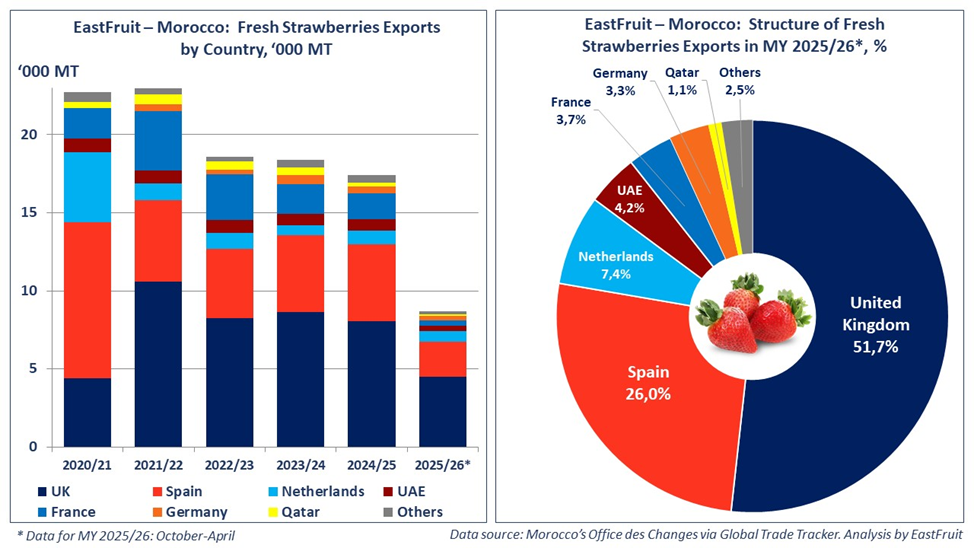 These combined pressures led to export declines across all major markets. France saw the steepest drop, with shipments falling by more than 80 percent, while the Netherlands experienced a more moderate contraction. The most consequential declines occurred in the UK and Spain – Morocco’s two largest buyers – where exports fell by 44 and 54 percent respectively. Saudi Arabia was the only market to show growth, but volumes remain too small to influence the overall trend.
The season’s results underscore a broader transformation of Morocco’s berry industry. Investors and major cooperatives are redirecting capital away from fresh strawberries and toward blueberries, blackberries, and avocados. The strawberry sector is now maintaining relevance primarily in the frozen IQF segment, where Morocco even set a record in 2025 for exports to the United States after Mexican shipments declined.
Morocco’s fresh strawberry industry is no longer shrinking due to temporary shocks – it is undergoing a structural reconfiguration that is reshaping the country’s entire berry portfolio.
The use of the site materials is free if there is a direct and open for search engines hyperlink to a specific publication of the East-Fruit.com website.
Credit: Source link