

Morocco and India Form Joint Commission on Language AI, Targeting Darija and Amazigh in Public Services
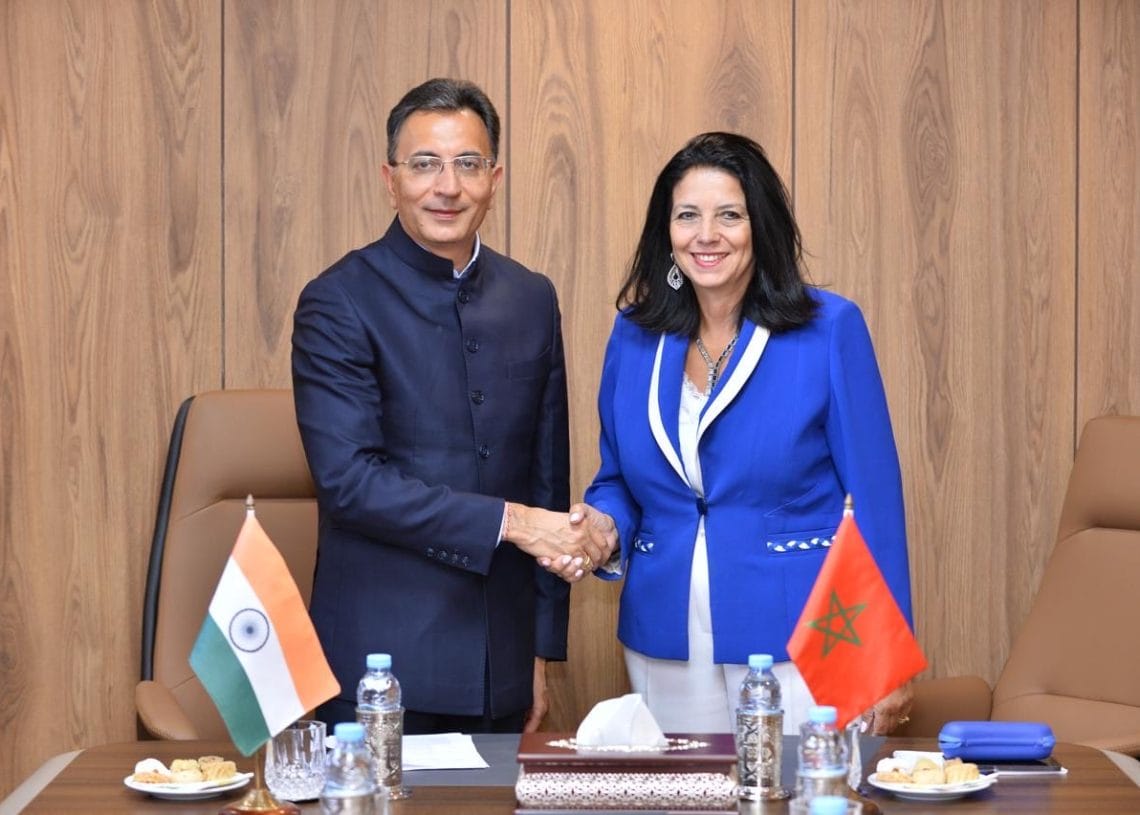
Morocco and India have agreed to establish a joint commission on languages and digital technologies, with the immediate objective of integrating Moroccan Darija and Amazigh into Idarati, the platform through which Moroccans access administrative services online.
The agreement was reached in Rabat during talks between Morocco’s Minister Delegate for Digital Transition and Administration Reform, Amal El Fallah Seghrouchni, and India’s Minister of State for Commerce and Industry and Electronics and Information Technology, Jitin Prasada.
Seghrouchni said the commission would focus on large language models, citing India’s experience in the field and an Indian application supporting 28 languages. The partnership will also cover small language models — a technically apt choice for Darija and Amazigh, both low-resource languages where compact models running on modest infrastructure are often more practical than frontier systems.
She also referenced the Al Jazari Institute, which operates in Arabic, Amazigh and Darija to make it easier for citizens to interact with the administration. Morocco has been expanding that institute into a national network, with the inaugural site in Guelmim-Oued Noun and a second agreed for Nador in the Rif.
A different kind of partner
India’s presence in African AI is less documented than that of the other powers courting the continent, and it brings a distinct offering.
At GITEX Africa in Marrakech last year, Indian representatives presented the country’s digital public infrastructure stack — Aadhaar for identity, UPI for payments, DigiLocker for document storage. These are government-owned, open, interoperable rails rather than proprietary platforms, and India has been actively exporting the model.
That is a different proposition from US hyperscaler cloud contracts, Chinese infrastructure financing, Gulf sovereign capital or European regulatory alignment — all of which iAfrica has tracked across the continent this year. For a country whose minister has described Morocco as a potential “third voice” on AI governance, distinct from US, European and Chinese frameworks, an Indian partnership is ideologically consistent.
The Rabat talks covered public digital infrastructure directly, alongside digital identity, electronic payments, data governance and the use of digital infrastructure to modernise public administration. Digital skills were a further strand, covering training programmes, expert exchanges, university partnerships and professional certification in emerging technologies.
Where it fits in Morocco’s build-out
The language commitment is the most concrete element, and it is consistent with a pattern Morocco has been building for two years.
The government partnered with Mistral AI to establish a multilingual lab developing models in Arabic, Amazigh and other African languages. It signed an agreement with the CNDP to design large language models tailored to Morocco’s language, culture and legal framework. It has promoted open-source AI specifically as a route to handling Arabic, Darija and Amazigh. Idarati X.0, the unified administrative platform, is being developed through eight cooperation agreements with a national digital wallet linked to the electronic identity card.
Morocco’s AI Made in Morocco initiative targets a 100 billion dirham GDP contribution and 50,000 AI jobs by 2030, backed by the $1.2 billion Nexus AI Factory near Casablanca and a planned 500MW renewable-powered data centre in Dakhla.
The regional context
Darija and Amazigh sit in the same category as the languages other African states are now building for. Egypt launched BelMasry this month, a free state-built platform handling Egyptian colloquial Arabic across regional dialects. Nigeria open-sourced N-ATLAS and is scaling it through the GSMA’s five-government ATLAS Umoja initiative. LINGUA Africa is funding 26 projects across more than 50 languages.
What distinguishes Morocco’s approach is that the target is a working government service rather than a research artefact. Idarati is where Moroccans renew documents and file requests. A model that handles Darija there is either usable or it is not — a clearer test than most language-AI announcements permit.
The Rabat meeting followed talks between Seghrouchni and Prasada in New Delhi in February on the sidelines of the AI Impact Summit. Prasada was in Morocco from 24 to 25 August for the seventh session of the Morocco-India Joint Commission, covering broader economic and commercial cooperation.
Credit: Source link