

Meeting between Aqila Saleh and Mohammed Takala: Is Turkey repositioning itself in Libya or trying to influence the architecture of the political settlement?
Is Turkey repositioning itself in Libya or trying to shape the political settlement?
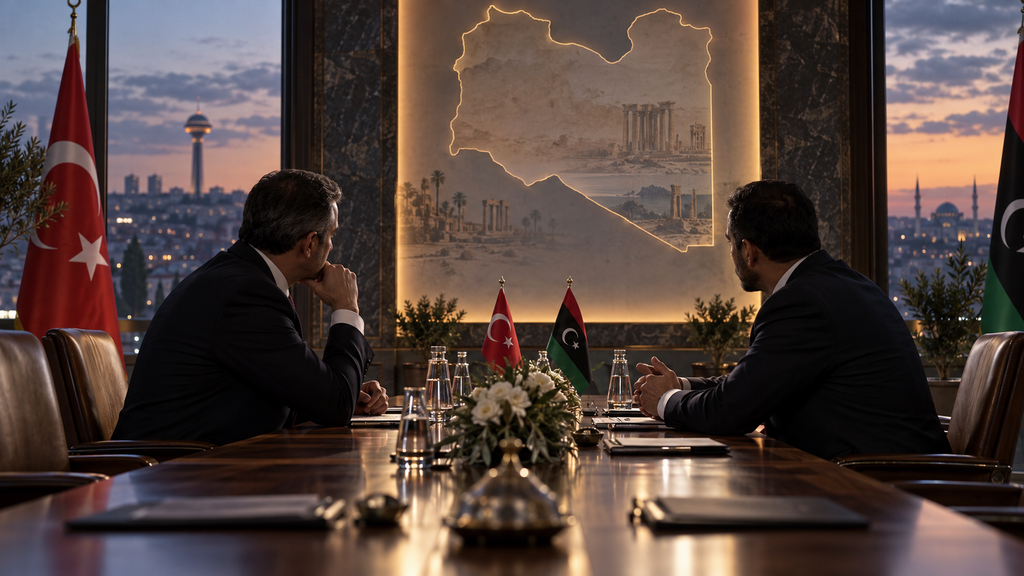
The meeting between Libya’s House of Representatives speaker Aguila Saleh and the head of the High Council of State Mohammed Takala in Ankara was not just a casual political encounter. Reducing its significance to merely Turkey communicating with two Libyan parties would be an incomplete reading of a more complex picture.
The meeting took place at a highly fluid political moment, where the political process in Libya is stalled while multiple international and regional initiatives compete, Libyan forces vie for legitimacy and influence, and several capitals attempt to reposition themselves in anticipation of a phase whose rules are not yet settled.
So the real question is not only what was discussed between Aguila Saleh and Mohammed Takala, but whether Turkey has indeed begun to reshape how it approaches the Libyan file — moving from a policy focused mainly on influence in the west to a broader approach that engages different centers of power in the east, west and south and seeks a decisive role in any future political settlement.
This question becomes more important given the nature of the meeting and its host, especially the presence of Turkey’s intelligence chief Ibrahim Kalin, which gives the gathering a significance that goes beyond conventional diplomacy.
Turkey, which entered the Libyan arena forcefully in 2019 and built over the past years a wide network of political, security, military and economic ties in the west, now realizes that the continuation of the Libyan crisis in its current form poses risks to its interests even as it offers levers of influence.
Ankara cannot base its future Libya strategy on a single actor, no matter how influential that actor may be at a given moment. Libya is politically and institutionally divided, with multiple centers of power, and any serious settlement will ultimately need to engage the east, west and south and take into account local, regional and international forces that have become part of the equation.
Thus, the Saleh–Takala meeting in Ankara can be understood as a multi-directional Turkish signal.
The first message is directed at Libyans: Turkey still has the capacity to bring together figures representing competing political centers at one table, and it does not see itself as confined to western Libya or as a political-military ally of only a specific group of forces.
This point is crucial. Since 2019 Turkey has entrenched its presence deeply in western Libya, but the country’s recent shifts have made it difficult for any external power to treat Libya as a one-dimensional sphere of influence.
The second message is aimed at regional powers, chiefly Egypt and the UAE, and perhaps Russia to varying degrees: Ankara wants to be present in discussions about upcoming political arrangements and not leave the shaping of Libya’s future entirely to others.
The third message is for the international community: Turkish influence in Libya should not be viewed solely as a military presence, but as a political asset that can be transformed into negotiating power and influence over the institutions and arrangements any settlement would produce.
Here the presence of Ibrahim Kalin becomes significant.
The attendance of an intelligence chief at this type of meeting does not necessarily indicate a secret deal or a completed agreement, and one should not turn the mere presence of an intelligence official into definitive proof of undisclosed understandings. But it would also be wrong to dismiss it as a mere protocolary detail with no meaning.
Intelligence services in countries dealing with complex crises do more than direct security work: they play an important role in managing communications with political and security actors, testing ideas that are hard to raise through formal diplomatic channels, gauging the positions of different forces, and preparing conditions for possible future understandings.
Kalin’s presence may therefore indicate that Ankara views the meeting as part of a broader management of the Libyan file, not just as a political encounter between two Libyan figures.
That said, methodological caution remains necessary.
So far there is no sufficient public evidence to say there is a completed Turkish-Libyan deal or that any new agreement has been reached about the shape of the executive authority, elections, or the distribution of sovereign positions. What can be said, based on available information, is that there is an attempt to expand contacts and build new room for Turkish maneuver within the Libyan scene.
This leads to the key question: what does Turkey want from Libya?
The answer cannot be reduced to politics alone.
First, Turkey wants to protect the gains it has accumulated since 2019, foremost among them maritime, security and military agreements that are part of its strategic vision in the Eastern Mediterranean.
Turkey also wants to maintain its position in the Libyan market and to benefit from reconstruction, energy, infrastructure and contracting opportunities—sectors that could become long-term economic interests if Libya enters a phase of political stability.
At the same time, Ankara needs a political and security environment stable enough to safeguard its investments and agreements, and to prevent any future government from regarding Turkish interests as a temporary legacy tied to a particular political phase.
There is also the security dimension: concerns about terrorism, organized crime and irregular migration, and Libya’s geographic importance for Turkey in the Mediterranean and North Africa.
For these reasons, the Turkish interest appears closer to building a broad network of influence than to backing a single Libyan side.
That may be the most important implication of the meeting.
Turkey does not seem to be abandoning its traditional allies in western Libya, but it also appears more conscious that sustainable influence cannot rest on a one-way alliance.
Influence tied to specific figures or governments may evaporate once power changes, whereas influence based on institutions, diverse relationships and various centers of power is more likely to endure.
From this perspective, the meeting can be read as an attempt to move from a single-centered influence strategy to a multi-centered one.
This does not mean Turkey has decided to renounce its western allies or that it has become allied with the east, but rather that it wants to be able to engage both sides simultaneously and to have greater room for maneuver should the balance of power inside Libya shift.
If such a shift is underway, it will matter in the next stage.
The Libyan political process no longer moves only among Libyan parties; it has become a stage where the calculations of Cairo, Ankara, Abu Dhabi, Moscow and Western capitals intersect, alongside the role the United Nations tries to preserve as the international framework most closely tied to the political track.
Any Turkish expansion into eastern Libya will be scrutinized in Cairo, which views eastern Libya as vital to its national security. The UAE and Russia will watch according to their interests, while European capitals and Washington will observe whether Turkish moves help advance a settlement or add another external player to the conflict equation.
Thus the matter is bigger than the Aguila Saleh–Mohammed Takala meeting.
It concerns the broader question of who will participate in engineering the next Libyan phase.
Will the settlement remain hostage to competing international initiatives? Can the United Nations maintain its central role? Or will Libya enter a phase in which regional initiatives become more influential than the UN-led track?
In my view, Turkey is trying to secure a place at the heart of this process without necessarily becoming the sole decision-maker.
That is an important distinction.
Turkey cannot produce a Libyan settlement on its own, nor can any other regional power. The Libyan reality is too complex for a single foreign capital to reshape it according to its own vision.
But Ankara has tools that cannot be ignored. It has deep military and security ties, political presence, economic agreements, and the ability to engage influential forces in the west of the country. It now seems to be trying to extend that capacity to broader political circles.
The real test of this shift will not be a meeting here or a visit there but what follows.
If contacts turn into regular dialogue with figures and institutions from the east, west and south, if practical understandings emerge on electoral laws, the form of executive authority or sovereign institutions, and if that is accompanied by Turkish economic and security activity beyond western Libya, then one could say Ankara has begun a genuine strategic repositioning.
If, however, this remains confined to political meetings and diplomatic messages, talking about a major Turkish shift would be premature.
There is another equally important factor: regional reactions.
Any Turkish expansion into eastern Libya will make relations with Egypt even more consequential. If Ankara and Cairo can manage this competition through understandings that prevent Libya from becoming a proxy battleground, regional rivalry could become a pressure element pushing toward settlement.
If, however, Libya returns to a logic of blocs, any Turkish attempt to expand influence may provoke counter-reactions, opening the door to further internationalization instead of resolving the crisis.
Therefore Libyans should be asking not only: what does Turkey want? but also: what do Libyans themselves want from this competition?
The real danger is not Libya engaging with Turkey, Egypt, the UAE, Russia or others, but that external understandings become a substitute for Libyan decision-making.
Libya needs balanced relations with all influential powers, but first and foremost it needs a clear Libyan political track, institutions capable of decision-making, and announced arrangements against which actors can be held accountable.
Any Turkish understanding with Libyan figures, however significant, should not become a closed deal that reproduces the crisis under new names.
The next phase needs public, institutional agreements rather than personal arrangements, and linking any economic or security support to a clear political process—not to entrenching one side’s influence or excluding another.
In the end, the Aguila Saleh–Mohammed Takala meeting in Ankara may be merely a tactical step within Turkey’s network of contacts with Libyan actors, and it may be the start of a broader change in Turkish policy toward Libya.
Current indicators, however, suggest a more cautious reading: Turkey is not withdrawing from Libya, nor is it abandoning its influence in the west, but it does appear more willing to widen its circles of influence and contacts beyond its traditional areas.
That implies Ankara may be moving from asking “who is our ally in Libya?” to a more realistic, strategic question: “How do we protect our interests regardless of the shape of the next settlement?”
If that is indeed the new direction, Turkey is not only repositioning itself in Libya; it is trying to secure a seat at the table where the contours of Libya’s future will be drawn.
But having a seat does not mean having the final say.
If Libya is to emerge from its crisis, the ultimate decision must remain Libyan. Any settlement lacking genuine internal consensus will remain vulnerable, no matter the regional or international support behind it.
Credit: Source link