

Map Shows Areas Trump Has Sought to Bring Under US Control After Hormuz Remarks
President Donald Trump said Friday that he could soon declare the Strait of Hormuz a “territory of the United States,” escalating his rhetoric about the strategically vital waterway as the war with Iran continues.
Speaking before law enforcement officers in Garden City, New York, Trump suggested the U.S. effectively controls the strait through its naval blockade of Iranian ports.
“After we finish defeating Iran, which is being very badly defeated, pretty soon I’ll be declaring the Hormuz Strait a territory of the United States,” Trump said. “Essentially that’s what we have. The blockade. No ships get through.”
The president also acknowledged he has used the U.S. military “a little bit more than I wanted to” during his second term but defended the conflict and its impact on energy markets, saying, “I did the right thing.”
Newsweek has reached out to the White House via email on Friday for comment.
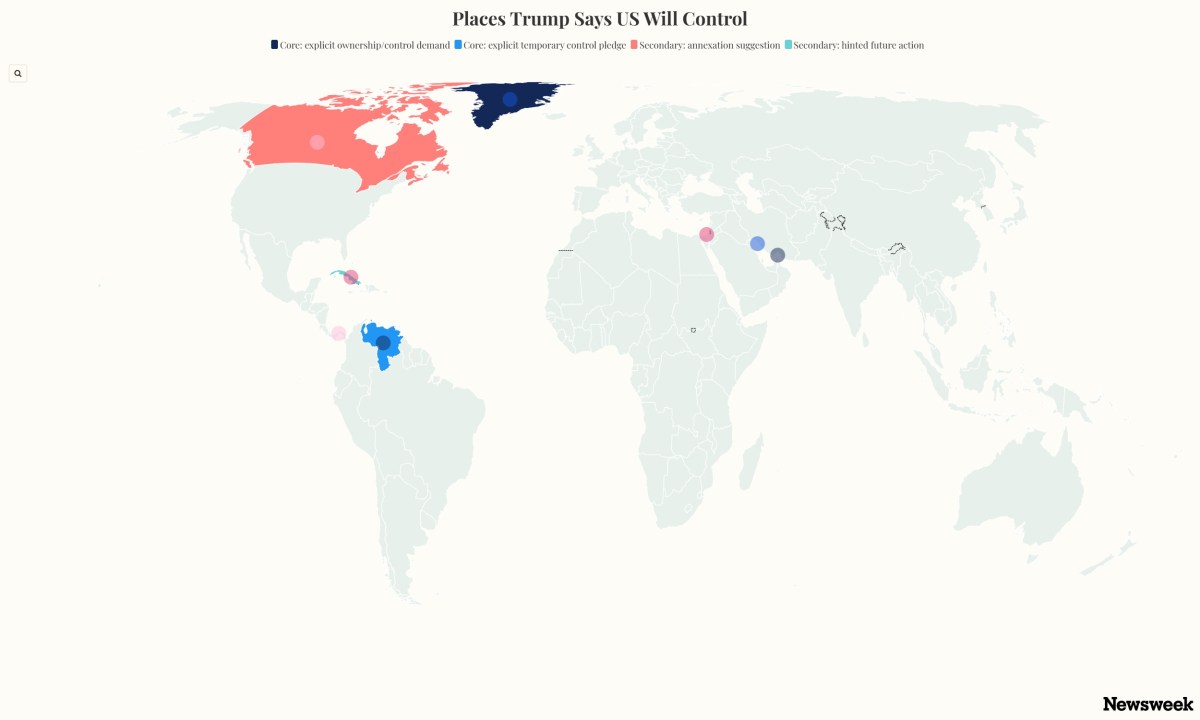
Trump’s comments about the Strait of Hormuz are the latest in a series of statements envisioning expanded U.S. control over strategically important territories and regions. Since returning to office, he has advocated U.S. ownership of Greenland, suggested Canada should become the 51st state, called for reclaiming the Panama Canal, proposed an American takeover of Gaza and floated taking control of Cuba.
Strait of Hormuz/Kharg Island
Two months before his Hormuz Strait remarks, Trump said in June that the United States could take control of Kharg Island.
Kharg Island sits at the center of Iran’s oil export system, just northwest of the Strait of Hormuz in the Persian Gulf, serving as a critical hub for shipments moving through the region’s most important energy corridor. Its deep-water terminals allow large oil tankers to load directly offshore—an advantage that much of Iran’s shallow coastline lacks.
“At some point in the not too distant future, we will be taking Kharg Island, and other oil infrastructure points, and assume total control of their Oil and Gas Markets, much like we have with Venezuela, which is working out brilliantly for both Venezuela and the United States of America,” Trump wrote in June on Truth Social.
Trump has floated variations of the idea for decades. In a 1988 interview, he suggested the United States should “go in and take it”—referring to Kharg Island—in response to Iranian aggression.
Greenland
Earlier this month, Trump renewed controversy regarding the geopolitical status of the Arctic, predicting that Greenland will come under U.S. control before the conclusion of his presidential term in 2029.
During a Friday phone interview, Real America’s Voice host Steve Gruber told the president, “I made a prediction on this program that before you left office, that Greenland would be under our operational control,” Gruber said. “It’s still incredibly important in defending the Western Hemisphere.”
Trump responded: “They want to do something very important. Greenland is important from our standpoint, not from their standpoint. You should make that bet, actually.”
The administration frames the continued push for Greenland, an autonomous territory of Denmark, through the lens of national security, citing escalating strategic competition with Russia and China in the Arctic. As the world’s largest island, Greenland occupies a vital geographic corridor between North America and Europe.
The United States already maintains a strategic military presence on the island via the Pituffik Space Base, which supports critical missile-warning and space-surveillance operations. The territory also holds vast reserves of rare-earth and critical minerals essential to modern technology and defense supply chains.
Leaders of Greenland and Denmark, along with Greenland residents, have largely rejected the administration’s claims, emphasizing the island’s right to self-determination under international law.
Cuba
Trump said in May during remarks in Florida that the United States would take over Cuba “almost immediately,” suggesting an aircraft carrier could be positioned offshore after the conflict in Iran.
The comments came the same day Trump signed an executive order significantly expanding U.S. sanctions on the Cuban government and its affiliates. The U.S. continues to maintain a pressure campaign targeting Cuba’s fuel supplies, though recent exemptions have allowed some petroleum shipments to private businesses on the island.
The U.S. and Cuba have had fraught relations for decades, dating back to Fidel Castro’s Cuban Revolution in the 1950s. Recent blackouts and fuel shortages that plague the island have worsened in recent months as the White House and other senior U.S. officials have openly predicted the downfall of the communist government and tourism, a vital pillar of Cuba’s economy, collapses.
Havana has pushed back on Trump’s rhetoric by reaffirming Cuban sovereignty while pursuing negotiations with Washington aimed at easing tensions and addressing bilateral disputes through dialogue.
Cuban President Miguel Díaz-Canel told Newsweek in April, “Also, I can state with absolute certainty and honesty that a military action against Cuba- aside from being a highly embarrassing situation- would result in immense losses for both nations and peoples. The loss of life and material destruction would be incalculable. Such an act of aggression would be extremely costly in every respect, and it is not what our peoples deserve.”
Canada
Trump has repeatedly pushed Canada to join the U.S. as its 51st state, though he has largely dropped off those threats in recent months.
The United States’ northern neighbor has rebuffed Trump at every juncture, and the country’s prime minister, Mark Carney, won the 2025 federal election after running an anti-Trump campaign that emphasized the importance of Canadian sovereignty and territorial integrity.
During a May 2025 White House meeting, the exchange turned pointed when Trump once again floated the idea of making Canada the 51st U.S. state. Carney firmly responded that his country was “not for sale,” to which Trump replied with a smirk, “Time will tell.”
The imposition of tariffs has also heightened tensions between the two countries, disrupting one of the largest and most enduring trade relationships in the world.
Gaza Strip
In February 2025, Trump proposed that the United States “take over” and assume long-term ownership of the Gaza Strip, clear the territory of wreckage, and redevelop it.
The plan involved the permanent relocation of Gaza’s Palestinian population.
The territory has been devastated in Israel’s war with Hamas since the Islamist militant group attacked Israel on October 7, 2023, killing around 1,200 Israelis and kidnapping more than 200.
The administration’s current approach focuses on a U.S.-backed postwar governance plan involving Palestinian administrators, international security forces and reconstruction efforts rather than formal American ownership of the territory,
Last week, Israeli Prime Minister Benjamin Netanyahu rejected a 15-point plan for Gaza, put forward by Trump’s Board of Peace, saying that Israeli forces will not withdraw from the territory until Hamas is “genuinely” disarmed.
Panama Canal
Trump has repeatedly asserted that the United States should reclaim ownership of the Panama Canal.
The United States turned over the Panama Canal Zone to Panama in 1999 but has remained the canal’s biggest user. About 5 percent of global trade, estimated at some $270 billion, passes through the 51-mile waterway each year. The U.S. Navy uses the canal to deploy ships between the Pacific and Atlantic oceans, most recently against Venezuela.
The Trump administration’s increased focus on security in the Western Hemisphere—sometimes referred to as the “Donroe Doctrine”—made the Panama Canal a natural target because of fears that the Chinese state could wield political and economic influence in Panama.
“And above all, China is operating the Panama Canal, and we didn’t give it to China; we gave it to Panama. And we’re taking it back,” Trump said during his 2025 inaugural address.
Beijing and Panama City have both rejected such concerns.
While the canal itself remains under Panamanian control, the Trump administration has secured a significant win in its effort to limit Chinese influence over canal infrastructure, including a February Panama Supreme Court ruling against a Hong Kong-linked port operator.
Venezuela
In January 2026, U.S. forces conducted a raid in Caracas to capture Venezuelan President Nicolás Maduro on narco-terrorism charges. While former Vice President Delcy Rodríguez was sworn in as interim president, President Trump shared a satirical mock-up image on social media depicting himself as the “Acting President of Venezuela.”
After the Maduro raid, when asked by NBC News who is ultimately in charge of Venezuela, the president said, “Me.”
However, Venezuela differs from several of Trump’s other expansionist proposals. While he has boasted about U.S. control over Venezuelan oil revenues following the 2026 intervention, the debate has now centered on energy resources and economic influence rather than making Venezuela a U.S. territory.
Gulf of Mexico/America
Trump’s push to rename the Gulf of Mexico as the “Gulf of America” reflected another effort to reshape the geography of the Western Hemisphere in line with his political vision. Unlike his other proposals, the Gulf initiative involved a naming change rather than a bid for additional U.S. territory or sovereignty.
Contact Newsweek editors on this story: Gray R. Thomas