

Mali’s Shifting Battlefield Challenges Russia and Draws U.S. Attention
Intelbrief / Mali’s Shifting Battlefield Challenges Russia and Draws U.S. Attention
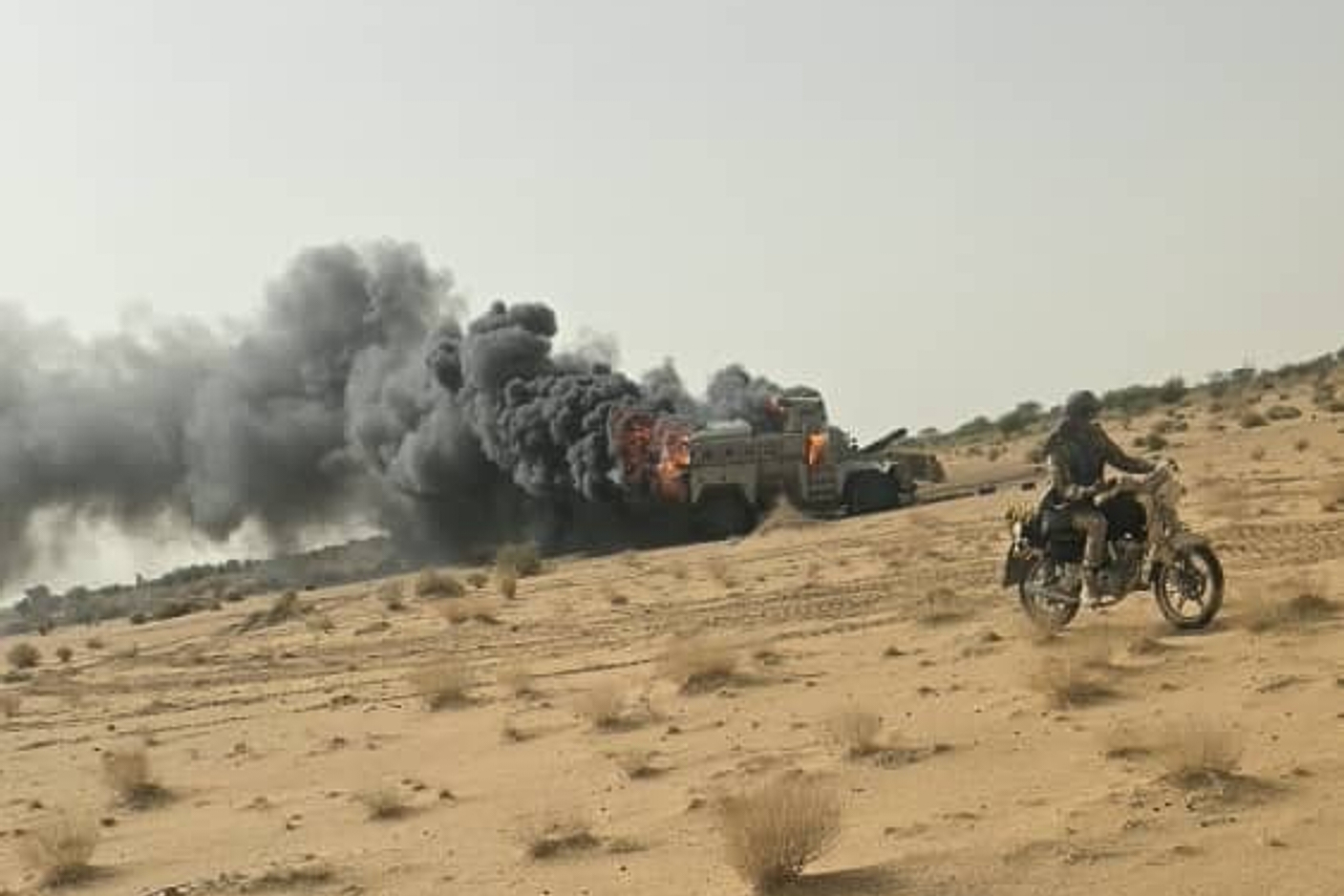
Azaward Liberation Front via AP)
Bottom Line Up Front
- The Trump administration is reportedly weighing military options against Jama’at Nusrat al-Islam wal-Muslimin (JNIM), al-Qaeda’s affiliate in the Sahel, marking what could become a significant expansion of U.S. counterterrorism operations in Africa.
- Bamako has not dismissed the prospect of U.S. involvement, suggesting a growing recognition that existing security arrangements with Russia have failed to contain the insurgency.
- The shifting military balance has been accelerated by the emergence of tactical coordination between armed groups, particularly JNIM and the predominantly Tuareg separatist group, Azawad Liberation Front (FLA).
- Whether Washington decides to authorize military action, limit engagement to intelligence support, or not intervene at all, it will confront a security landscape that has fundamentally changed since the early years of the insurgency.
The Trump administration is reportedly weighing military options against Jama’at Nusrat al-Islam wal-Muslimin (JNIM), al-Qaeda’s affiliate in the Sahel, marking what could become a significant expansion of U.S. counterterrorism operations in Africa. According to the Washington Post, there is debate among senior U.S. government officials over authorizing military action in Mali as JNIM continues to establish itself as one of al-Qaeda’s most capable global affiliates and as its guerrilla campaign continues to intensify throughout the Sahel, with fear of spillover to neighboring states. If U.S. President Donald Trump decides to pursue strikes in Mali, it would be the eighth country Washington has authorized military strikes in, including strikes on Islamic State targets in Nigeria, since the start of Trump’s second term.
The consideration of intervention in Mali also comes at a time when the U.S. is actively engaged against Iran and considering action in Cuba — raising questions about the sustainability of a multi-pronged war effort. These deliberations reflect a broader shift in Washington’s approach to Africa — especially regarding its relationship with Sahelian states since U.S. troops pulled out of Niger in 2024 — as Mali’s security landscape enters a more volatile phase. This phase is characterized not only by the continued expansion of jihadist groups but also by shifting alliances of armed groups and the growing limitations of Russia’s security partnership with Bamako. An unnamed official from the Trump administration told the Washington Post regarding Russia’s impact in Mali: “We hope that other African nations take note of Russia’s terrible performance in combating terrorism.”
The administration’s deliberations coincide with one of the most severe security crises Mali has faced since the jihadist insurgency began over a decade ago. Since seizing power in successive coups in 2020 and 2021, the military junta in Mali has distanced itself from Western partners, including France, and deepened security ties with Russia, first through the private military company the Wagner Group and now through the Russian-controlled Africa Corps. While the partnership was intended to restore state authority and reverse insurgent gains following the withdrawal of French forces, the junta finds itself in an increasingly tenuous position, with underwhelming impact from Russia.
JNIM’s demonstrated ability to conduct complex, coordinated attacks across multiple regions, destroy high-value military assets, disrupt supply routes, and strangle Bamako of fuel, suggests that the balance of power is shifting decisively in favor of the insurgent group. According to Héni Nsaibia, West Africa Senior Analyst at ACLED, Bamako is increasingly operating from a defensive posture, responding to JNIM offensives rather than dictating the tempo of the conflict. Recent attacks by JNIM on Malian and Africa Corps troops in the village of Kouakourou, including downing and destroying a Russian Mi-24 helicopter — in which Africa Corps fighters reportedly left dozens Malian soldiers behind which were subsequently captured and executed by insurgents — displays the junta’s dependence on Russia and the erosion of its ability to project force across the country.
The shifting military balance has been accelerated by the emergence of tactical coordination between armed groups, particularly JNIM and the predominantly Tuareg separatist group, the Azawad Liberation Front (FLA). Although the two groups have fundamentally different long-term objectives — JNIM seeks to establish its own governance based on its interpretation of sharia law while the FLA seeks greater autonomy in northern Mali — they share the immediate objective of weakening the junta regime and expelling Russian-backed forces from the region. The effectiveness of this cooperation became evident during coordinated offensives earlier this year and again in July. Reuters reported that earlier in the month insurgents launched coordinated attacks across five positions throughout Mali, forcing government forces to respond across multiple fronts simultaneously. Although Malian authorities asserted that the attacks were repelled and that a number of terrorists were killed, the operations nevertheless demonstrated the insurgency’s level of operational coordination rarely seen earlier in the conflict.
This cooperation has not eliminated competition amongst insurgent groups in the region. In particular, the New York Times reported that JNIM remains locked in an intense rivalry with the Islamic State Sahel Province (ISSP) for territory, recruits, and influence across the Sahel. While JNIM has generally established itself as the dominant jihadist actor in the region, ISSP continues its campaign to expand influence, especially in eastern Mali and western Niger. This competition could complicate potential U.S. intervention, with some experts concerned that degrading JNIM could inadvertently create opportunities for ISSP to expand.
These developments have simultaneously exposed the limitations of Russia’s security partnership with Mali despite Africa Corps’ efforts to find solutions to confront these groups. For example, ADF Magazine reported that Moscow recently introduced kamikaze-style first-person-view (FPV) drones following multiple defeats at the hands of JNIM and FLA. However, insurgent groups in the region themselves employ FPV drones, with the FLA particularly skilled at their use, even taking down a government helicopter with a drone in 2025. Additionally, these groups have adapted quickly to dodging Russian drones, dispersing their forces and exploiting geographical areas that might make visibility difficult.
Perhaps acknowledging Africa Corps’ shortcomings, Mali has not dismissed the prospect of U.S. involvement. In comments reported by the Washington Post, Malian foreign minister Abdoulaye Diop said that Bamako would not rule out cooperation with the United States provided that the partnership respects Mali’s sovereignty and reflects the country’s national priorities. While the junta continues to emphasize its strategic relationship with Moscow, Diop’s remarks suggest a growing recognition that existing security arrangements have failed to contain the insurgency.
Yet any decision for the U.S. to intervene militarily in Mali would carry significant risks. Some analysts question whether U.S. involvement would even meaningfully improve Mali’s security outlook. Wassim Nasr, Senior Research Fellow at The Soufan Center told the Washington Post that neither France nor Russia has been able to stem the insurgency and questions how Washington’s approach would be different. Analysts are also concerned that direct U.S. strikes could encourage JNIM to add focus toward American interests, which it has traditionally not done.
Ultimately, JNIM’s growing coordination with the FLA, its continuing rivalry with ISSP, and the inability of Malian forces or its Russian partners to regain control have created a far more resilient insurgency ecosystem than existed a few years ago. While the prospect of U.S. military intervention reflects concern over Mali’s deteriorating security environment, the experiences by France and Russia demonstrate the complexity in the role outside actors play in addressing these groups. Whether Washington decides to authorize military action, limit engagement to intelligence support, or not intervene at all, it will confront a security landscape that has fundamentally changed since the early years of the insurgency.
Credit: Source link