
Mali’s political and security crisis: A deep-rooted complexity
The recent political and security crisis in Mali, which has returned to the forefront in recent weeks due to the encirclement and threats against the capital, is not new.
It dates back to the founding of the modern Malian state, which, like many other African countries and much of the Global South, was an artificial construct combining highly contradictory components.
The scene appears complex, and among the political actors, the observer finds groups with divergent orientations: some are nationalist separatists, others are extremists, and still others believe in preserving national unity at any cost.
This complexity has made comprehensive analysis more difficult. Each side interprets the conflict according to its own inclinations. Some analysts offer unconditional support to the government in Bamako, viewing it as the legitimate authority that must be backed against rebels and separatists.
Others take the opposite view, arguing that the rebel groups have the right to act and that their demands are understandable and legitimate.

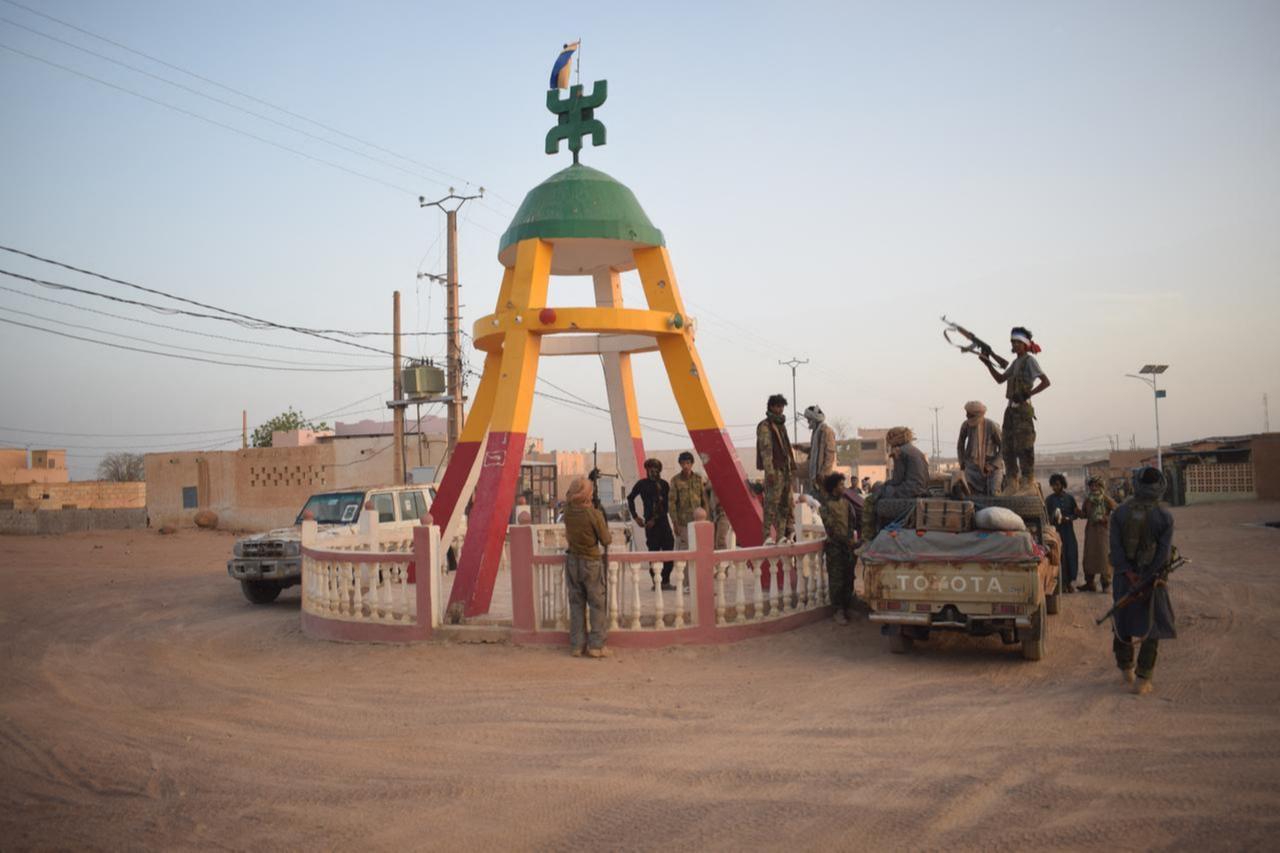
Tuareg rebels of the Azawad Liberation Front (FLA) ride on the back of pickup trucks in Kidal, on April 26, 2026. (AFP Photo)
Legacy of artificial borders and colonial maps
To truly understand the mechanics of this crisis, one need only look closely at a map of Mali. The first observation that comes to mind concerns its borders.
You will notice that its three northern sides were drawn with straight lines, as if produced by a ruler. One does not need much expertise or specialization to conclude that such borders in this region can only be minefields, prone to explosion.
Anyone with even a basic understanding of African demographics quickly realizes that Mali’s borders were drawn without respect for the specificities of tribes and ethnic groups that have moved across the region’s space for centuries, long before the emergence of modern states.
Because the borders drawn by the whims of colonial powers are frequently treated as sacred and untouchable, it is necessary to recognize the significant difference between the concept of the state in Western Europe and its manifestation in the Global South or former colonies.
In European countries, borders were largely formed through the union of principalities and small entities. These small states shared similar languages and cultures.
They practiced politics independently and with sovereignty over small patches of land—sometimes no larger than a city or town—before deciding at a certain moment to form states named Greece, Italy, Germany, and so on.
In Europe, this modern formation did not satisfy everyone equally, but the presence of a dominant unifying culture and a shared language among the majority fostered a broad consensus. This agreement was reinforced by a growing conviction that a large, unified nation-state was inherently stronger and more resilient than pre-modern systems, where every minor feudal domain claimed the status of an independent homeland.
In Africa, the situation was different. The foreigner who drew the borders aimed to distribute territories among the colonizers and cared little about grouping peoples of similar cultures into one nation.
On the contrary, for the colonizer, creating ethnically contradictory homelands could be a successful recipe to keeping these entities preoccupied with internal conflicts and preventing the unification of peoples against foreign rule.
Thus, this dilemma is not unique to Mali; it is a condition shared by most African countries, where conflicts have increased since independence. Their people view their countries’ borders with skepticism—either because they believe the borders should have expanded further and that the modern map wronged them, or because they believe part of the territory should have seceded to become exclusive to groups they consider homogeneous.
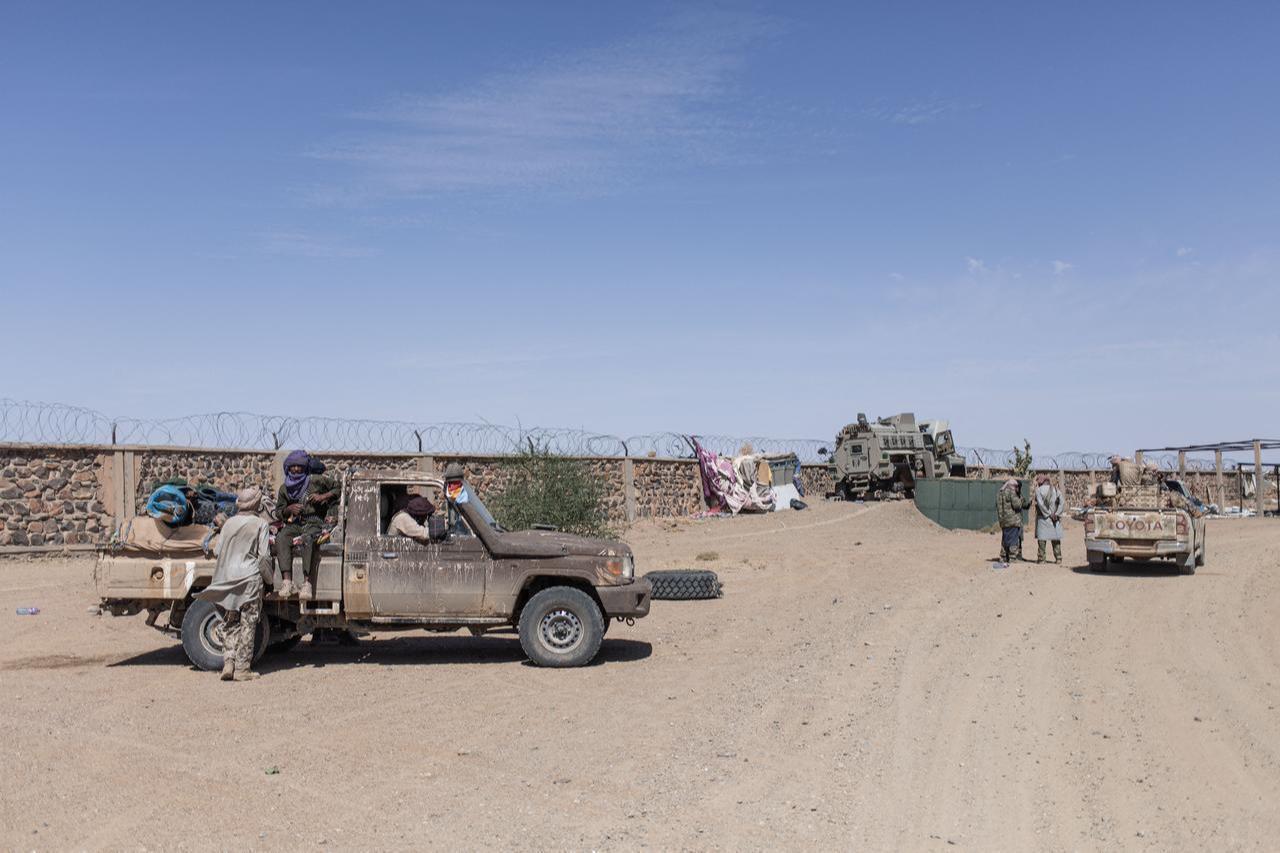
Armed members of the National Movement for the Liberation of Azawad (FLA) are seen on pick-up trucks the Battle d’Amachach camp, following the withdrawal of African Corps four days earlier, in Tessalit, Mali, May 6, 2026. (AFP Photo)
Azawad rebellion and threat of regional fragmentation
In northern Mali, Tuareg rebels take up arms to demand a homeland of their own under the name “Azawad.” These Tuaregs consider that little unites them with the peoples of the south, and that the demand to form their own state is an old one, presented to France before independence. France ignored it and insisted on uniting everyone in the state of Mali.
Anyone following the writings of Azawadi activists discovers that the matter is more complicated and will not end even if Mali is divided into two states. In the imagination of some, there is a dream called the “Greater Azawad State,” which includes what they consider their historical territories.
This claimed land extends across all areas where Tuareg tribes are present: from western Libya and southern and southeastern Algeria, through present-day northern Mali, western Niger, northern Burkina Faso, and even eastern Mauritania.
Official spokespersons deny the existence of this goal, but whispered discussions confirm these aspirations, which await the right moment for realization. They remind us of similar dreams held by other ethnic groups in various regions seeking their own exclusive homelands.
One reason for regional concern about the expansion of Azawadi fighters is the fear among local observers that if the Azawadis gain control of Mali—or even carve out a geographical space within it—it would only be the beginning, from which they might launch demands for new territories.
This would plunge the entire region into a cycle of instability, especially if they obtain sufficient resources and support.
The Azawadis are accused of receiving support from France to sow chaos and sabotage. The truth is that the French may have a role, but their most prominent role was through those borders, drawn in a way that was known to contain the seeds of future strife.
It was clear from the time of independence that this artificial map would not be satisfactory and would lead to war.
More to Read
The name “Azawad Liberation Front” recalls the many rebel movements in Africa that adopted the word “liberation” in their titles. This word has zero substance because it assumes that the entire current reality is wrong and that it is impossible to coexist with the existing state model or to work within it.
This meant working to change all equations—either by reaching power through rebellion and arms, as many rebel groups have attempted and continue to attempt, or by succeeding in achieving secession, as happened in Sudan under the leadership of the Southern Movement, which was paradoxically known as the “Sudan People’s Liberation Movement.”
This backdrop leaves regional states and international organizations in a deeply precarious position. On one hand, they consistently affirm their support for Mali’s territorial integrity, firmly rejecting any moves toward secession or the backing of separatist rebel movements.
This stance is entirely logical, anchored in a foundational regional principle: the deep-seated fear that allowing secession in Mali could ignite a domino effect of separatist crises across neighboring states.
On the other hand, these states and organizations do not want their firm stance to be interpreted as support for the Malian government, especially since most of them deal with Bamako as a rogue military coup regime.
Another striking element in this issue is the entry of the al-Qaeda-affiliated group Jama’at Nusrat al-Islam wal-Muslimin (JNIM) into the fray, coordinating with the Azawadis toward the goal of toppling the capital.
This seems strange. Understandably, this organization would aspire to repeat the scenario in Syria, but coordinating with a nationalist movement of secular orientation appears to be an unusually pragmatic step for extremist organizations.
The specificity of the African context tells us that the bond of ethnicity and tribal project is often far stronger than all ideologies, including political Islam itself, which retreats to make way for national or tribal alignment.

May 21, 2026 03:17 PM GMT+03:00
Credit: Source link