

Malik Agar’s Quiet Diplomacy and the Imperatives of Ethio Sudanese Border Stabilization – HORN REVIEW
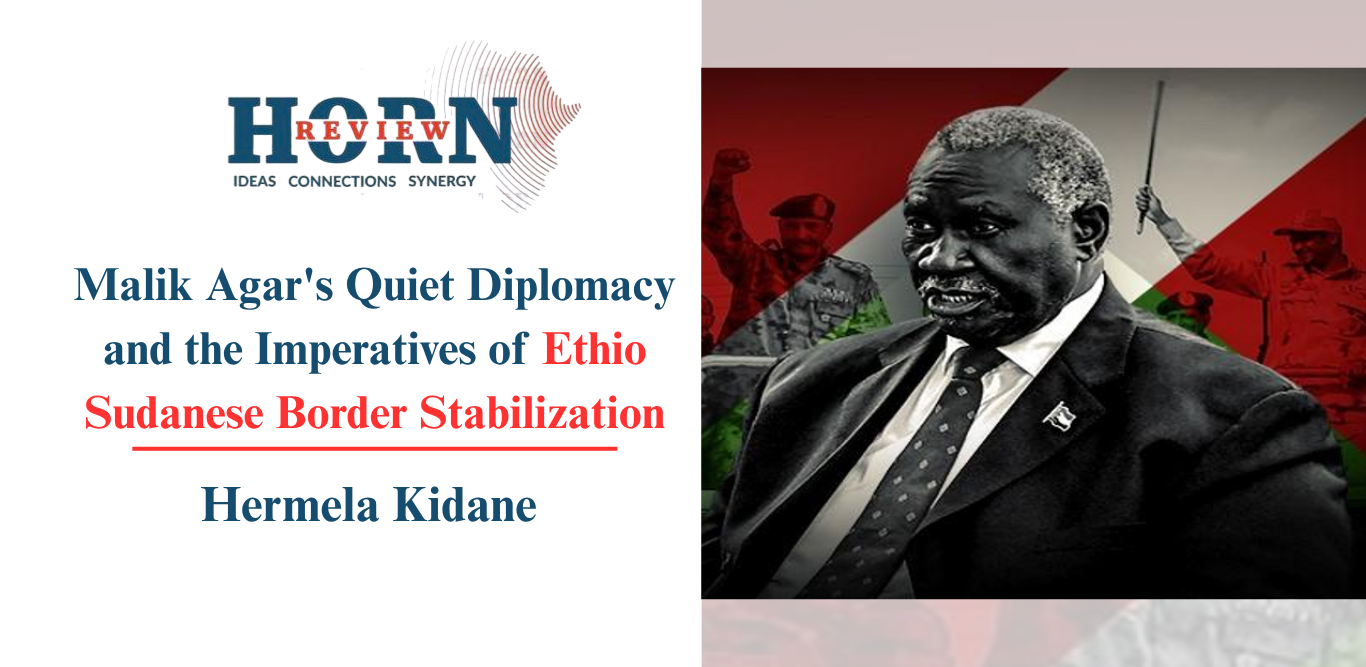
The security of the Horn of Africa is entering a measured recalibration as Sudan’s Sovereign Council under General Abdel Fattah al Burhan pursues discreet diplomatic engagement with Ethiopia through Malik Agar its Deputy Chairman. This initiative seeks to de-escalate accumulated tensions arising from earlier Sudanese accusations that Ethiopian drones had targeted Sudan Armed Forces positions from Bahir Dar. Those claims which failed to secure meaningful traction within the Arab League or among key regional partners such as the United Arab Emirates and which remain unverified in open reporting while being consistently denied by Ethiopia reflected less a settled attribution of responsibility than a deep concern over the vulnerability of Sudan’s eastern flank during the ongoing civil conflict with the Rapid Support Forces. In a war of attrition that has already stretched the Sudan Armed Forces across multiple fronts the prospect of an unsecured border with Ethiopia raised the spectre of logistical pressure or coordinated pressure that could compound existing challenges. Negotiation has emerged as the rational preference over confrontation grounded in geographic realities and the imperative of concentrating finite military resources on the primary internal contest.
The selection of Malik Agar as the principal interlocutor is itself a careful exercise in leveraging regional knowledge and historical connectivity. Agar’s political and military foundations lie in the Blue Nile region which shares a frontier with Ethiopia’s Benishangul Gumuz area. This has fostered extensive cross border social, economic and political linkages over decades. Agar’s earlier interactions with Ethiopian institutions dating to the period of the Ethiopian People’s Revolutionary Democratic Front have equipped him with an informed understanding of the networks, pathways and interlocutors that shape the frontier zone. Although historical associations with external support during earlier insurgencies against the al Bashir government are occasionally noted in Sudanese discourse those same associations now render him a credible channel for dialogue. Moreover Agar’s consistent advocacy of a secular political orientation rather than an Islamist order aligns with preferences for pragmatic cooperation that Ethiopia has long valued in its neighborhood relations. His elevation within the Port Sudan administration thus provides a bridge figure capable of communicating both Sudanese security concerns and the mutual interest in border stability.
A second equally consequential dimension of Agar’s mandate concerns the internal configuration of the Sudan People’s Liberation Movement North. The movement has long been divided between Agar’s faction and that led by Abdel Aziz al-Hilu. Al-Hilu maintains an independent military capacity in South Kordofan and portions of Blue Nile insists upon a secular constitutional order and retains the option of self determination for the Nuba populations should that demand remain unmet. Although he initially declined formal alignment with either the Sudan Armed Forces or the Rapid Support Forces by 2025–2026 he had formally aligned with the RSF led Government of Peace and Unity serving as its vice president thereby transforming his movement from a potential spoiler into a formal component of the opposing coalition.
Agar by contrast opted for negotiated inclusion through the 2020 Juba Peace Agreement and subsequent participation in national institutions. This divergence creates both competitive pressure and diplomatic opportunity. From the perspective of Port Sudan al Hilu’s autonomy now compounded by his formal association with the RSF presents a latent challenge to rear area security. Ethiopia’s established channels of communication and geographic proximity to al Hilu’s forces are widely recognized as potentially significant though the precise extent of current Ethiopian leverage remains difficult to verify through open sources. By engaging Ethiopia through Agar the Sudanese leadership seeks to encourage the use of that influence in favor of dialogue and restraint thereby reducing the risk of additional fronts while simultaneously reinforcing Agar’s standing as the principal representative of Blue Nile interests within the national framework.
Ethiopia’s posture in these exchanges is characterized by measured pragmatism and a clear prioritization of its own western border security. Ethiopia’s fundamental interest lies in preventing the Sudanese conflict from generating uncontrolled spill overs, refugee flows or the establishment of any single hostile authority along its frontier. The quiet nature of the diplomacy reflects an awareness that over commitment would be counterproductive while the maintenance of open channels with multiple Sudanese actors preserves flexibility.
Ethiopia’s capacity to encourage restraint among peripheral armed groups constitutes a stabilizing asset rather than an instrument of unilateral pressure it enables Ethiopia to support de-escalation without assuming formal mediation burdens that could entangle it in Sudan’s internal power struggles. Regional considerations further reinforce this caution. Instability that draws in additional external actors risks complicating Ethiopia’s broader strategic environment including questions of Red Sea access and the management of shared water resources associated with the Grand Ethiopian Renaissance Dam. Consequently engagement with Agar serves the dual purpose of clarifying Sudanese intentions and reducing the probability of miscalculation along a sensitive border.
The Blue Nile Benishangul Gumuz corridor is not a peripheral field but a decisive zone in which trans border ethnic ties, historical supply networks and local power brokers can either amplify or dampen national level conflicts. Sudan’s turn toward dialogue illustrates how acute vulnerability can compel even a sovereign military authority to rely upon former adversaries who possess the requisite regional fluency. For Ethiopia the situation shows the value of consistent low profile engagement that prioritizes predictability and mutual non interference. Successful quiet diplomacy of this kind rarely produces public accords its achievement lies instead in the prevention of worst case escalations and the gradual construction of working understandings that allow both sides to manage shared frontiers without diverting resources from more pressing internal priorities. In this system such restraint remains an essential contribution to collective security.
By Hermela Kidane, Researcher, Horn Review
Credit: Source link