

Libya: Between the Abundance of Initiatives and the Poverty of Solutions
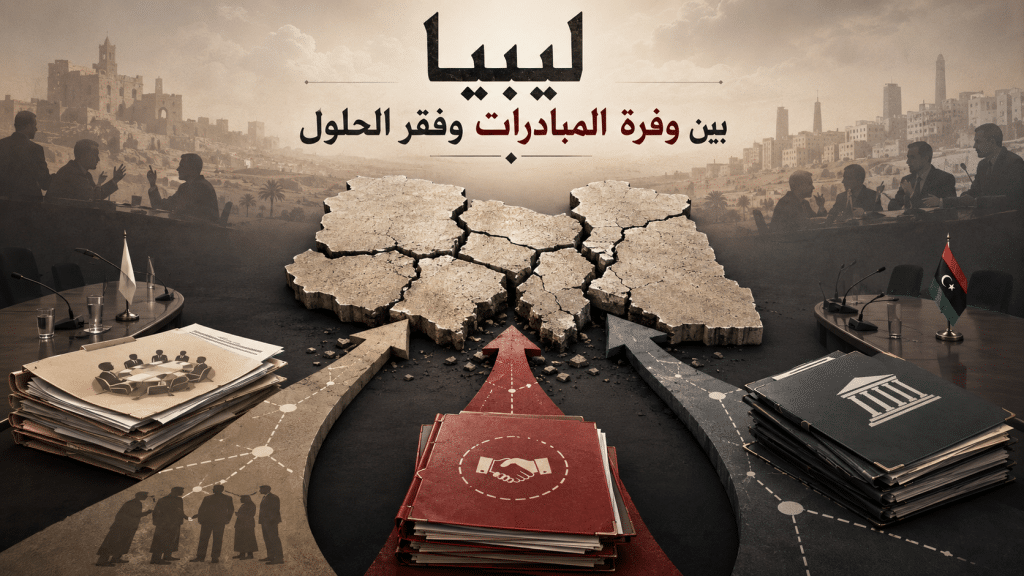
In politics, the depth of crises is not measured by the number of proposed initiatives for resolution, but rather by the number of initiatives that fail to reach a conclusion. From this perspective, the situation in Libya exemplifies the paradoxes of contemporary conflicts; as political initiatives increase, the sense that a solution is becoming more elusive grows stronger.
In recent years, Libya has turned into an open laboratory for political initiatives. Successive UN envoys have managed the situation, international conferences have been convened in various capitals, agreements have been signed only to falter, and dialogues have been launched under multiple titles. Today, the country finds itself facing three competing initiatives vying to lead the next phase, while the landscape becomes increasingly complex and the ambiguity surrounding the future of the political process deepens.
At first glance, the proliferation of initiatives may seem like a positive sign, reflecting both local and international interest in extricating Libya from its prolonged crisis. However, a deeper analysis reveals that the issue lies not in the absence of proposed solutions, but in the nature of the political environment that produces these solutions. Competing initiatives do not necessarily reflect political vitality, but rather the absence of a unified national center capable of imposing a cohesive vision for the future of the state.
The Libyan crisis is no longer merely a matter of government, elections, or even institutional legitimacy. It has evolved into a crisis concerning the very nature of the state and the question that has been postponed since 2011: how can a national authority be built in a country where local, regional, and international interests intersect on an unprecedented level?
It is precisely here that the current competition among the three initiatives can be understood.
The UN initiative represents a continuation of the idea of managing the crisis through international legitimacy. It is based on the assumption that reengineering the political process through a new dialogue, a new government, or new legal amendments could pave the way to elections and, subsequently, stability.
However, the problem is that the Libyan experience has shown that the dilemma is not fundamentally procedural. The crisis does not stem from a lack of dialogues, an absence of laws, or a lack of transitional institutions. In fact, Libya likely possesses enough political agreements, temporary constitutional texts, and transitional roadmaps for more than one state.
What is lacking is genuine consensus regarding the nature of the upcoming authority and the distribution of power, wealth, and influence after the transitional phase concludes.
As for the initiatives or proposals that revolve around American or regional movements, they reflect a different trend that relies more on political realism than on procedural legitimacy. The essence of this approach lies not in redesigning the political process but in rearranging the balance of power on the ground.
Regardless of the accuracy of the circulated details regarding these proposals, their mere existence reflects a growing conviction among some international parties that the Libyan crisis can no longer be managed solely through formal institutions, but rather through networks of influence and centers of real power that have formed during years of division.
Conversely, the initiative from the three presidencies aims to regain control of the situation from within Libya itself. It is based on the notion that existing institutions, despite all the surrounding controversies, still possess the capability to produce a new political path that ends the successive transitional phases.
However, this approach faces a fundamental dilemma. The institutions seeking to lead the change are themselves a product of the transitional phase that they intend to conclude. Herein lies the contradiction between the need to benefit from existing institutions and the need to overcome the constraints that these institutions have imposed on the political process over the past years.
Yet, what unites these three initiatives, despite their differing origins, is greater than what divides them.
All of them operate under an implicit assumption that the Libyan crisis can be resolved through a settlement among the existing political elites. They all focus on rearranging the relationship between current actors rather than rebuilding the relationship between the state and society.
This is the essence of the Libyan impasse.
The political process has gradually transformed from a national project aimed at state-building to an ongoing process of managing power balances. The goal has often become preventing an explosion rather than fostering stability, maintaining a minimum consensus rather than producing a comprehensive historical settlement.
Therefore, the question facing Libya today is not which initiative is more viable, but whether the approaches underpinning these initiatives can genuinely produce a lasting solution.
Modern conflict history tells us that prolonged crises do not end merely through elite agreements, but rather when a new political equation emerges that makes the continuation of conflict costlier than its resolution.
So far, Libya has not reached this stage.
The various parties remain capable of coexisting with a state of neither peace nor war. Regional and international powers still find more room for maneuver in managing the crisis than in pursuing a definitive resolution. Transitional institutions possess incentives that make maintaining the status quo less risky for them than venturing into an uncertain political future.
This helps explain the failure of most previous initiatives, and perhaps the current ones as well.
Elections, despite their importance, are not a magic solution. A unified government is not an end in itself. Unifying institutions does not represent the end of the road. All of these are tools within a broader political process, not substitutes for it.
If current approaches continue to frame the Libyan crisis as merely a conflict between competing authorities that can be reconciled through temporary settlements, the likely outcome will be the emergence of a new version of the transitional phase under a different name.
Libya has reached a historic moment where it no longer needs new initiatives as much as it needs a review of the assumptions underlying previous initiatives. After more than a decade of repeated experiments, the question is no longer how to transition to the next phase, but rather why have all prior stages failed to achieve statehood?
The real danger does not lie in the failure of a specific initiative, but in entrenching the belief that the crisis can be contained indefinitely without incurring severe national costs. States typically do not collapse due to a lack of ideas, but rather due to a persistent inability to convert ideas into stable institutions and politically acceptable norms for all.
Thus, Libya today finds itself in a harsh paradox: the number of initiatives proposed to end its crisis has never been greater, yet the path to a final solution has never been more unclear.
In short, it is a country suffering from an abundance of initiatives and a scarcity of solutions.
Credit: Source link