

Kikuyu Land and the fight to reclaim Kenya’s stolen land
The award-winning investigative documentary Kikuyu Land has hit screens across the UK and USA. New African Features Editor Jamila Versi sat down with co-director Bea Wangondu, protagonist Mr Mungai and producer Joseph Njenga to hear a little more.
“The soil is fertile, but the land is cursed,” the logline of the beautifully shot Kikuyu Land reads.
In the 96 minutes-long film, Mr Mungai’s claim to his family’s stolen land sets him face to face with the multinational giant that has taken it over – and the dark side of Kenya’s tea plantations.
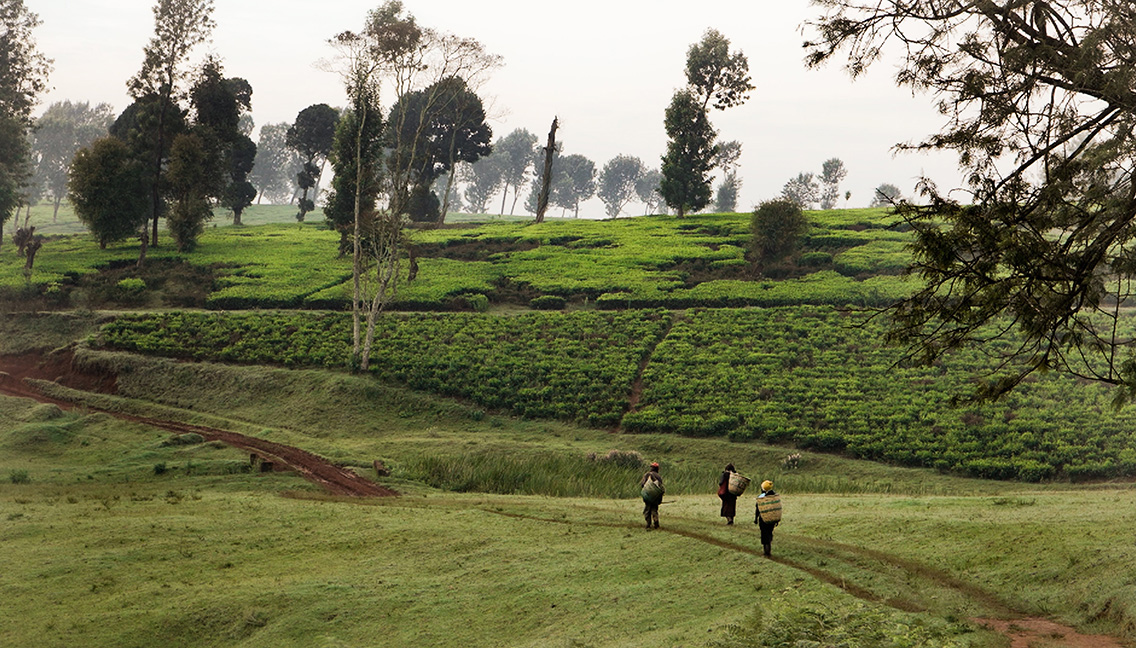
“I was told that God created everything that he did – and when he needed to rest, he came to Kikuyu Land. It was our garden of Eden,” co-director Bea Wangondu’s voice rings out across scenes of the landscape surrounding Mount Kenya.
The fight for land is one of the most important political and economic struggles in Kenya and has been a source of contention for generations. This documentary, co-directed by Bea and Andrew H. Brown, moves slowly across the tea highlands as it explores the dark legacies of traditional land lost during colonialism.
The documentary follows Mr Mungai, an engineer whose family land has been turned into tea plantations, as his fight widens into a reckoning with plantation labour, neocolonialism, inherited privilege, and the dangers of asking who benefits from Kenya’s colonial past.
A landscape of belonging
“What does land mean to you?” I ask.
Bea Wangondu joins the call from LA, where the film is touring, and describes the oral traditions through which she learned that God lived on top of Mount Kenya. There is a tree, she tells me, her eyes lighting up, that is still revered today – the mugumo tree – and it stretches out like a canopy, almost like a church, beneath which people would gather to worship the God who lived on the mountain.
Trees offered medicine, rivers sustained food, and everything had a place within that relationship with the land. Much of what Bea knew came from her grandmother, through stories and everyday conversations in which she learned how these things connected. But she tells me, “I didn’t personally have a relationship with the land. I only knew what I knew. I knew what they told me.”
For Mr Mungai, the story is not too dissimilar. Joining me from Kenya along with his son and the film’s producer, Joseph Njenga, he lives close to his ancestral land – but does not own it.
“We grew up landless,” he says. “We did not have a building we could call our own.” The family moved between rented homes, while his mother and grandfather rented small plots to grow maize and beans.
He faintly remembers his grandmother pointing out places where they used to grow food, but it was only much later that he understood she was describing land that had belonged to her husband. Mungai has finally been able to buy a small piece of land, although it has taken considerable struggle and hard work, while a few kilometres away lies the ancestral land he estimates would be worth between 125 billion and 150 billion Kenyan shillings today.
And for Njenga, growing up around the plantations prompted different questions. Why did some households need heavy security? Why were certain properties marked against trespassing? Who had the authority to establish ownership?
Petitioning for land back
The history behind his claim stretches back well over a century. In 1902, colonial legislation designated vast areas of what’s today Kenya as Crown land, enabling their sale or lease to white settlers while disregarding African communal ownership. The displacement that followed, and the concentration of land in settler hands, still shape the struggles the film follows.
In one section, Mungai shows Bea the paperwork behind his 3000-acre claim to his grandfather’s land: the petition, the affidavits, and the documents they were instructed to deliver to those occupying it. A friend had told him the government had opened an opportunity for people whose land had been taken to seek redress through the National Land Commission, and he submitted his petition in 2019.
What followed was a lot of correspondence, meetings with commissioners and promises of a decision that kept moving further away. They hadn’t expected it to take so long, he tells me, describing the frustration of being told an outcome would come in March, then May, while the family kept waiting.
In the film, we watch him pursuing the claim and gathering with others outside, where he stands with a microphone before the crowd. First, their lands; secondly, their lands; thirdly, their lands – the demand comes back to him in chorus.
He has collected folders of document after document, including colonial letters describing the removal of native families: “I am giving the families concerned seven days before forcible removal, but I have reason to believe that in no case will the natives move voluntarily,” he reads out loud from a letter dated March 1940.
After years of petition, the claim is denied.
Wangondu explains that it is the Commission’s prerogative “whether or not your evidence is enough… and they came back and said it’s not”. What would be enough, one is forced to wonder.
Mungai intends to improve his petition and present it again, telling me that his spirit is “not yet down and out”. When I ask what justice would look like, his answer is clear: “For us, justice would be only one thing. Give us back our ancestral land.”

‘We’ve carried the empire’
As the filmmakers move onto the plantations, the story becomes troubling on several levels. Stephen, a child working in the fields, explains that no one at school knows about his plantation work. Feeding his younger siblings, he says: “When you are small, the world lets you dream. But there comes a time when dreaming feels like lying. Lying to yourself and your family that no longer needs you to be a boy.”
At another point, women labouring on the plantation chat as a child comes to work. His mother has left, one explains, so he has to fulfil the quota. These exchanges sit alongside harrowing allegations from current and former workers on plantations associated with British multinational Unilever, as women describe sexual exploitation and rape by field managers and their children being forced to witness what they go through.
“The land is cursed,” says one worker, while another describes the lasting pain of the loads she carried: “Unilever was built on the bodies of Kikuyu women – we’ve carried the empire on our backs.”
The film states that Unilever declined all requests for comment or an interview. During production, it completed the sale of its global tea business, including its Kenyan operations, to CVC Capital Partners. The deal was agreed in 2021 at €4.5 billion, approximately $5.1 billion at the time, and completed in July 2022, according to Reuters.
“I don’t believe a better life is possible,” says one labourer – a devastating statement after the accounts of hardship we have heard.
Safety and security
How did you ensure the safety of the labourers while filming? I ask Wangondu.
The team knew from the beginning how sensitive the story could become, she explains, and kept the crew small throughout. Njenga, having grown up around the plantations, knew the back roads and what could work for them, making it easier to get in, film and leave.
Some workers’ identities were concealed so they could speak while retaining their jobs, and Wangondu describes helping a featured family move away from plantation housing so they were no longer dependent on the management whose practices the film examines.
Mungai and Njenga have their own concerns. Mungai recalls frightening encounters when delivering petition documents to people occupying the disputed land, and says he subsequently felt he was being followed. Njenga tells me he has received suspicious phone calls in recent months, a reminder that the risks continue long after the camera stops recording.
When the camera turns around
There are two aspects of the film where the camera turns back towards Bea herself. The first comes as she begins to understand her own family’s role in this history, following questions she had asked since childhood about why her grandfather had so much more land than those around him.
“My granddad worked for the coloniser,” she realises in the film after diving into the archives, and describes acting as a middleman, getting local people to take out loans for land without explaining how repayment worked, then buying that land at a fraction of its value when they defaulted.
Finding her grandfather’s name in British records in London and reading the details of what had been written about him was devastating. “It was such an identity shift,” she tells me, recalling how questions about the family’s land had previously brought warnings that she should stop asking because they could cause trouble.
In the film, conversations with her uncles reveal resistance, alongside a desire to keep the discussion within the family. We discuss the tension of respecting her family while still ensuring the film’s – and her own – transparency. “You’re talking about family, family and I’m African,” Bea says. “Respect your elders. One. Number two, there are things you don’t talk about.” She hopes the film can open a conversation, although when we speak, it has not yet screened in Kenya, and she does not know how the family will respond.
The second is the constant reminder of the risks facing journalists. Under the camera’s gaze, Wangondu arrives at plantation gates asking who owns the land and is warned that she is asking for trouble. Alongside footage concerning abducted Kenyan journalists and activists, the film makes it clear that she is moving in dangerous territory.
One interview with an anonymous character is explicit about the risks she is facing. It left her questioning whether to continue. “As soon as that interview was done, that specific one, I was done,” she recalls. “I was not sure.” Public visibility offers some protection, she believes, but the fear remains: “You need to make a decision of what resistance looks like to you.”

A better tomorrow, today
Kikuyu Land premiered in competition at Sundance in January 2026 and won Best Documentary Feature at Mountainfilm, before reaching cinema audiences in the UK and USA.
For Njenga, that attention is an opportunity to sustain the work beyond the screenings through Better Tomorrow Today, the organisation he founded to support plantation communities through education, healthcare and social justice. Based on the idea that “the point of tomorrow being better is now, not tomorrow”, the film gives his father’s campaign a platform, and he hopes international partnerships can help other families continue their struggles too.
For a film so full of the beauty of this place, it is the question of who gets to call it home that stays with you. As the interviews conclude, I ask them what they hope this film will leave audiences with, and what they hope the film achieved. The answers keep circling back to ideas of justice. “As Kenyans, we spend so much time being told who we are, what to learn, what to own. This film is our opportunity to reclaim that.” Wangondu says. “And to look at colonialism and what it did to Kenyans from a Kenyan perspective.”
Injustice is everywhere, says Njenga. “The system has been engineered to sabotage the people claiming justice and to protect those in power. Despite us being granted independence, the colonisers still have an upper hand on the affairs.” But Njenga and Mungai both agree that theirs is “a cry for justice, and we always have the power to fight. And we fight through hope, through love, through empowerment… so that we can be a free people.”
Editorial Credit:
KIKUYU LAND is in UK cinemas 2nd October www.kikuyulandfilm.com
Watch the teaser trailer here.
Crédito: Link de origem