

Kajo-Keji IDPs urge South Sudan, Uganda to fast-track border demarcation
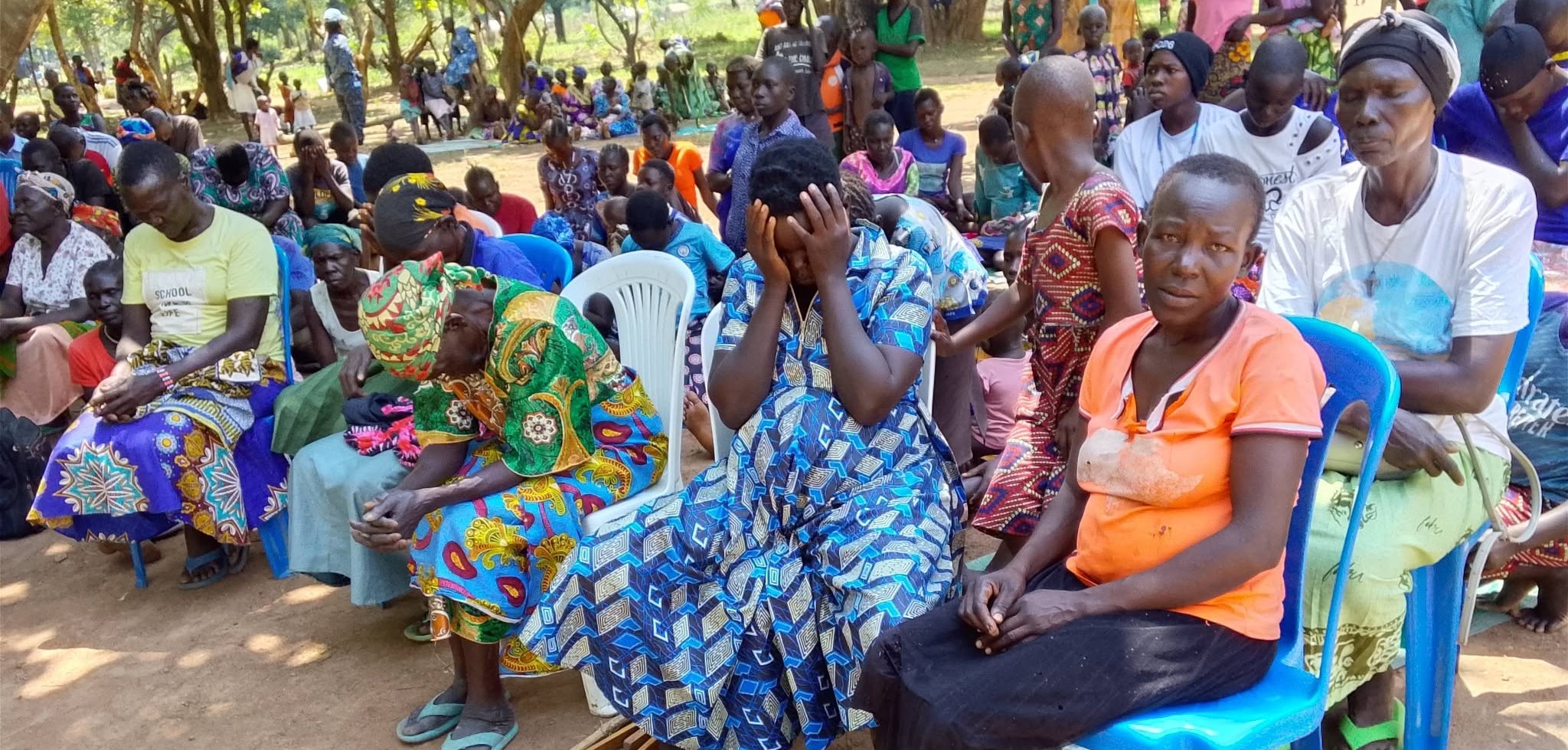

KAJO-KEJI — The internally displaced persons from Kajo-Keji County of Central Equatoria State on Monday called on the governments of South Sudan and Uganda to accelerate the demarcation of their shared border to address long disputes.
The IDPs sheltering in Liwolo Payam made the call during a high-level field visit by a United Nations Mission in South Sudan (UNMISS) delegation to displaced communities along the border corridor on Monday.
The visiting UNMISS team were welcomed by Rt. Rev. Joseph Aba, Bishop of the Episcopal Diocese of Liwolo to the displacement sites.
The visit followed an appeal for urgent humanitarian assistance for some 30,000 displaced civilians in the area.
During the visit, community leaders and IDP representatives expressed growing frustration over recurring border disputes and military tensions, which they said have repeatedly displaced families, disrupted livelihoods, and triggered serious humanitarian crises in Kajo-Keji County.
The IDPs said delays in resolving border-related issues continue to create uncertainty for communities living along the frontier and could undermine efforts to restore peace and stability in the area.
“We are living in constant fear and uncertainty,” said an IDP representative who an IDP representative, who requested anonymity for security reasons.
The IPD called on both governments to strengthen bilateral cooperation and expedite the identification and marking of the official border.
He said clearing the boundary would help prevent misunderstandings and land-related disputes between communities.
“Without clear physical border markers, our communities are trapped in continuous cycles of violence and displacement,” he said.
“We need the African Union, our government in Juba, and the government in Kampala to intervene, finalize the border delineation, and ensure our safety.”
For his part, Rt. Rev. Joseph Aba, Bishop of the Episcopal Diocese of Liwolo, reiterated the church’s call for immediate peacebuilding interventions alongside urgent humanitarian assistance.
Bishop Aba said overcrowded IDP sites in Sokare, Kerwa, and surrounding areas are facing severe shortages of basic shelter, clean water, medical supplies, and food.
“We need to address the root cause, the long-standing boundary ambiguities, as the only path toward permanent stability,” he said.
The UNMISS team acknowledged the communities’ plight and reaffirmed its mandate to protect civilians, support local peace initiatives, and advocate for peacebuilding mechanisms between the two neighboring countries.
Tensions between the South Sudan People’s Defence Forces (SSPDF) and the Uganda People’s Defence Forces (UPDF) along the Kajo-Keji border have been linked to disputes over territorial boundaries, security operations, and movement of forces in the border area.
Kajo-Keji County in Central Equatoria State shares a border with Uganda’s Moyo District and other areas in the West Nile region.
In early 2025, clashes were reported between SSPDF and UPDF troops in Kajo-Keji County after confrontations over a disputed area along the border.
The fighting led to civilian displacement, with thousands of residents fleeing their homes for safer locations, including Uganda.
Both sides exchanged accusations, with each blaming the other for triggering the confrontation.