

It’s not just Hormuz. Red Sea shipping lanes are now under threat, too.
As the battle for control of the Strait of Hormuz in the Persian Gulf grinds on, a new fight in the Red Sea is only just beginning.
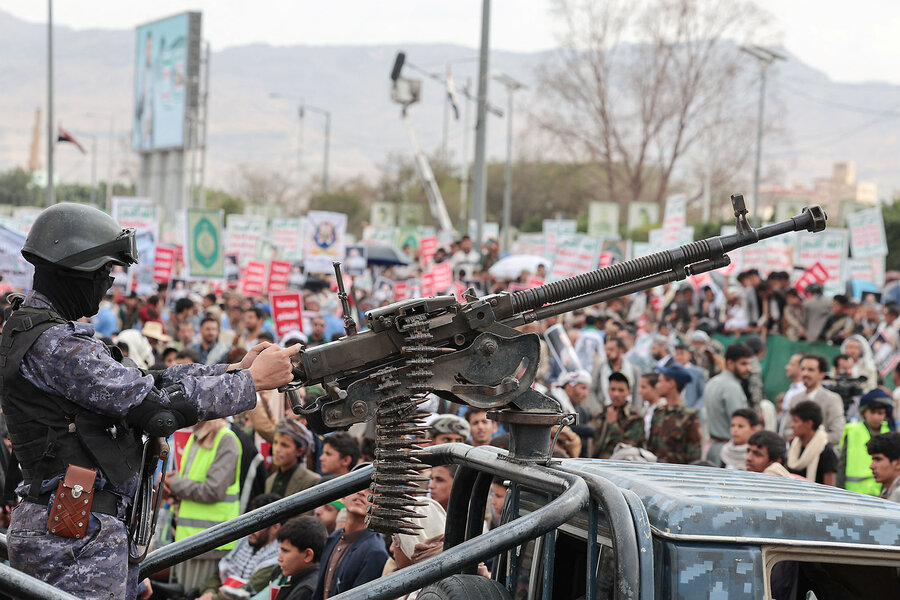
On Monday, Iranian-backed Houthis in Yemen announced a naval blockade against Saudi Arabia, warning they would target ships attempting to transit the Bab el-Mandeb Strait. Located at the southern entrance to the Red Sea, the passage had not played a major part in the Iran conflict.
In the early hours of Thursday, however, the Houthis followed through on the threat by striking two Saudi oil tankers. Saudi Arabia confirmed that one ship was hit, and the global price of oil quickly jumped over $100 a barrel for the first time since May.
Why We Wrote This
The stalemate between the U.S. and Iran over control of the Strait of Hormuz has created a global economic shock. Now, the conflict is threatening to disrupt international shipping through the Red Sea.
The Bab el-Mandeb is a narrow waterway – just 19 miles wide – between Yemen to the east, on the Arabian Peninsula, and the Horn of Africa to the west.
Since Iran closed the Strait of Hormuz in early March, the Red Sea passage has become vital for Saudi petroleum exports. For the past four months, the kingdom has exported its oil via pipeline to the western port of Yanbu. From there, more than half – 3.5 million barrels per day – is sent by ship by way of the Red Sea and out through the Bab el-Mandeb Strait.
A full blockade by the Houthis of Bab el-Mandeb could further hamper global oil supplies, already reduced by 10% with the Strait of Hormuz closure, according to the International Monetary Fund.
For more than a decade, Saudi Arabia has been locked in military conflict with the Houthis in Yemen. The Iran-aligned group seized Yemen’s capital of Sanaa in 2014 and still controls about one-third of the country.
The Saudi kingdom backs a rival, internationally recognized Yemeni government and enforces a blockade of Yemen’s ports. The Houthis accuse Riyadh of carrying out “an unjust and oppressive siege” and “plundering our resources.”
Just last week, tensions escalated again after the Saudi military struck the airport in Sanaa.
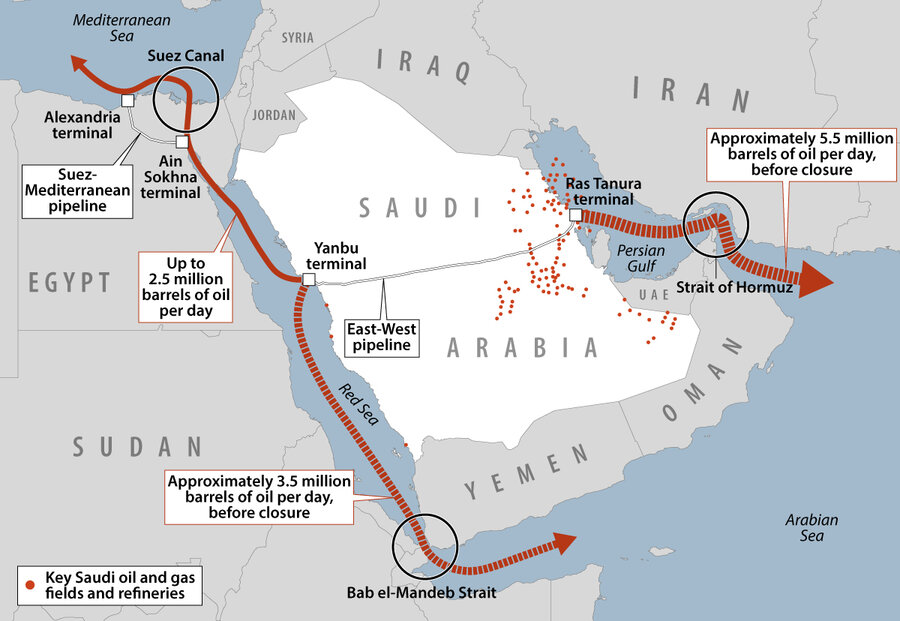
Gulf States Newsletter, U.S. Energy Information Administration
|
Jacob Turcotte/Staff
The Houthi defense minister said the group’s armed forces were waiting “to implement any directives issued by the Iranian supreme leader.” Observers say the timing of the closure of Bab el-Mandeb is hardly coincidental.
“Whether Tehran directly ordered this particular timing, or whether the Houthis moved opportunistically, the effect is the same,” says Hesham Alghannam, a Saudi political analyst and Carnegie Middle East scholar based in Riyadh.
“Iran now holds leverage over both choke points simultaneously, a structurally unprecedented position,” he says.
In a social media post on Thursday, President Donald Trump said the United States “will hold Iran responsible” for the Houthis’ actions, and that “the Houthis are a Surrogate and/or Proxy of Iran.”
Mr. Trump vowed that “major military punishment will be inflicted upon Iran” should the blockade continue.
This comes as Iran has targeted the port of Aqaba in Jordan, another key Red Sea transit point, with ballistic missiles four times in the last week.
An Arab government official, who spoke with the Monitor on the condition of anonymity because he is not authorized to comment publicly, says the escalation of this conflict to include the Red Sea amounts to a “nightmare scenario” for the Gulf, the wider Middle East region, and possibly the global energy industry as well.
An alternative shipping route around the Cape of Good Hope on the southern tip of Africa would add about 2,700 miles to Gulf oil shipments, further driving up costs.
There are risks for Iran here, too.
“If traffic through the Bab el-Mandeb ends up significantly reduced, it increases the economic cost for everyone else, which the Iranians view as part of their own leverage against the U.S.,” says Ali Vaez, an Iran expert with the International Crisis Group.
“They might hope to strengthen their hand in negotiations,” but he says the Houthis’ actions could also prompt “the U.S. to double down on its own military operations, while the naval blockade further strains Iran’s already battered economy.”

Saudi Arabia had maintained daily communication with Iranian diplomats throughout the war. The Saudi government also helped negotiate the most recent ceasefire with Iran.
By allowing the Houthis to halt Saudi oil shipments, Iran “has put its own back-channel to Riyadh, the one Iran needs for any negotiated off-ramp [to this war], under serious strain,” says Dr. Alghannam, the Saudi analyst.
Limited Options
A blockade in the Red Sea has the potential to push the Trump administration – currently weighing how to break the stalemate with Iran – toward further military escalation, though it is unclear how much sway Tehran has over the Houthis in Yemen.
The U.S. might also choose to restart military operations against the Houthis in Yemen. But a previous American bombing campaign in 2025 – in response to its targeting of maritime shipping – appeared to do little to degrade the group’s military capabilities.
One potential path out of the current crisis, according to Dr. Alghannam, would be direct negotiations between Saudi Arabia and the Houthis, mediated by Gulf neighbor Oman.
If Saudi Arabia agreed to ease its blockade on Yemeni ports and open a flow of aid into the country, the Houthis could be encouraged to suspend their embargo, he says.
Another potential route to de-escalating the situation in the Red Sea might run from Riyadh to Beijing.
China brokered a normalization agreement between Iran and Saudi Arabia in 2023, helping to tone down the enmity between the two regional rivals. Economic ties with Beijing run deep, too, because China is the biggest buyer of both Saudi and Iranian oil.
“China – Iran’s primary economic lifeline – has a direct interest in resolving a dual choke-point crisis that threatens its own energy supply and its Gulf trade relationships simultaneously,” Dr. Alghannam says.
On Thursday, Mr. Trump issued his latest threat to Iran. “I am considering a massive attack. Bigger than ever before. I am close to making a decision. We are all set for it,” the president said in an interview with Axios.
Comments are closed.