
Israel-Papua New Guinea Relations

Israel and Papua New Guinea established diplomatic relations in 1978, three years after Papua New Guinea gained independence from Australia. For decades, the relationship remained friendly but relatively limited, with Israel handling relations with Papua New Guinea through its embassy in Canberra, Australia. Papua New Guinea maintained a diplomatic presence in Israel through honorary representation before later opening a full embassy in Jerusalem. The relationship has been shaped by diplomatic support, development cooperation, agricultural training, water technology, energy, health, education, and the strong Christian affinity for Israel among many Papua New Guineans.
A major element of the relationship has been Papua New Guinea’s consistent support for Israel in international forums. Israeli officials have often described PNG as a close friend in the Pacific, and the government of Papua New Guinea has emphasized that its ties with Israel are rooted in shared values, religious affinity, and respect for Israel’s historical connection to Jerusalem. This support became especially visible after the Hamas attack on Israel on October 7, 2023, when PNG continued to side with Israel in key international debates and votes, including at the United Nations.
The most significant milestone in bilateral relations came on September 5, 2023, when Prime Minister James Marape and Israeli Prime Minister Benjamin Netanyahu jointly inaugurated Papua New Guinea’s embassy in Jerusalem. Papua New Guinea became the first Pacific Island country, and the fifth country overall at the time, to open an embassy in Israel’s capital, joining the United States, Guatemala, Honduras, and Kosovo. The Israeli Foreign Ministry said the decision would strengthen and deepen relations between the two countries, while Netanyahu praised PNG as a “true friend” of Israel.
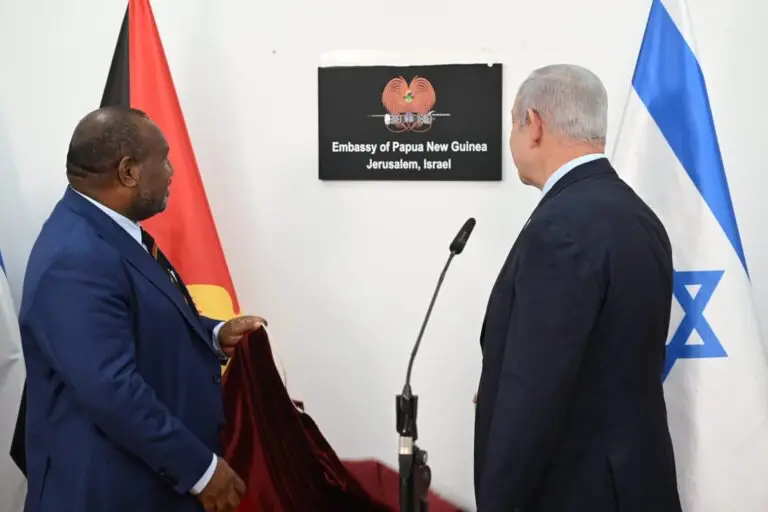 PNG Prime Minister Marape and Israeli Prime Minister Netanyahu inaugurate PNG’s Embassy in Jerusalem (September 5, 2023).
Marape framed the embassy opening as both a diplomatic and spiritual decision. He said Papua New Guinea had chosen Jerusalem because of its “strong spiritual connections” and shared Christian principles with Israel, and described Jerusalem as the Jewish capital. He also said the move reflected PNG’s sovereign right to determine the location of its embassy. Netanyahu, in turn, said the opening marked an important step in expanding ties and encouraged Israelis to view Papua New Guinea as a partner in tourism, business, and development.
Development cooperation has been a central pillar of the relationship. During Marape’s 2023 visit to Israel, the PNG government highlighted cooperation in agriculture, hydro and solar energy, fisheries, information and communications technology, higher education, security, and health. PNG pointed to Israeli-linked agricultural projects in the country, including a hydroponic farm at Nine-Mile, a dairy farm at Ilimo near Port Moresby, and agricultural initiatives in Southern Highlands Province. The two countries had also signed a Joint Declaration of Cooperation in 2015 covering agriculture, energy, fisheries, higher education, agricultural internships, and healthcare, while a 2013 agreement waived visas for diplomatic and official passport holders.
Israel has also assisted Papua New Guinea through MASHAV, Israel’s international development cooperation agency. In 2016, Israel sent a mobile water purification and desalination unit to PNG during a severe drought, providing clean drinking water to rural communities. Marape’s 2023 visit also included engagement with the MASHAV Agricultural Training Center, and PNG invited the center to cooperate with its National Agricultural Research Institute, reflecting the importance of Israeli agricultural expertise to PNG’s development goals.
Religious and cultural affinity has given the relationship an unusual character. Papua New Guinea is overwhelmingly Christian, and Marape has repeatedly linked his country’s support for Israel to biblical and Judeo-Christian values. This religious dimension has helped make support for Israel politically resonant in PNG and has reinforced the symbolic importance of the Jerusalem embassy. Israeli and Jewish outlets have also reported on religious communities in Papua New Guinea that identify with ancient Israel or claim connections to the Lost Tribes. However, those claims are cultural and religious rather than a formal element of state policy.
Following the October 7 war, Israel made a diplomatic push to deepen ties with friendly Pacific Island states, including Papua New Guinea. In October 2025, Deputy Foreign Minister Sharren Haskel visited PNG as part of what Israel described as a groundbreaking Pacific diplomatic mission. Haskel met Marape and conveyed Netanyahu’s appreciation for PNG’s support, particularly its decision to open the embassy in Jerusalem and its backing for Israel in international forums. Marape reaffirmed that Papua New Guinea recognized Jerusalem as Israel’s “eternal” capital and said PNG stood with Israel while calling on Hamas to take the first step toward peace.
 Israeli Deputy Foreign Minister Sharren Haskel and PNG Prime Minister Marape during her state visit to PNG (October 29, 2025).
The Jerusalem embassy was temporarily closed on March 2, 2026, after Papua New Guinea cited the regional war involving Israel, the United States, and Iran. PNG Foreign Minister Justin Tkatchenko said embassy staff had been instructed to follow Israeli shelter directives and that operations would be relocated to Port Moresby until normal activity could resume. The government described the step as a security measure, not a reversal of its Jerusalem policy.
In June 2026, Israel announced that it would open a representative office in Papua New Guinea, marking a further upgrade in bilateral ties. Foreign Minister Gideon Sa’ar said that after speaking with Marape, he thanked the prime minister for his friendship and support for Israel, specifically citing PNG’s 2023 decision to open its embassy in Jerusalem. The move indicated Israel’s interest in strengthening its own diplomatic presence in a country that had become one of its most supportive partners in the Pacific.
Overall, Israel-Papua New Guinea relations are warm, symbolic, and politically important, even though trade remains limited. Papua New Guinea provides Israel with strong diplomatic backing in the Pacific and recognition of Jerusalem, while Israel offers expertise in agriculture, water, health, energy, technology, and development. The relationship rests on a combination of strategic diplomacy, practical cooperation, and deep religious and cultural sympathy for Israel.
Sources: Ministry of Foreign Affairs, “Papua New Guinea to Open Embassy in Jerusalem, Israel’s Foreign Minister Says,” Jerusalem Post, (February 26, 2023).
“PM Marape to Visit Israel and Open PNG Embassy in Jerusalem,” Government of Papua New Guinea, (September 2, 2023).
“Papua New Guinea Dedicates Embassy in Jerusalem,” Israel Ministry of Foreign Affairs, (September 6, 2023).
“PNG Opens New Diplomatic Mission in Jerusalem; Becomes First Pacific Nation to Do So,” Government of Papua New Guinea, (September 5, 2023).
“Outcomes From PM Marape’s First Official Visit to the State of Israel,” Government of Papua New Guinea, (September 6, 2023).
“Israeli Prime Minister Netanyahu Accepts Invitation to Visit PNG Soon,” Government of Papua New Guinea, (September 6, 2023).
“Deputy FM Haskel Launches Groundbreaking Pacific Diplomatic Mission,” Israel Ministry of Foreign Affairs, (October 19, 2025).
“Israel Appreciates Papua New Guinea for Standing by Its Side; PM Marape Receives Word From PM Netanyahu,” Government of Papua New Guinea, (October 29, 2025).
“PNG Embassy in Jerusalem Closed as a Result of War,” Government of Papua New Guinea, (March 2, 2026).
Tzvi Jasper, “Israel to Open Representative Office in Papua New Guinea, FM Sa’ar Announces After Talks With PM,” Jerusalem Post, (June 10, 2026).
Credit: Source link