

Is Nigeria addressing structural challenges impacting growth?
KEY POINTS
- Nigeria’s recent macroeconomic reforms have helped stabilize some key indicators, but they are not enough on their own to deliver the faster growth the country needs, according to CFG Advisory CEO Tlewa Adebajo.
- Adebajo said Nigeria needs to lift growth from about 4% to 8% to 10% to materially improve productivity, employment and living standards.
- He argued that high borrowing costs, heavy government debt service and weak long-term planning are crowding out private investment in infrastructure, manufacturing, mining and power.
- He called for a coordinated fiscal, trade, industrial and investment strategy that would use Nigeria’s domestic market and African trade links to attract manufacturing and resource-processing investment.
Nigeria’s structural bottlenecks are still holding back rapid expansion despite recent reforms that have stabilized some macroeconomic indicators, CFG Advisory CEO Tlewa Adebajo said, as debate grows over whether the country can turn policy adjustments into sustained long-term growth.
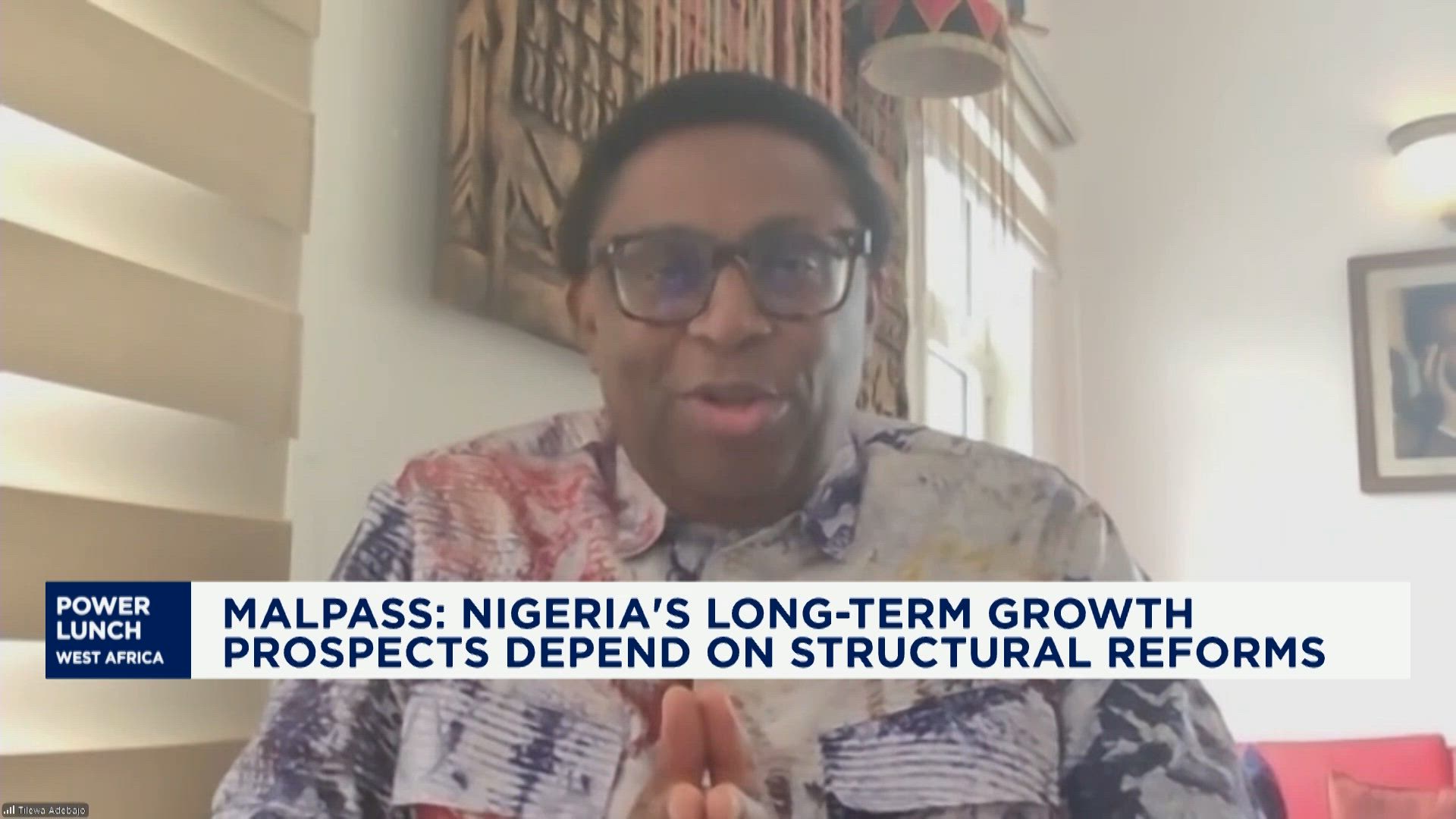
Speaking in a CNBC Africa interview, Adebajo said reforms such as foreign-exchange changes and broader macro stabilization efforts should be seen as only a first step, not a complete growth strategy. His comments came after the African Development Bank said Nigeria’s structural challenges continue to weigh on rapid economic growth, even as reforms have helped steady key indicators, and after former World Bank President David Malpass pointed to structural reforms including currency stabilization and unification as critical to the country’s long-term prospects.
Adebajo said the bigger issue is that Nigeria has yet to remove the structural impediments that suppress productivity. In his view, that is the gap between reform and growth.
“Reforms alone are not the magic bullet,” Adebajo said. “We need to put in place growth strategies. We need to remove the structural impediments that will bring productivity back into our economy and grow the Nigerian economy.”
He said the economy’s growth rate of about 4% is not enough for a country with Nigeria’s demographics and development needs. According to Adebajo, growth closer to 8% to 10% is needed for the country to create enough value through stronger productivity, more employment and a broader investment cycle.
Adebajo also questioned whether Nigeria has a sufficiently structured development framework to support that scale of expansion. He said the country has not had a focused national plan capable of transforming productivity in a sustained way since the Third National Development Plan launched in 1975.
That absence of a clear long-term pipeline, he argued, is visible across strategic sectors. He pointed to a shortage of large bankable projects beyond a handful of examples, including the Dangote refinery and the Nigeria LNG Train 7 project, and said the country has not moved quickly enough to build the next wave of industrial, transport and agricultural investments.
“What other projects are in Nigeria today?” he said, citing limited visible progress on rail, power and large-scale agro-processing assets. He added that Nigeria should be building productive capacity not only for its domestic economy, but also for export into the ECOWAS subregion and the wider African Continental Free Trade Area.
That regional angle featured prominently in his argument. Adebajo said Nigeria should use AfCFTA more deliberately by attracting manufacturers to produce locally for West African and pan-African markets, rather than treating the economy as a closed national system.
He offered China as a practical example. China is one of Nigeria’s largest trading partners, and Adebajo said policymakers should be using that trade relationship to negotiate manufacturing investment into Nigeria’s free trade zones, with output aimed at both the local market and exports across Africa.
“That is a strategy,” he said, describing a model in which imports are gradually substituted by domestic manufacturing over two to three years through targeted bilateral engagement, industrial incentives and export-oriented production.
His criticism was especially sharp on the fiscal side. Adebajo said government borrowing and debt-service pressures are undermining the private sector’s ability to invest, while also limiting public capital spending.
He said planned borrowing of around 20 trillion naira this year is contributing to the crowding out of businesses, while debt-service costs of roughly 16 trillion to 17 trillion naira now absorb more resources than major public allocations such as defense, education, infrastructure and health combined. CNBC Africa could not independently verify the latest figures cited in the interview.
Adebajo argued that this dynamic is raising financing costs across the economy and shortening the maturity profile of investment. With Treasury bill yields elevated and interest rates around 35% for some borrowers, he said many businesses would find it difficult to survive, let alone finance long-term industrial expansion.
“The fiscal side of things is doing a lot of damage to Nigeria’s economy,” Adebajo said. “Government needs to put its fiscal house in order so that monetary policy can sync with fiscal policy, trade policy, industrial policy and, more importantly, investment policy.”
He said that alignment is necessary if Nigeria wants to attract more foreign direct investment rather than relying mainly on foreign portfolio inflows chasing high yields in short-dated government securities.
The weakness, in his view, extends to infrastructure. He said Nigeria still lacks a coherent plan for power-sector rehabilitation and expansion, particularly in transmission and distribution, even though reliable electricity remains one of the most important conditions for manufacturing competitiveness.
Adebajo also pointed to mining as a major missed opportunity. He said Nigeria has significant rare earths and critical minerals potential, but much of the activity remains informal and artisanal, limiting the sector’s contribution to official output and tax receipts.
He estimated the rare earths mineral trade opportunity at about $1 trillion annually, while saying its contribution to GDP remains below 2%, underscoring what he described as a major disconnect between resource potential and economic value capture. He said recent movement in lithium processing and battery-related projects is encouraging, but too slow relative to the size of the opportunity.
There are, however, examples of what more structured development could look like. Adebajo cited the Segilola gold mine in Osun State as a model for transparent and properly documented mining investment that generates taxable value. He said Nigeria should replicate that kind of structure across its mineral sector.
On oil and gas, he said policy changes are beginning to support a rebound, but Nigeria is still recovering from years of underinvestment. He noted that crude production was about 2.5 million barrels per day in 1977, compared with roughly 1.5 million barrels per day now, with the country still struggling to return to 2 million barrels per day.
That record, he said, shows how prolonged policy weakness can erode national capacity even in core sectors.
Adebajo said the state should now focus less on trying to directly drive economic activity and more on regulation and enabling conditions. He pointed to the cement, banking and telecom sectors as examples where private-sector participation, backed by a workable policy environment and regulatory oversight, produced better results.
“The government no longer has the capacity to drive the economy,” he said. “Government should focus on regulation and basically creating an enabling environment.”
As a starting point, Adebajo called for a return to structured national planning. He said Nigeria should revisit its Third National Development Plan, review what was achieved and where implementation failed, and use that process to design a more credible roadmap for industrialization, trade, power, logistics and investment.
His central message was that stabilization without a project pipeline, fiscal discipline and a long-term production strategy will not be enough. For investors and policymakers alike, the next test is whether Nigeria can turn reform momentum into a coordinated plan that lifts growth well above current levels.
Credit: Source link