

Iran, Israel, and the US: When governments lose the language of diplomacy, war follows – JURIST – Commentary
When governments lose the capacity to speak clearly, war follows. A philosopher argues that the conflict between Iran, Israel, and the United States is as much a crisis of political language as it is of military force.
“A man with an unpleasant voice was reciting the Qur’an loudly.
A wise-hearted passerby said to him, “What salary do you receive?”
He replied, “None.”
The man said, “Then why do you give yourself so much trouble?”
He answered, “I recite for God’s sake.”
The wise man said, “Then for God’s sake, do not recite.”
If you recite the Qur’an in this manner,
You will diminish the splendor of Islam.” (Saadi, Golestan, Story on the Qur’an reciter)
I was teaching logic when applause erupted from the neighboring classrooms. The rhythm was not festive; it was confirmatory, almost ritualistic. For a moment I persisted in speaking about syllogisms, about premises and conclusions, as though the architecture of reason could insulate the classroom from the tremor moving through the corridor. Yet the sound grew denser, more unified. When I opened the door, one of the boys looked at me and said, “Professor, they attacked.” That pronoun—they—was not merely grammatical. It was political. In its simplicity, it enacted the most fundamental distinction of the political: it constituted an enemy. I realized then that war does not begin with weapons. It begins with articulation. A city fractures linguistically before it fractures materially. From that moment emerged the question that governs this meditation: what occurs when sovereignty itself begins to stutter? Not when it is defeated, not when it collapses institutionally, but when it loses its capacity to articulate proportionately, intelligibly, and dialogically.
To understand this, one must begin not with geopolitics but with hermeneutics. Hans-Georg Gadamer reminds us that understanding is never complete. Human beings are always, in a profound sense, not fully justified in their claims. We never say exactly what ought to be said; we approach meaning asymptotically. This incompleteness is not a defect but a condition of dialogue. Because we cannot exhaust truth, we must enter conversation. Language, therefore, is structurally unfinished. What I call “stuttering” is, at the ontological level, universal. Every human articulation carries an element of insufficiency. Dialogue compensates for this insufficiency; openness sustains meaning. Yet when this ontological condition is denied or obstructed by political authority, stuttering transforms into structural instability, a linguistic fracture that endangers sovereignty itself.
Political stuttering begins when this ontological incompleteness is denied rather than mediated. When sovereignty constricts channels of dialogue—internally or externally—the natural incompleteness of language hardens into structural silence. The state does not cease speaking; it repeats. It oscillates between assertion and hesitation. It narrows diplomatic corridors while amplifying declarative rhetoric. This is no longer human finitude; it is political contraction. Internal disagreement ceases to be addressed proportionally, and the ruler’s words lose their capacity to orient, to instruct, or to unify.
Here, the classical insight of Al-Farabi acquires renewed urgency. In Fusul al-Muntaza‘a (Chapter 67), Farabi writes: “It is also tyranny that the ruler of the city becomes angry with a group who have committed a sin, yet the punishment he inflicts upon them—war and killing—is greater than what their sin deserves. Such punishment is undoubtedly injustice and oppression. Many there are who, by killing others, seek to cure their own anger and extinguish their resentment; yet they do not kill the one with whom they are angry, but instead kill the innocent who had no part whatsoever in producing that anger.” This passage reveals that injustice is not merely excess force; it is disproportion. The ruler who exceeds proportion ceases to address the people as a generality. He loses communicative measure. Anger replaces articulation. Punishment replaces persuasion. What appears as strength is already weakness: the inability to calibrate language to justice. Disproportionate punishment is not merely moral failing; it is linguistic failure. The ruler, in seeking to master the city through force, loses mastery over its articulation. The city does not simply resist; it becomes incomprehensible to those who govern it.
If we read this alongside Plato in Book V of the Republic, the problem sharpens. Plato distinguishes genuine war from stasis. War occurs between naturally distinct peoples; stasis is self-division. A people cannot coherently wage war against itself without dissolving its political identity. Civil war is self-mutilation. Yet the collapse of internal distinction is not only destructive; it is linguistically revelatory. It signals that the political language through which unity, justice, and authority are articulated has failed. Carl Schmitt translates this ontological distinction into the modern vocabulary of the political. In The Concept of the Political and later in Political Theology II, he differentiates between the public enemy (hostis) and the private adversary (inimicus). Sovereignty presupposes clarity in this distinction. When internal disagreement is elevated to existential enmity, the state confuses inimicus with hostis. It declares war where correction would suffice. In doing so, it erodes its own generality. Civil conflict, therefore, is not a stable political form; it is the sign of conceptual implosion. The collapse of the friend–enemy distinction within sovereignty generates linguistic breakdown: commands fail to convey intention, decrees fail to orient behavior, and silence expands among those who are governed.
If sovereignty begins to treat internal plurality as public enemy, it loses its linguistic position as sovereign. It no longer speaks for the whole. Its articulation ceases to correspond to the lived vocabulary of its society. This is the moment of severe stuttering. The state may still command, yet each command requires repetition because prior speech failed to generate shared understanding. Silence deepens internally—not necessarily visible silence, but communicative estrangement. Oscillation between assertion and hesitation dominates, not because strategy demands, but because comprehension is lost. Internal misarticulation produces defensive coercion, and coercion is mistaken for authority.
In the Iranian case, this estrangement has acquired structural dimensions. A digitally connected society maintains dense communicative ties with the global sphere—academic networks, economic exchanges, cultural circulation—while official diplomatic and discursive channels have progressively narrowed. The result is a divergence between societal articulation and sovereign articulation. The people increasingly perform the dialogical function that sovereignty has restricted. They create informal bridges to the world precisely because formal bridges have contracted. This inversion is politically decisive. When the communicative task of sovereignty migrates to society, the state’s stutter intensifies. Its oscillation between negotiation and threat, between openness and denunciation, reveals not strategic complexity but linguistic instability. Every attempt at external clarity is undermined by internal incoherence. The state projects power externally, yet internally, its language cannot sustain legitimacy.
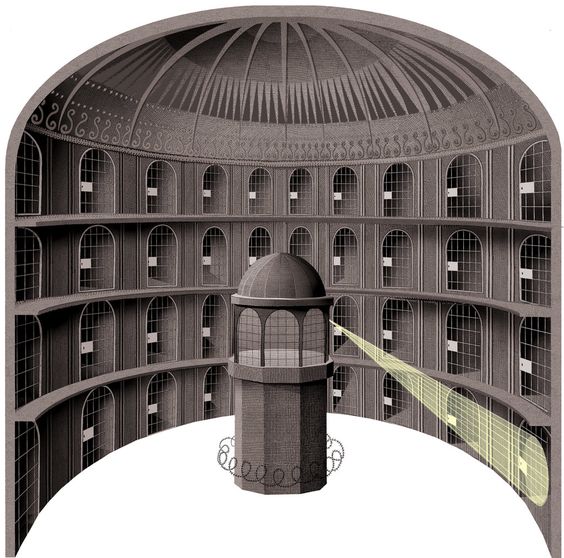
Such instability cannot remain internal. Michel Foucault’s panopticon offers the governing metaphor here: under conditions of global surveillance and interpretive scrutiny, nothing stays hidden for long. Here, the panopticon becomes international: the entire world functions as a lens and amplifier. Intelligence networks, financial oversight, treaty obligations, media infrastructures, and human rights regimes render every internal hesitation observable and interpretable. Misalignment between command and comprehension, silence and articulation, is translated into diplomatic suspicion, sanctions, and even military anticipation. The global panopticon interprets domestic stuttering as instability, and instability becomes an occasion for external intervention. Civil linguistic fracture projects outward as public conflict. Internal confusion produces external enemy. Here, the stuttering of sovereignty is not metaphorical; it is geopolitical. The state, having lost communicative proportion internally, seeks resolution by positing an unequivocal public enemy, yet this act can only exacerbate instability, producing a cycle in which the internal fracture shapes international confrontation.
The ethical dimension of articulation is captured with devastating economy by Saadi Shirazi in the parable above. Intention, Saadi reminds us, does not sanctify expression. Poorly executed speech can diminish the very truth it seeks to honor. The lesson is not irreverence; it is responsibility. Intention does not sanctify expression. Poorly executed speech can diminish the very truth it seeks to honor. Politically translated, excessive articulation without clarity weakens authority. There are moments when measured silence preserves sovereignty more effectively than incessant declaration. Strategic restraint is not weakness; it is linguistic discipline. In Iran, the repeated closure of channels of international dialogue illustrates precisely this dynamic. Stuttering arises when language is blocked, and louder speech cannot compensate. Responsibility demands both articulation and restraint, proportion and intelligibility.
This perspective carries profound implications for the understanding of postmodern international law. Law is not merely a set of rules nor is war merely an outcome of material force. Rather, both emerge from the coherence—or failure—of political language. Under the scrutiny of the global panopticon, every hesitation, every uncoordinated decision, is amplified, interpreted, and reacted to in ways that deepen instability. International tensions, including those involving Iran, the United States, and Israel, are intelligible as the external manifestation of internal stuttering: misaligned messages, obstructed channels of diplomacy, and constrained communicative pathways within sovereignty transform domestic fragility into geopolitical confrontation. Postmodern international law, therefore, becomes a lens through which the health of political language, the emergence of conflict, and the conditions for strategic restraint can be simultaneously understood, analyzed, and, where possible, mitigated. Clarity is power; restraint is strategy; stuttering is the prelude to war. This is the lesson of Farabi, of Schmitt, of Gadamer, of Saadi: governance depends on intelligibility, on ethical articulation, on the careful calibration of discourse. Force alone cannot substitute for understanding; sincerity cannot compensate for misarticulation. Political stuttering produces structural fragility, misperception, and conflict.
The boy in the classroom reflected this structural truth: a state fractures when language fails. In a panoptically observed world, stuttering is amplified and projected externally. The confrontation among Iran, the United States, and Israel is intelligible as the cumulative effect of communicative constriction, closure of diplomatic channels, and repeated misarticulation. Yet even here, the final observation emerges: the global panopticon renders every internal fissure visible. We are all, sovereign and subject alike, contained within a network of observation. The stutter is amplified, the silence interpreted, the oscillation read as threat. In this international panopticon, sovereignty is never a private possession; it is relational, linguistic, and ethical. Every failure of articulation becomes a site of conflict; every act of clarity becomes an instrument of legitimacy. War and peace, domination and survival, are inseparable from the state’s capacity to speak, to be heard, and to listen. The final lesson is stark and unambiguous: in a world in which all are observed, the ultimate power lies in language—not merely in the capacity to coerce, but in the capacity to articulate proportion, intelligibility, and ethical discernment.
AmirAli Maleki is a researcher specializing in international law and the philosophy of law, and the Editor of PraxisPublication.com. He works in the fields of political philosophy, Islamic philosophy, and hermeneutics. He is the recipient of JURIST’s 2026 David M. Crane Rule of Law award.