

ICE seizes passports, issues ankle monitors to Springfield Haitians | Local

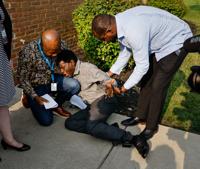
Benjamin Louis (left) and Viles Dorsainvil (right) support Monsanto Maler, a Haitian immigrant living in Springfield, as he cries and falls to the ground after getting his ankle monitor installed on Sunday, Aug. 9, at the U.S. Immigration and Customs Enforcement office in Blue Ash.
Immigrant advocates say Immigration and Customs Enforcement is taking passports from Springfield Haitians who lost their Temporary Protected Status — on top of forcing them to wear ankle monitors.
Taking away their passports does not make sense if the Department of Homeland Security wants Haitians who have lost legal status to self-deport back to Haiti, said Springfield G92 representative Marjory Wentworth.
“They can’t self-deport with an ankle monitor on and they don’t have a passport,” Wentworth said.
When Haitians report to ICE’s Blue Ash office with their required immigration documents, agents fit them with ankle monitors and confiscate their passports, said Vilès Dorsainvil, president of the Haitian Community Help and Support Center.
Dorsainvil said that he believes hundreds of Haitians in Springfield have received letters with pre-scheduled appointments at the Cincinnati-area ICE office, where they now know they will be outfitted with ankle monitors. He said he thinks only Springfield Haitians have received the letters.


People attend a vigil and rally in support of Haitians who were checking in at the U.S. Immigration and Customs Enforcement office in Blue Ash on Sunday, Aug. 9, 2026. Haitians living in southwest Ohio, and largely in Springfield, were sent letters requiring them to be there after their Temporary Protected Status (TPS) was recently terminated by the Trump administration. Those who checked in were fitted with ankle monitors. Hundreds of protestors were on-site supporting the immigrants.
At least 500 people attended a rally outside of the Blue Ash ICE office Sunday, Aug. 9, where they sang, cheered and clapped to show support as Haitian immigrants from Springfield went into the office for their appointments.
That support was powerful, Wentworth said, noting most of the attendees were not from Springfield. She said she met one woman who drove with a group from Cleveland to the 7 a.m. rally.
Wentworth said she saw at least two pregnant women forced to wear the devices, with one wearing it around her wrist.
“Are we going to send them back to a country with basically no medical infrastructure and no prenatal care?” Wentworth said.
She described another instance, in which a Haitian man who is still working — not all Haitians lost their work permits — is required to wear specific boots to his job, but they wouldn’t fit with the ankle monitor.
“He went to one ICE office and they sent him to another one because he’s trying to get a different kind of monitor because it doesn’t fit over the boots for him to work, and they won’t change it,” Wentworth said.
Many Haitians in Springfield are continuing to stay home, and there is widespread fear and confusion, Wentworth said. She said organizations who are providing assistance like food — especially needed for those who have now lost their ability to legally work — need more donations. These organizations include the Haitian Support Center and the local St. Vincent de Paul.
Dorsainvil echoed the feeling of uncertainty and agreed that the situation has been emotionally difficult for a lot of people.
“That’s the way it has been for so many folks,” Dorsainvil said.
Wentworth pointed to American history, noting that 19th-century abolitionist Frederick Douglass — who served as U.S. minister to Haiti — once said America’s “coolness” toward the nation was rooted in race.
“When you take a group of people and decide to change the laws so that they become illegal … this is what we did to keep people in slavery, and anyone who’s not connecting those dots is denying what I think is a natural connection with our own history,” Wentworth said.
DHS did not return several requests for comment in time for publication.


People attend a vigil and rally in support of Haitians who were checking in at the U.S. Immigration and Customs Enforcement office in Blue Ash on Sunday, Aug. 9, 2026. Haitians living in southwest Ohio, and largely in Springfield, were sent letters requiring them to be there after their Temporary Protected Status (TPS) was recently terminated by the Trump administration. Those who checked in were fitted with ankle monitors. Hundreds of protestors were on-site supporting the immigrants.
SPRINGFIELD NEWS-SUN COVERAGE
Community impacted by end of TPS for Haitians

The U.S. Supreme Court has ruled in favor of the Trump administration and gave the federal government the green light to remove legal protections for more than 330,000 Haitian immigrants who reside in the United States, which includes an estimated 10,000 to 15,000 people who live in the Springfield area.
Here are some highlights of community perspectives and our reporting on this issue.