

How Spain Created Its Own Psychological Crisis Over Occupied Ceuta
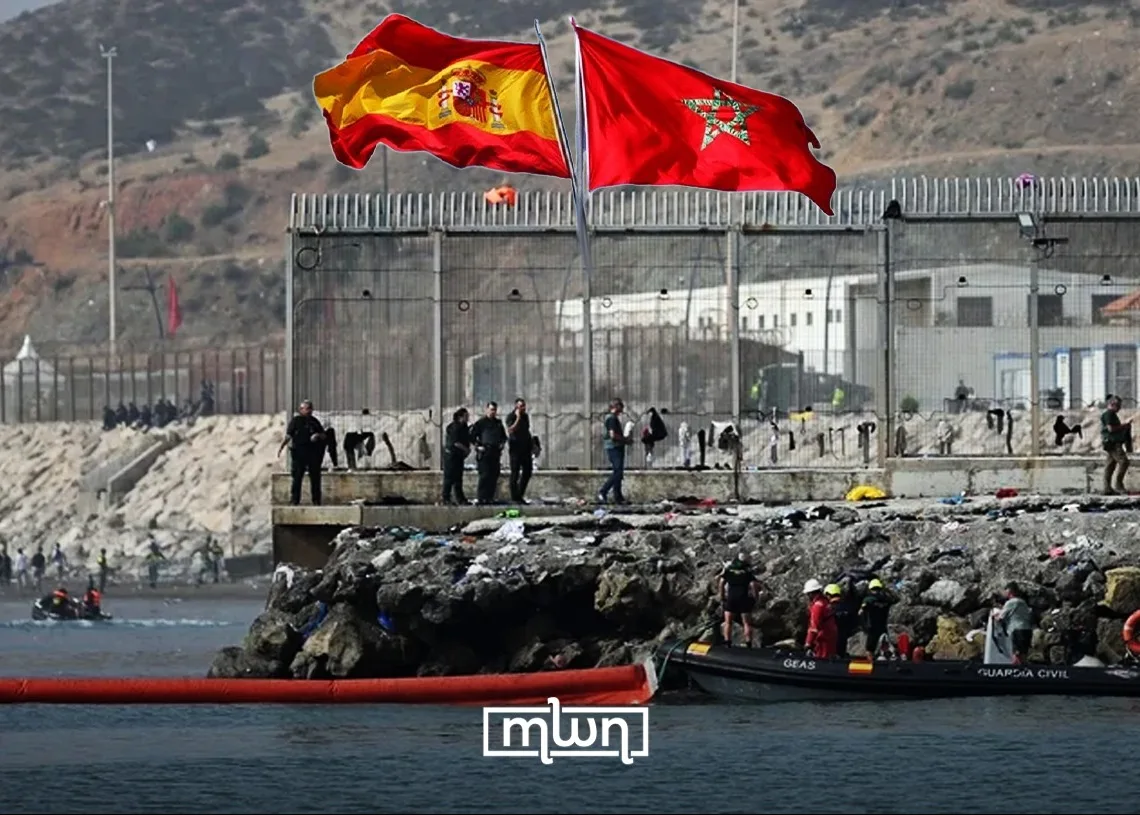
Since the events in occupied Ceuta on July 30 and 31, a large segment of Spain’s media and political class has remained fixated on a recurring question: what does Morocco want, and was Rabat behind what happened? Television screens, newspapers, and social platforms quickly filled with terms such as “invasion,” “hybrid warfare,” “threat,” and “betrayal,” followed by intelligence leaks, conflicting narratives, political accusations, and conspiracy theories. After more than a month of this noise, however, the balance sheet points to a different outcome. The greatest pressure did not fall on Morocco; it instead rebounded inside Spain.
An analytical review of material published between July 30 and September 4, conducted for this article, draws on opinion polling, official data, institutional reports, digital indicators, fact-checking records, and a limited qualitative review of Spanish online reactions. Taken together, these sources present a clear picture of the psychological and informational pressure that accumulated inside Spain. Over a matter of weeks, anxiety, hypervigilance, confusion, declining trust, anger, and increasingly sharp divisions in public debate coincided with intense media and political coverage that reproduced the crisis day after day instead of helping contain and absorb it.
Spaniards under mounting psychological pressure
In Ceuta, the Official College of Psychology of Ceuta warned of anxiety, sleep disturbances, hypervigilance, exhaustion, difficulty concentrating, and persistent preoccupation. It linked these symptoms to prolonged uncertainty and heavy exposure to emotionally charged messages and images on social media. Psychologist Javier García, a member of the Psychological Intervention Team for Emergencies and Disasters, also said fear had led some people to avoid leaving their homes, while cases of anxiety, panic attacks, and clear signs of psychological exhaustion were being recorded.
Significantly, these symptoms appeared among people who held opposing political readings of what had happened. García referred to people who described the events as an “invasion” and others who saw them as a humanitarian crisis, yet both groups displayed similar patterns of anxiety and psychological pressure. The evidence indicates that the psychological impact was not simply a function of what individuals believed about Morocco, but of the media and political environment in which Spaniards were immersed throughout the following weeks.
Conflicting narratives, eroding trust
At the national level, a Sigma Dos poll conducted by the Spanish polling and public-opinion research firm found that 99% of Spaniards had heard about the events within just a few days. The survey covered 1,203 respondents and was carried out on August 5. Yet this near-universal awareness was not accompanied by greater confidence in the handling of the crisis. The Ministry of Defense received a score of 3.6 out of 10, the Spanish government 3.1 out of 10, and the Interior Ministry just 2.8 out of 10. Another 68.7% of respondents believed the government had ignored warnings from the intelligence services.
These figures capture the damage done to institutional trust during the crisis. Institutions that should have provided a stable account and reduced uncertainty instead became part of the confusion, especially as public contradictions emerged over what the security and intelligence services knew before the events and whether advance warnings had actually reached the relevant authorities.
Spain’s public broadcaster RTVE documented these contradictions in a report on what it described as the government’s conflicting accounts over Ceuta. Defense Minister Margarita Robles said the National Intelligence Center (CNI) had warned of the risk of attempted entries by sea and that the information had reached the Government Delegation. Interior Minister Fernando Grande-Marlaska said the same day that “there was no report.” The Government Delegation in Ceuta then issued a statement saying it had received no such warning. RTVE also documented the government’s changing position on creating a unified command to manage the crisis.
Disinformation fuels a broader climate of tension
As official narratives clashed, rumors and competing interpretations multiplied. By September 3, Maldita.es, a Spanish non-profit fact-checking organization specializing in disinformation, had compiled 56 cases involving false claims, misleading information, or content that required contextualization. The material included old videos recirculated as footage from Ceuta, false or decontextualized visual content, and stories about crimes and events that had not occurred in the way they were being presented.
Spanish citizens were therefore confronted with a continuous flow of information that did not produce greater clarity. Instead, it increased the need to search, verify, and reinterpret what they were seeing and hearing. As official accounts diverged and media coverage expanded, the public sphere became more receptive to alternative and sensational narratives, deepening confusion and weakening trust in official sources.
The digital sphere reflected the same sharp rise in tension. Official FARO data from Spain’s Observatory on Racism and Xenophobia (OBERAXE) show that hate and discriminatory content rose from 40,800 items in June to 57,406 in July, an increase of roughly 41%. July 30 and 31 alone generated 9,590 hate messages, as this content tripled during the peak of the events.
During the first 25 days of the crisis, OBERAXE recorded 78,476 hate messages, an average of 3,139 per day, compared with a daily average of 1,294 during the first seven months of the year. Calculated from those published averages, hostile content rose by about 143%, while the peak came on August 1 with 6,615 messages in a single day. This shift points to greater anger, aggression, and division in Spain’s public debate at the same time that confidence in institutions was falling and doubts about official narratives were widening.
These factors accumulated into a sustained cycle of psychological and informational pressure inside Spain. Uncertainty pushed the public to follow the news more intensively. Heavier exposure increased the chances of encountering disinformation and sensational content, while competing narratives heightened anxiety and anger and further weakened institutional trust. With every new round of coverage and leaks, the search for a more convincing explanation drove the public back into the same media environment that had produced much of the confusion in the first place.
Rabat contains the crisis as Madrid stumbles
Morocco, by contrast, handled the events differently. Moroccan institutions did not launch a hysterical, all-out campaign against Spain, nor did crisis management turn into an internal war among ministries, security services, and state institutions over responsibility and competing narratives, as happened in Spain. The response remained focused primarily on managing the situation on the ground, pursuing inciters and human-trafficking networks, providing official information, and documenting what occurred through legal and human-rights channels.
On August 2, Morocco’s Interior Ministry set out its official account of the events. It attributed the events to the malicious exploitation of digital platforms, the spread of false information, human-trafficking networks, and a misleading interpretation of a Spanish legal development that circulated online as if it allowed people to reach Ceuta and Melilla by swimming without the possibility of return. The ministry also reiterated Morocco’s commitment to cooperation and coordination with its partners.
The legal development in question was Supreme Court ruling 814/2026, issued on June 29 by the court’s Fifth Chamber and widely circulated in July. The ruling held that the mechanism known as “rejection at the border,” or immediate return, does not apply to people intercepted at sea while trying to reach Ceuta or Melilla by swimming; such cases instead fall under return procedures set out in Spain’s immigration law.
The National Human Rights Council (CNDH) documented how an inaccurate reading of the ruling spread online, claiming that swimmers who reached the enclaves could no longer be returned, alongside details on routes, gathering points, and preparations for crossings. Morocco World News also reported the scale of the misleading posts surrounding the ruling.
When new calls for mass crossings later appeared, Moroccan authorities responded through monitoring, arrests, and preventive measures without turning them into a political and media mobilization against Spain. On August 7, the CNDH published preliminary findings based on field and digital monitoring, witness testimony, and cross-checking information from multiple sources, documenting injuries, arrests, violence, and a range of facts linked to the crossings and returns.
When Rabat chose to send political and sovereignty-related messages, it did so on specific occasions and in clear language. In several media appearances, Justice Minister Abdellatif Ouahbi reiterated Morocco’s historical and geographical rights over Ceuta and Melilla and called for a mechanism for dialogue with Spain over their future and return to the homeland.
Later, Ceuta was invoked during the religious ceremony chaired by King Mohammed VI at the Royal Palace in Rabat to mark Eid Al-Mawlid Annabawi. Minister of Endowments and Islamic Affairs Ahmed Toufiq spoke of the bay‘a, or pledge of allegiance, as being tied to preserving the country’s territory and fundamental principles. He then recalled Qadi Iyad and Abu al-Abbas al-Azafi, both scholars from Ceuta, before invoking the memory of Morocco’s mobilization to liberate occupied cities in the early modern period.
Amid the campaigns accusing Morocco, Rabat did not enter a daily cycle of defensive argument. On August 31, Spanish Prime Minister Pedro Sánchez said there was “no information” from any intelligence center raising doubts about Moroccan authorities’ orchestration of the Ceuta crisis. He described cooperation with Morocco as “frankly positive,” pointing to continuous communication with Rabat on July 30 and 31 and the rapid Moroccan security deployment in Fnideq.
This is where the central paradox emerging from the indicators becomes clear. Morocco was the main target of a large part of Spain’s media and political campaign; yet fear, confusion, competing narratives, and anger accumulated primarily within Spanish society itself. Instead of producing a sense of control and certainty, the intensity of the coverage helped create a more tense environment with less confidence in its institutions.
Ceuta brings the question of occupation back to the fore
The backlash did not stop at the psychological level. On September 2, cities across Spain saw large demonstrations in support of Ceuta, after Spain’s federation of municipalities and provinces called for rallies outside town halls across the country. Thousands marched in Ceuta under the slogan “Ceuta is not for sale, Ceuta is defended,” while right-wing and far-right forces pushed the mobilization toward reaffirming continued Spanish sovereignty over the city.
The scene raises a question that goes beyond the events of July 30 and 31. If Spanish sovereignty over Ceuta is as settled and secure as Spain’s official discourse repeatedly claims, the need to mobilize streets in cities far from Ceuta simply to reaffirm its Spanish identity reveals how sensitive the issue becomes whenever the city returns to public debate.
The historical record contains a fact that is difficult to sidestep. Academic sources describe 1415 as the beginning of Portugal’s conquest and military occupation of Ceuta. A Cambridge University Press account describes the operation as a massive military expedition against the Moroccan port city of Ceuta involving roughly 20,000 men and a fleet of more than 200 ships and transports. Historical sources also record that Portuguese forces seized the city in August 1415 before that military occupation ultimately gave way to a permanent Spanish presence. The official website of the Spanish Army likewise presents the 1415 episode as the conquest of Ceuta under Portugal’s King João I.
The episode was therefore not a passing attack, but a military conquest followed by occupation and, ultimately, permanent Spanish control over a Moroccan city. That fact takes on greater significance when set against the Spanish discourse that dominated the summer of 2026. The campaign began by trying to establish Morocco as the source of a threat and ended with Spain once again declaring, to itself before anyone else, its determination to hold a city whose subjection to European control began through conquest and military occupation more than six centuries ago.
After all the psychological pressure, confusion, and competing narratives generated by the crisis, the debate now reaches beyond what happened at the end of July. If Spanish institutions have produced no evidence that Morocco planned the events, the transformation of a migration crisis into such intense media, political, and public mobilization over Ceuta raises another question about why the city provokes such exceptional sensitivity whenever it returns to the forefront.
If it has not been established that Morocco planned what happened, why did a migration crisis trigger this level of psychological, political, and media mobilization over Ceuta, and why was the city’s mere return to the spotlight enough to unleash a broad mobilization in defense of a status quo whose modern roots lie in European conquest and military occupation? Is it because Spaniards have begun to realize they are defending a status quo built on land that was never theirs to begin with?
Credit: Source link