

How Iranian people are feeling the bite of new US sanctions
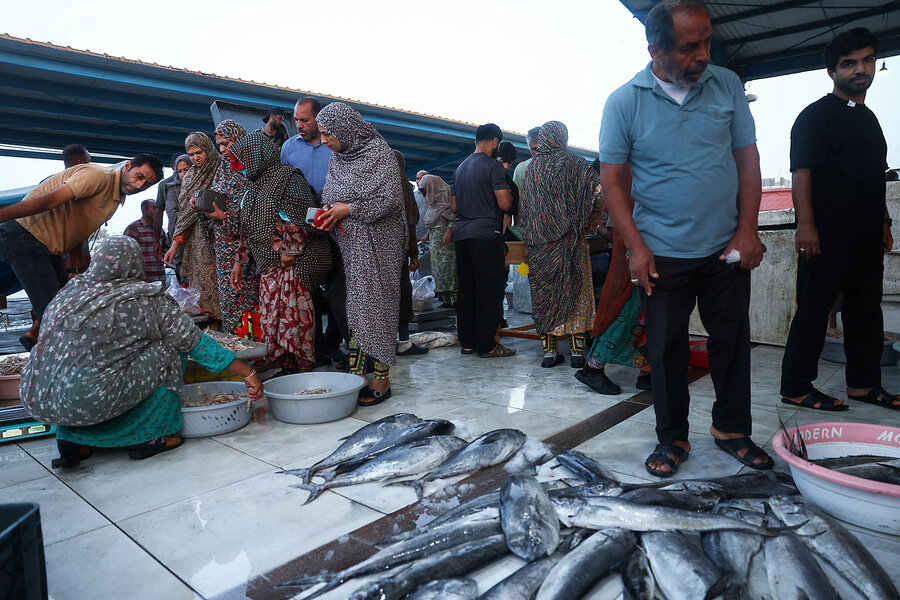
For one Iranian woman in northeast Tehran, the impact of the U.S.-Israeli war against Iran can no longer be measured simply in the number of destroyed military targets or the several thousand soldiers and civilians killed.
The middle-aged homemaker with a master’s in Persian literature, who gives only the name Roya out of fear of repercussions, says ordinary Iranians are bearing the brunt of an American naval blockade and stepped-up sanctions.
After more than six months of military action failed to yield the Islamic Republic’s capitulation, the White House imposed the new measures, promising to turn years of “maximum pressure” sanctions into an even more stringent “economic D-Day.”
Why We Wrote This
Iran’s economy was in ruins even before the war, and before U.S. President Donald Trump’s latest “D-Day” sanctions. So far, ordinary Iranians are bearing the brunt and feeling apathetic, meaning surviving leaders, for now, might face a lower risk of an uprising.
The result, says Roya, is deepening apathy among her fellow citizens, whose preoccupation now is just getting by.
“The reality of economic warfare in our daily lives is that our tables are shrinking by the day, our mental peace is disappearing … and we are constantly running and running. For what? Just to survive,” says Roya, who once expected and hoped that the U.S.-Israeli war would weaken the Iranian regime.
“Economic warfare … means a father checking his empty pockets and feeling ashamed that he cannot provide for his child,” she says. “It means a young person giving up on marriage and any plans for the future. It means a worker whose salary cannot even cover basic costs. Those are people I see every day.”
Untouched by U.S. sanctions are Iran’s ruling elite, she says.
“Life as a whole has turned into a vicious cycle; no matter how hard we work, we feel we are falling behind,” says Roya, who, like many Iranian women fed up with the Islamic Republic’s strict social rules, no longer wears a mandatory hijab head covering. The Monitor contacted her through an encrypted messaging app, and first did so in June.
“The real pain is that there is no clear prospect” for the coming years, she adds. “That feeling of being trapped in absolute hopelessness about the future has exhausted all of us.”
New exchange of fire
U.S. President Donald Trump has achieved few of the war aims he laid out. Iran’s military has been degraded, but Tehran has not been forced to give up its nuclear and missile programs, nor have U.S-Israeli attacks triggered regime change.
After a month of relatively quiet stalemate, the Pentagon said Monday it struck two Iranian mine-laying launchers on Larak Island, to limit Iranian control over the Strait of Hormuz, which the Islamic Republic’s surviving leadership says will remain permanent.
International shipping traffic through the strait, which accounted for 20% of the world’s energy supplies, was open before the conflict. Iran retaliated immediately for the Monday strike by launching eight ballistic missiles – all reportedly intercepted – at U.S. bases in Jordan, and drones at the United Arab Emirates.
Mr. Trump said Monday that renewed strikes on Iran would be “limited,” but he warned, “That doesn’t mean we won’t smack them.” On Tuesday, U.S. Central Command said it was responding to the latest Iran fire by striking Islamic Revolutionary Guard Corps targets in Iran.
The uncertainty is gripping Iranians, says Sanam Vakil, director of the Middle East and North Africa program at Chatham House, a think tank in London.
“The fact that the regime was able to stand up to the U.S. and Israel, together,” she says, “sent a very strong message to the dissident component of the population,” who has been left in dismay and doesn’t “have plans as to what comes next.”
“We’re in a holding pattern,” says Dr. Vakil. “Society has been traumatized; people are bearing the brunt economically; they will be made poorer; they certainly aren’t going to be ‘liberated.’ And there are no good new ideas.”
The result is not all good news for Iran’s leaders, either.
“While they performed well, their options are limited,” says Dr. Vakil. “They are playing with pretty diminished cards. I think the war has given them renewed energy, reinforced their belief, similar to after the Iran-Iraq War. [But] the war has also confirmed that probably resolving their issues with the United States is almost impossible.”
Leaders have recognized growing unease about continued deprivations caused by the war. Lines for fuel have sprung up, and officials are discussing reducing costly fuel subsidies – a step that sparked deadly protests in the past.
Indeed, economic grievances prompted days of nationwide demonstrations in January – quelled only when security forces killed at least 7,000 people, and perhaps thousands more.
“Some people say that sanctions have no effect; to those people, I truly do not know what to say,” President Masoud Pezeshkian said on state television Friday. “We are in a state of war, and we must accept these wartime conditions.”

Majid Asgaripour/WANA/Reuters
Iran’s supreme leader, Ayatollah Mojtaba Khamenei, issued a statement Sunday prohibiting actions that harm public morale.
“Weakness, defects, and deficiencies do not require narration and highlighting,” he said, calling for “preserving unity and safeguarding social cohesion.”
Government has an “excuse”
As the war grinds on, Iranians caught in the middle say that the chances of a popular uprising leading to regime change are even more remote.
“People are more disappointed than angry, and there is a kind of apathy, to the point where the daily devaluation of the currency does not even lead to collective online reactions, let alone public protests,” says a Tehran electronics engineer and father of two, who gives the name Behnam to avoid reprisals from Iranian authorities.
“The war has created an excuse for the government to avoid responding to macroeconomic demands,” says Behnam, who was first contacted by the Monitor in June. The economy was already in “shambles” before 2026, but the war “eliminated” the possibility of protest and demand, he says, and has enabled the regime to “attribute all shortcomings to the conflict.”
Behnam also notes that decades of the “most severe” sanctions against Iran never managed to halt cash-heavy support for regional allies, including Hezbollah in Lebanon, Yemen’s Houthis, and factions in Syria and Iraq. Nor did they dent development of costly nuclear and missile programs.
The ruling elite’s triumphalism at surviving the joint U.S.-Israeli onslaught might also extend, at least for now, to the lowering of the risk of an uprising at home.
“We no longer see the same rage that we saw in previous years,” says Roya, the Tehran homemaker. “Things have gone far beyond that, and people are becoming more indifferent and resigned. When you are confronted every day with a stream of bad news and astronomical prices, at some point … you become numb.
“We no longer have the energy to protest,” she says. “We are simply getting through each day, waiting to see what shock tomorrow has in store for us.”
An Iranian researcher contributed to this report.
Comments are closed.