

How anti-war movements rise, fade, and endure
On Feb. 28, 2026, President Trump initiated a war against the government of Iran. The attack decimated Iranian leadership as the United States and its allies initiated a series of actions aimed at triggering regime change. This particular war did not command the popularity of earlier conflicts, but it did garner the support of 41% of surveyed Americans when it began. By May 2026, support for the war had dropped to 36%. The public’s response to the war against Iran highlights an important dynamic found in many countries. Wars are often popular at the outset, but that support often fades.
With public opinion behind them, an independent observer might expect to see streets filled with millions of energetic peace protesters. Reflecting on the Vietnam War, Martin Luther King Jr. saw the movement for freedom as a crucial factor in the push for peace. In a speech now known as “Beyond Vietnam,” King insisted that “a time comes when silence is betrayal. That time has come for us in relation to Vietnam.” He then argued against those who said that “peace and civil rights don’t mix,” explaining how the road from Montgomery had led him to his current anti-war position.
The expectation of peace protests in reaction to the conflict in Iran would be consistent with how many scholars and writers understand civil society as a counterweight to the state and market. Writers observe that states and markets have a powerful role in shaping society, and civil society offers a “third way” between the dollar and the voter. Collective action creates a place for interests that might otherwise be submerged by profit-driven action and bureaucratic edict.
Given that perspective, and the low levels of public support for the war against Iran, this moment should be a golden era for peace protest, yet anti-war protest has been muted. This modest protest presence points to an alternative understanding of how civil society behaves in wartime: People are often hesitant to criticize even unpopular wars.
One of the most consistent findings from the academic study of wars is that wars often attract a high level of support from nearly all sectors of society—at the beginning. The desire to support the state during wartime is so strong that political psychologists have a phrase for this phenomenon: the “rally around the flag” effect. Typically, psychologists argue that human beings have an instinctual desire to align with their community in times of threat, and this emotion may supersede an individual’s reservations about the war, at least initially. This desire to support authorities in times of war means that civil society bends to the whims of war, and gladly so. Recent research using modern data has explored this pattern further. Using data from Israeli polls, Yuval Feinstein and Geffen Ben-David found that the Oct. 7 attack triggered a wave of support for the war in Israel. Feinstein and Ben-David identify evidence suggesting that support for the war was motivated by a desire to support troops despite low confidence in Israeli leadership.
The “rally around the flag” effect is not uniform, and it is important to note substantial variations in its outcomes. Val Burris studied these differences using data from the American National Election Studies and various media polls. He found that Vietnam-era college students were more likely to support the war than less-educated people, while college students during the Iraq War era were less likely to support the war. In both cases, extended conflict suppressed support for the war. In terms of geography, a consistent theme is that people in Southern states are more likely to support war at its start and continue supporting as the conflict goes on.
In wartime, the situation is not stable, and support for war often fades. Few policies enjoy uniformly high approval ratings forever, and the costs of war become apparent once initial enthusiasm wanes. Many service members never come home, and many who do return carry scars—mental, emotional, and physical. Adding insult to injury, the financial costs of war mount as states must find the funds to pay for it, whether through taxes or public debt.
The Iran war has resulted in higher prices for consumer goods because the conflict has disrupted crucial oil supplies. Economists at the Federal Reserve Bank of Dallas noted that average oil prices of about $60 per barrel in February 2026 spiked to a high of $103–$107 per barrel in the days following the start of the Iran conflict. A report from the Center for American Progress notes that gas prices have increased dramatically and that grocery prices in the U.S. have risen about 2.9%, a burden that disproportionately affects low-income households. These costs are a contributing factor in why, according to sociologist Sidney Tarrow, modern states rely on “out of sight” wars. States may choose to avoid conflicts involving citizen soldiers, electing instead to settle disputes through contractors and mercenaries.
Perhaps the best summary of the public opinion issue comes from “Manufacturing Militarism: U.S. Government Propaganda in the War on Terror” by Christopher J. Coyne and Abigail R. Hall. Focusing on the Iraq War and the broader War on Terror, they argue that public support for war was amplified by people’s fears, and that the U.S. government actively cultivated that support by promising retribution in Iraq and Afghanistan. This support did not last. By 2006, support for the Iraq intervention had been below 50% in polls for over a year, and support for the Afghanistan War also dropped.
The peak and decline of war’s popularity has an important implication for civil society: Collective action becomes more viable. Protesting war in its early days is an almost futile effort, but the openings for protest grow once the public tires of the conflict. This raises an important question: Who will maintain the banner of resistance once the public tires of war?
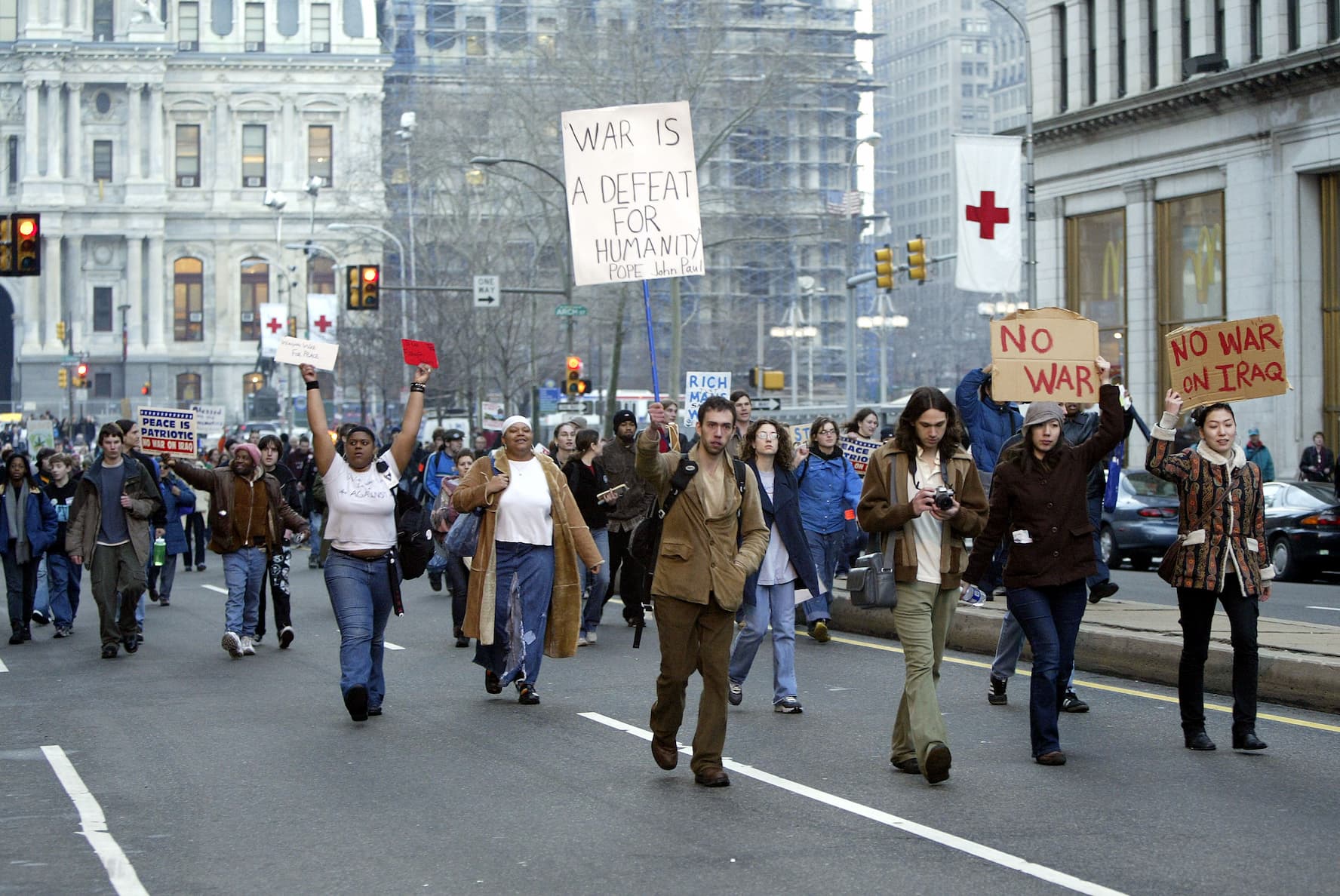
In recent American history, we can look to the anti-Iraq War movement of the Bush and Obama administrations for examples of how civic organizations maintained opposition to war. Some of the most well-known organizations responsible for anti-war protest were United for Peace and Justice (UFPJ), the ANSWER Coalition, and MoveOn. The first two groups represent a classic approach to organizing, pulling allied civic groups into larger umbrella organizations. MoveOn started as a Clinton era anti-impeachment group before turning to other topics, such as anti-war activism.
These groups, and others, demonstrate how civic organizations can maintain an oppositional identity in the face of broader pro-war sentiment. The social and political constituencies each of these organizations recruited, in broad strokes, was a portrait of anti-war activism: UFPJ was a “big tent” group focused on war, MoveOn appealed to partisan Democrats, and ANSWER leaned left. Within each of these constituencies, there is a wide range of civic organizations. For example, UFPJ often attracted religious groups, many of which have longstanding traditions of opposition to war. Union organizations, such as Service Employees International Union and the International Brotherhood of Electrical Workers, were also prominent in the anti-war coalition.
It’s also important to note that civil society played an important part in counter-protest—the “other side” of protest. Research on counter-protesters during the Iraq War era is scant, but news reports have kept a record of their actions. Some counter-protesters were veterans who felt that anti-war protesters disrespected veterans. Others were conservative activists who wished to oppose excesses on the left. Then there were “protest warriors” who appeared at anti-war rallies in order to mock the progressive left. There is a stark asymmetry between anti-war protesters and counter-protesters: The anti-war movement drew on mobilized constituencies within the mainstream of Democratic politics, such as unions and religious groups, while the converse was true of the counter-protester.
There are also significant policy implications for civic organizations that might mobilize against war. The first is to be prepared for extended political campaigns. The large protests that appear at the beginning of a conflict reflect intense emotions, which need to be transformed into an attitude oriented toward long-term political engagement, one that may prove more effective once the “rally around the flag effect” fades. A second implication is to resist strong partisan alignment. Civic leaders should build future peace movements on a strong foundation of cross-party support. Given that the public often supports war to signal support for soldiers, having allies across all major political parties will make it possible to build coalitions that can curtail or end unnecessary wars.
So, what does this brief overview tell us about civil society, collective action, and anti-war mobilization? It shows that even when war is popular, civil society can still be a voice for peace, one that will continue to rely on groups centered in progressive politics.