

How a ‘white elephant’ ended up in Colombia’s congress
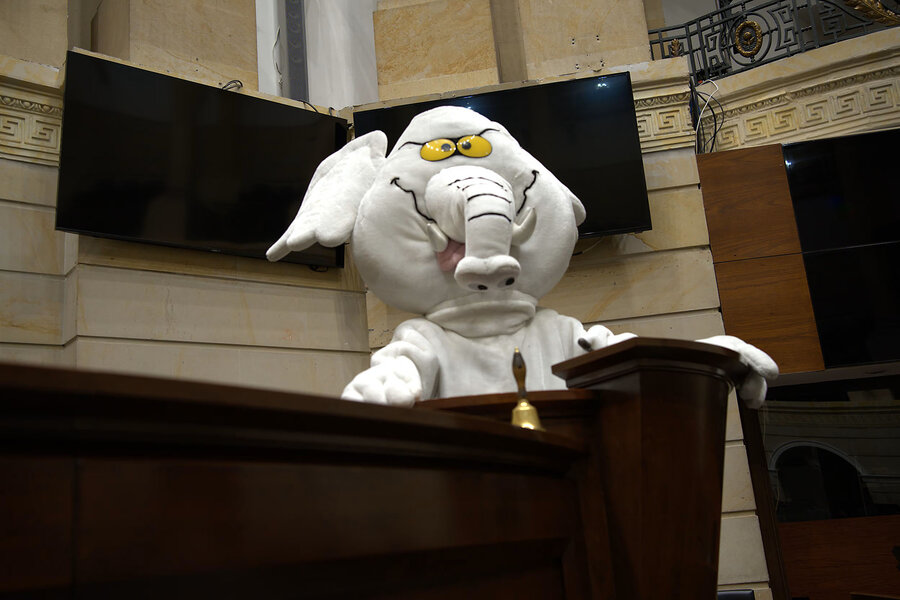
Colombia is swearing in its new Congress this week, with dozens of legislators taking their oath of office on July 20.
One of them may be dressed as an elephant.
Luis Carlos Rúa, a content creator who campaigned on promises of tackling corruption and government waste while wearing a white elephant costume, was elected to the Senate with about 120,000 votes, more than most of his peers. He says he’s “grateful” to his voters for rebelling against traditional politicians and picking el elefantito, or “the little elephant.”
Why We Wrote This
An anti-corruption candidate rose to fame for highlighting government waste – and doing it in an elephant costume. Several political outsiders, including Colombia’s president-elect, leaned on social media to blaze a path to elected office this year.
Mr. Rúa revealed his identity to voters only a few days before the March 8 election. He is among a group of Colombian leaders in their 20s and 30s who have mastered social media, and are using it to engage with audiences who don’t feel represented by the nation’s political class.
“People elected me because they know I have a genuine cause,” says Mr. Rúa, who describes himself as an activist, not a social media influencer. “They figured that with their vote, they could support my efforts to monitor public spending.”
Social media is making it possible for more political outsiders to win elections in Colombia – a country that has long been dominated by big parties or wealthy families who exchange favors, jobs, or public contracts for votes, says Carlos Andrés Arias, a political consultant based in Bogotá.
This year, a city council member who became famous for publishing questionable government contracts on social media was also elected into Congress, and a comedian who makes a YouTube show about Colombian politics won a Senate seat. The recent winner of Colombia’s presidential election, Abelardo de la Espriella, had no political experience or party affiliation but reached young people with the help of AI-generated videos.
“In the past, someone in a white elephant suit, with no political patrons, would have had no chance,” Mr. Arias says.
Putting politicians to work
For the past four years, Mr. Rúa has traveled around Colombia making Instagram reels about government projects that are wasteful or behind schedule. In many parts of the world, such projects are referred to as “white elephants” – often highly visible, costly, and difficult to maintain.
As he rants about potholed roads and rickety overpasses in a squeaky voice that is edited with audio software, Mr. Rúa dons an elephant costume that resembles something that a bouncy, college team mascot might wear.
The videos are funny, but they also generate outrage. As the elephant points to incomplete school buildings, broken bridges, or damaged roads, his account has grown to almost 400,000 followers on Instagram – with some videos regularly garnering thousands of comments.
“The idea is to put pressure on politicians, and put them to work,” Mr. Rúa says in a phone interview from Pereira, a city in central Colombia.
After he makes his videos, Mr. Rúa files lawsuits against the government officials or agencies responsible for the incomplete or wasteful projects. In some cases, he has obtained rulings from judges that order state and municipal officials to allocate new resources to unfinished projects in order to secure their completion.
“At first, I was doing this as a hobby,” he says. “But after I saw it was having an impact, I decided to go all in” on el elefantito.
An online hero, unmasked
The newly elected senator says he became interested in fighting corruption after working as a public relations officer for the municipal government of Pereira, his hometown in a mountainous part of Colombia known as the coffee triangle. One of his tasks at the time was to monitor what media outlets were saying about the local government.
Stories about roads, schools, and other infrastructure projects that were behind schedule generated headlines. In some cases, funds had been assigned to these projects, he discovered, but were then used for other purposes, such as political campaigns.
After falling out with the city’s mayor, Mr. Rúa says he took a break from politics for a couple of years. Then, in 2022, he started to make videos about failed infrastructure projects – and bought himself the white elephant suit.
“It was a way to reinforce my message,” Mr. Rúa says. The costume also enabled him to remain anonymous, which in turn made him feel safer. Dozens of human rights defenders are killed every year in Colombia, and he has received death threats himself.
But traveling around Colombia to make videos cost him savings. Crowdfunding helped. But ultimately, the struggle to fund his elephant project motivated him to run for office.
In Colombia, each legislator is given a generous monthly budget to hire support staff. Mr. Rúa figured he could use some of that money, as well as the travel budget senators are allocated, to keep up with his elephant videos, and his lawsuits against corrupt officials.
“Instead of donating money to a crowdfunding page, people could support my project with their vote,” he says.
The political campaign was brief.
He had to seek the support of a political party to get on the ballot, but there was nothing requiring him to disclose his identity to voters. But, three days before the vote, he published a video where he took off his mask and disclosed his identity for “transparency’s sake.”
“Our project will continue, until politicians are scared of stealing,” he says in the video.
As a senator, Mr. Rúa says he will work on a law to regulate companies – and municipal governments – that run expensive toll roads. And he will continue to produce white elephant videos that denounce faulty and expensive infrastructure projects. Though, if Mr. Rúa is busy attending congressional debates, one of his staff members will have to step into his elephant suit, he says.
“Anyone can be that elephant that stops officials from stealing money in Colombia.”