

Home Minister Sudan Gurung on police firing, Gen Z justice, religious tensions and the criticism he faces
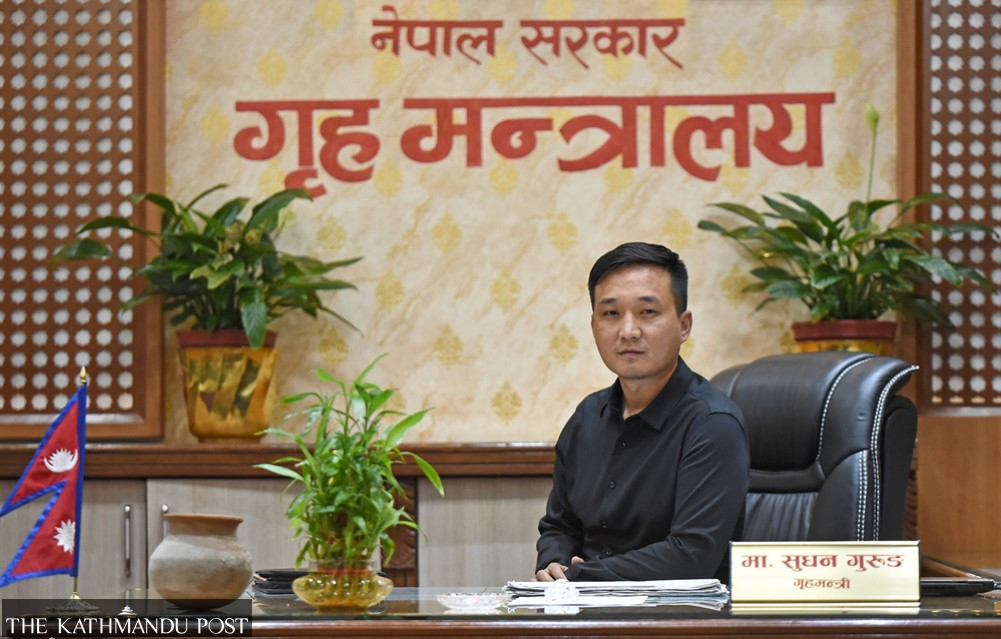
How has your experience been leading the Ministry of Home Affairs so far? What key reforms do you feel are necessary?
We must formalise operational directives into institutional regulations to ensure lasting impact. Furthermore, there is no structured system to motivate staff. Systemic transparency in transfers and promotions is lacking, and digitisation is practically zero, with operations relying on manual processes.
Security threats have evolved to include cyber attacks and digital offences. The ministry is currently unprepared for major digital threats, lacking robust measures for both digital offence and defence. We are working to address these gaps.
We are digitising the entire administrative structure. Moving forward, internal administrative software will track directives from the minister to the secretary, down to the relevant department and individual employee. This software enables real-time tracking of assigned tasks.
Poor performance will be logged for administrative action, while strong output will form the basis for transfers and promotions.
We plan to roll out this digital evaluation system across both Nepal Police and the Armed Police Force. Promotion and transfer processes have historically faced criticism over nepotism and financial irregularities. Digitisation will standardise performance tracking—such as an inspector’s case clearance rate and responsiveness to public grievances—making evaluation transparent and data-driven.
Given that the Home Ministry has Chief District Officers and Police Superintendents in every district, why do you frequently visit the field yourself? Does the system not function?
If the system worked independently, these problems would have been solved long ago. Visiting the field helps identify where the system fails and why existing mechanisms repeatedly fall short.
Going to the ground allows me to assess needs directly and verify whether instructions are being carried out. Our objective is to identify operational gaps and execute necessary structural reforms based on real ground conditions.
Critics have accused your field visits of being publicity stunts, leading you to remark before a parliamentary committee that you might stop going. Will you continue field visits?
I cannot cover every location single-handedly, but criticisms will not deter me from my vision and mission. Given the intense public scrutiny following the Gen Z movement, I would not be in this position if I listened to every critic. I am determined to face challenges directly, so criticism will not alter my working style.
Because I cannot visit every district personally, we are taking a team-based approach. Sometimes I visit directly; other times, a monitoring team goes. This maintains operational discipline, as local officials know monitoring can happen at any time.
Over time, compliance through oversight becomes routine practice, or ‘muscle memory’. The existing mindset among some civil servants is that ministers come and go, while permanent staff remain to outlast terms. I am working to change that mindset.
Do you believe that institutional mindset can be changed?
Yes, I believe it can. Without the possibility of change, election victory and stability would be unattainable. I have neither conceded defeat nor been intimidated.
While I may occasionally show emotion when witnessing public hardship, displaying empathy is not a sign of weakness. It reflects a deep sense of love and responsibility toward the country and its people.
Following your field visits, several police and Armed Police Force personnel were removed from their positions. What key operational issues did you observe on the ground?
Ground realities differ significantly from reports reviewed inside administrative offices. We have no right to decide anyone’s future sitting within the four walls of Singha Durbar. Directly observing public hardship provides the necessary context to amend relevant rules and laws. The primary deficiency currently is execution and follow-up.
Clear directions are being issued—what more could be asked for? They have been told that there will be no political interference and no pressure, nor do they need to lobby for transfers and promotions; they are free to work independently. Has there ever been a time like this before? No, there isn’t.
However, you cannot change people overnight when years of ‘muscle memory’ is at play. That is why proper execution and follow-up are essential. Without follow-up, things frequently go off track. The Home Ministry has the necessary rules, regulations, and procedures, but so far, they simply have not been followed or implemented.
Several high-profile cases handled by your ministry have not reached conclusions. What is the main obstacle?
It feels as though certain judges are uncooperative in some areas. Everyone knows why, though it cannot be stated publicly. The global community recognised the violence during the Gen Z movement as a severe issue, and recent electoral outcomes clearly demonstrated the public mandate. A majority, near to two-thirds, reflects explicit public trust.
Despite this, some judges appear hesitant to deliver justice aligned with public expectations, often relying on legal loopholes. Subtle phrasing in legal interpretations is sometimes used to shift narratives rather than serve the national interest.
How do you plan to address these judicial challenges, given that delivering justice involves the executive, judiciary, and multiple ministries?
We operate strictly within our constitutional jurisdiction, but judicial reform remains essential. We hope the new Chief Justice will introduce reforms to enhance transparency and address delays where legal proceedings outlive the victims themselves.
Seventy-six people were killed during the Gen Z movement. Who fired the shots and how it happened are technical details, but those who lost their lives have not received justice to date. When will they get justice?
Weren’t the cases sent to court right at the start to deliver justice? And haven’t we suffered injustice ourselves? Tell me, who has been arrested over the incidents of September 8? Everyone from September 9 is behind bars, while their families sit in the streets demanding justice.
Only now are we completing all the necessary legal procedures to deal with this. Yet, when procedures aren’t followed, they accuse us of acting impulsively out of emotion. Is this what they call acting with composure?
A committee has only just been formed. Several young Gen Z activists who suffered gunshot wounds are still suffering in jail. We have set up a committee for them, and recommendations for their release can only be made once its report is submitted. We must follow due process. Just because Sudan Gurung is sitting in this chair doesn’t mean he can release people simply because he feels like it.
A separate committee was formed to investigate state response and recommend action regarding security forces and civil servants during the Gen Z movement. What is the current status of that report?
That is also under investigation. They claim it has been concluded, and a report was indeed submitted. However, we are currently expanding its Terms of Reference (ToR) to ensure a more thorough investigation.
After all, someone who didn’t open fire shouldn’t be framed—only those who actually did must be held accountable. Moreover, this involves the highest authorities. What if rushing the process leads to injustice? Injustice affects not only the police but us as well. We came directly from that movement, so we must not suffer injustice in the pursuit of delivering justice. We have to be fair to ourselves too.
To ensure it isn’t rushed and is done properly, we are adding to the ToR to cover whatever was missed. Once it is done thoroughly and maturely, we must be certain that the work is satisfactory, no innocent person has been framed, no action was taken on mere hearsay, and people were arrested with full evidence. That is why it will take some time.
What is the status of the investigation into the Royal massacre?
I cannot comment on that. The Home Ministry is not a platform for releasing sensitive information; only surface-level details are shared.
But has it been initiated or not?
I cannot comment on that either.
During your previous tenure as Home Minister, questions were raised in Parliament and the media regarding your personal assets and share transactions. A government investigation was conducted, after which you returned to office stating you were cleared, but the report was not made public. Why?
It is surprising to hear this brought up in this manner. Prior to taking public office, I was an ordinary citizen who held no government positions, drew no state salary, and possessed no political authority.
Investigations into the abuse of power properly apply to public officials, not private citizens. When the current government initiated broad asset investigations, the courts paused the process based on established legal principles. Legal frameworks dictate that actions must be evaluated against the laws in force when they occurred, rather than applying retroactively.
While my actions as Home Minister are fully subject to public scrutiny, private financial transactions conducted as an ordinary citizen are protected under Article 28 of the constitution, which guarantees the right to privacy.
When questions were raised, I stepped down voluntarily to avoid any conflict of interest, demonstrating that I do not cling to office. The government subsequently appointed an independent panel led by a former judge, alongside the Financial Controller General and a Chartered Accountant, to conduct a thorough audit.
While I cooperated fully, the investigation extended into private personal details unrelated to public office. I requested that while the report may eventually be made public, the personal privacy of non-political private individuals involved in those historic transactions must be protected.
Credit: Source link