

Harvard expert on behavioral arms control, China-US strategic stability at Xiangshan Forum
As artificial intelligence, space technologies and quantum computing reshape the security landscape, traditional arms control is facing a fundamental question: How can countries regulate technologies that cannot simply be counted like nuclear warheads or missiles?
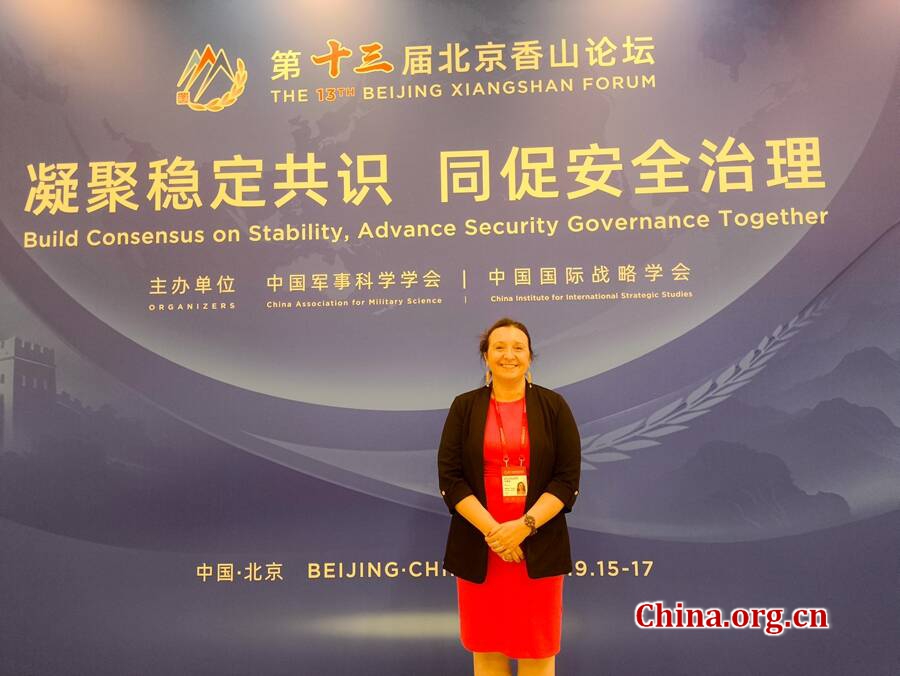
Francesca Giovannini, executive director of the Project on Managing the Atom at the Harvard Kennedy School’s Belfer Center for Science & International Affairs, poses for a photo in front of a Xiangshan Forum backdrop in Beijing, Sept. 15, 2026. [Photo by Xu Xiaoxuan/China.org.cn]
Francesca Giovannini, executive director of the Project on Managing the Atom at the Harvard Kennedy School’s Belfer Center for Science & International Affairs and director of the Research Network on Rethinking Nuclear Deterrence, believes the answer may lie in shifting the focus of arms control from quantitative reductions to countries’ behavior.
“For many years, arms control was mostly about hard weapons. You could count nuclear weapons, you could count missiles, and you can say, I’m going to reduce this number of missiles or dismantle this number of nuclear warheads,” Giovannini said Tuesday at the 13th Beijing Xiangshan Forum.
“But how do you trace AI? How do you control artificial intelligence?”
The emergence of new technologies, she argued, requires a different approach to arms control. “It’s no longer about quantitative reduction, but it’s going to be about qualitative changes,” she said.
Giovannini called this approach “behavioral arms control,” saying the focus should be on countries’ conduct rather than on controlling the technologies themselves.
“The best way to keep, in a way, check of the countries is by looking at the behavioral aspect,” she said. “So we call it ‘behavioral arms control,’ because it’s not controlling the technology. It’s going to control the behavior of the country itself.”
She said a similar approach could be considered in space, adding that the emergence of AI, quantum computing and other new categories of technology requires the international community to reconsider arms control.
Speaking about China-U.S. relations, Giovannini said mutual respect and equality should form the foundation of a constructive bilateral relationship of strategic stability.
She also called for greater clarity and consistency in U.S. policy toward China, warning that ambiguity could lead to unnecessary confrontation.
“We have to be crystal clear about what the China policy is and should remain. We should not have any misunderstanding about this,” she said.
She also stressed China’s increasingly important role in addressing global challenges.
“There is no problem in the world that can be solved without China’s involvement,” she said. “For many years, we thought the U.S. could handle all these problems by itself. But in reality, now we know China is an indispensable player in the world.”
She added that China has been putting forward important initiatives to help address these challenges.
Asked to sum up the Beijing Xiangshan Forum, Giovannini called it “comprehensive, impactful, and extraordinarily timely.”