

Gov’t Bets on Women’s Leadership to Deepen Peace, Justice and Democracy | News
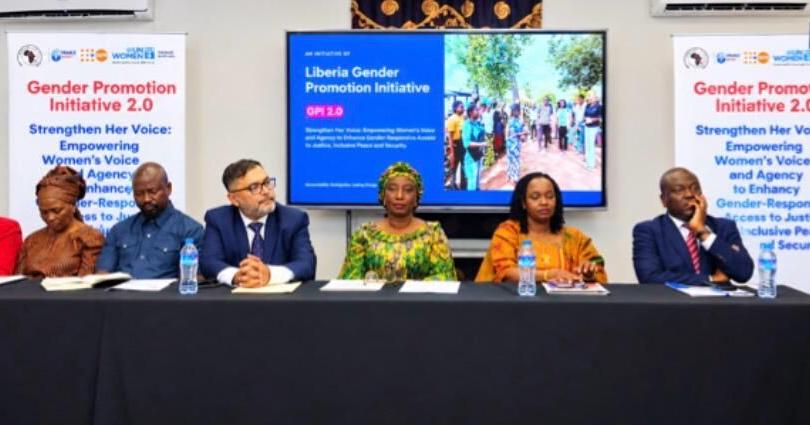
The country’s investment in women’s participation in peacebuilding and transitional justice is being framed not simply as another development intervention, but as a test of whether the country can convert decades of women-led activism into sustained influence over the institutions and decisions that shape its future.
The government and United Nations partners on Monday launched the US$3 million, three-year Gender Promotion Initiative (GPI) 2.0, targeting women’s participation in transitional justice, peacebuilding and decision-making while strengthening the capacity of women’s rights organizations across the country.
But for Minister of Gender, Children and Social Protection Gbeme Horace-Kollie, the significance of the initiative goes beyond its funding or the number of activities it will undertake.
She sees it as an opportunity to consolidate a distinctly Liberian legacy—women who organized, mobilized communities, mediated conflicts and demanded peace when the country was trapped in years of devastating civil war.
“Today we are not simply rolling out this project, considering it as another project again. We are strengthening a partnership around something that is very fundamental to our country’s future,” Horace-Kollie said.
That perspective places the minister’s intervention at the center of a much larger national question: after women helped fight for peace, how much power do they now have in shaping the peace?
One of the most important messages emerging from the launch is the call to move away from viewing women primarily through the lens of vulnerability.
Women have unquestionably suffered disproportionately from conflict, displacement, sexual violence, economic insecurity and other consequences of Liberia’s civil wars. But the country’s history also demonstrates that women have been among its most consequential peace actors.
Horace-Kollie argued that GPI 2.0 must recognize that dual reality.
Women, she said, should not be treated merely as victims and beneficiaries of transitional justice. They must also be recognized as leaders, advocates and decision-makers.
A peacebuilding process can provide services to women without necessarily giving women meaningful influence over the decisions determining how peace is maintained. Likewise, transitional justice can document violations against women without ensuring that women have a voice in determining how justice, reparations, reconciliation and institutional reform should proceed.
For Horace-Kollie, the new initiative should help close that gap.
She specifically pointed to the existing women’s peace hubs, describing them as community structures that should be strengthened rather than replaced by temporary project mechanisms.
Her position reflects an important lesson in development programming: sustainable peace cannot be built entirely through externally designed projects. Community institutions that have already earned trust and developed local knowledge can provide a stronger foundation for long-term peacebuilding.
The country’s modern political history cannot be fully understood without examining the role of women in the country’s peace movement.
During the civil wars, women increasingly organized across ethnic, religious and political divisions, challenging the idea that peace was exclusively the responsibility of armed groups, political elites or international negotiators.
Women mobilized communities, demanded negotiations, advocated for an end to violence and pressed political actors to take responsibility for the consequences of war.
Their activism helped establish an important principle—peace is not simply the absence of fighting; it is also the participation of citizens in determining how society moves forward.
That legacy has particular relevance today.
The country has maintained peace for more than two decades since the end of the civil war, but peacebuilding is not a one-time achievement. It requires institutions capable of addressing grievances, protecting rights, resolving disputes and ensuring that citizens believe the political system can deliver justice without violence.
This is why UN Resident Coordinator Christine Umutoni warned against treating peace as a finished project.
“Peace cannot be outsourced,” Umutoni said. “It’s the people of the land who will uphold the peace, sustain it.”
Her argument reinforces Horace-Kollie’s emphasis on local ownership. International assistance can provide resources, technical expertise and institutional support, but the durability of Liberia’s peace ultimately depends on Liberians themselves—and women must be among those shaping that process.
The challenge confronting Liberia now is different from the challenge facing women during the civil war.
During conflict, the immediate objective was to stop violence. In peacetime, the challenge is to ensure that women have meaningful access to the institutions where decisions about resources, justice, security, governance and development are made.
This is where the concept of women’s empowerment must move beyond slogans.
Empowerment cannot be measured simply by the number of women attending workshops or participating in consultations. It must also be measured by whether women have the resources, authority, representation and institutional access necessary to influence outcomes.
The GPI 2.0 therefore has an opportunity to address several layers of the problem: strengthening women’s organizations, building their technical capacity, increasing their participation in decision-making, supporting survivors and creating mechanisms through which women can contribute to early warning, conflict prevention and community dialogue.
UN Women Country Representative Dr. Abul Hasnat Monjurul Kabir said the program would particularly target capacity gaps among women-led organizations outside Monrovia.
Many such organizations, he noted, lack the technical capacity to compete for major development financing.
That is more than an administrative problem. It is a structural barrier to women’s leadership.
An organization may understand the needs of its community and have deep grassroots legitimacy, but without proposal-writing, financial-management, monitoring and institutional-management capacity, it may remain dependent on larger organizations to access resources.
Strengthening those capabilities can therefore shift women-led groups from being participants in projects to institutions capable of designing, managing and influencing national programs.
The timing of GPI 2.0 is particularly significant as Liberia advances its transitional justice agenda, including the establishment of the War and Economic Crimes Court.
The Justice Ministry has stressed that women’s meaningful participation will be essential to making the process victim-centered, gender-responsive and accessible.
UN Resident Coordinator Umutoni made an even broader argument: gender responsiveness must be incorporated throughout the justice process.
“Gender responsiveness must be integrated across policy, institutional arrangements, investigations, prosecutions, reparations, outreach, data collection—everything must have the gender in it,” she said.
That approach matters because transitional justice is not simply about prosecuting individuals accused of atrocities.
It can involve truth-seeking, accountability, reparations, institutional reform, memorialization and reconciliation. Each of those areas can affect women differently.
If women are absent from those processes, important dimensions of Liberia’s conflict experience risk being underrepresented.
The danger is therefore not only that women may be excluded from justice. It is that the justice process itself could be incomplete.
Liberia has demonstrated that women can occupy the highest levels of political leadership. But representation at the top does not automatically translate into broad-based empowerment for women.
The deeper question is whether women across the country—from rural communities to civil society organizations, professional institutions, local government and national decision-making structures—have the opportunity to exercise meaningful leadership.
That requires more than appointing women to positions.
It requires creating an environment in which women can compete, influence policy, control resources, organize, speak freely and participate in decisions without discrimination or intimidation.
It also requires investment in younger generations of women and girls.
For the country’s democracy to mature, women’s leadership must become normalized across political and civic institutions rather than treated as an exceptional achievement.
The same principle applies to peacebuilding. Women should not become visible only when conflict emerges. Their voices should be embedded in the systems designed to prevent conflict in the first place.
Horace-Kollie’s Emphasis on Accountability
Perhaps the strongest aspect of the Gender Minister’s message was her insistence that GPI 2.0 must produce measurable results.
Horace-Kollie called for clear responsibilities, transparent reporting and regular assessments, while saying the Ministry of Gender has designated focal persons to work with the initiative.
She also pledged direct personal involvement.
“I will be on it, like one of the implementers. If you give me the chance, I will be on the field to see what’s going on and show that it’s happening,” she said.
That commitment is significant because Liberia has accumulated numerous policies, strategies and action plans addressing gender equality and women’s empowerment. The persistent challenge has often been translating those commitments into sustained implementation.
The minister herself acknowledged that challenge, saying GPI 2.0 should help move Liberia from planning to implementation and from commitments to measurable results.
That is ultimately where the initiative will be judged.
The project will operate in Montserrado, Lofa, Nimba, River Gee and Grand Bassa, with activities including early warning and response, community dialogue and support for survivor networks.
Its geographic dimension is important.
The women’s empowerment agenda cannot be driven exclusively from Monrovia. The realities confronting a woman in a rural community can differ considerably from those confronting a professional woman in the capital.
Access to justice, economic opportunities, political participation, information and institutional support remains uneven.
Taking the program into counties can therefore help ensure that women’s participation in peacebuilding is not concentrated among organizations already connected to national institutions.
It also creates an opportunity to identify local women leaders whose work may never receive national attention but who are already resolving disputes, supporting survivors, mobilizing communities and preventing conflict.
The US$3 million investment is substantial in symbolic terms, but relatively modest against Liberia’s wider development needs.
That makes strategic implementation even more important.
The project will have to demonstrate that its resources are strengthening institutions rather than creating another temporary project structure; that women outside Monrovia can access meaningful opportunities; and that the capacities developed during the three-year period remain after external financing ends.
Horace-Kollie’s insistence on strengthening existing women’s peace hubs points toward the right approach.
If successful, GPI 2.0 could help transform women-led peacebuilding networks into stronger and more sustainable institutions capable of influencing policy long after the initiative closes.
The ultimate measure, therefore, should not be how many workshops are held or how many participants attend.
It should be whether women become more capable of preventing conflict, accessing justice, influencing decisions, leading organizations, shaping public policy and defending Liberia’s democratic gains.
As Horace-Kollie put it, “If we do that, this initiative will not just leave behind a successful project. It will contribute to the implementation of our national priorities, and it will also leave behind stronger women, stronger communities, stronger institutions, and a stronger, peaceful Liberia.”
That is a considerably higher standard than simply completing a development project.
Credit: Source link