

From Wheat to Direct Flights: Ambassador Maaninou on Morocco-Kazakhstan Ties

ASTANA – Kazakhstan and Morocco are looking to turn growing political ties into more practical economic cooperation, with logistics, grain supplies, investment and renewable energy emerging as areas of particular potential, according to Mohammed Rashid Maaninou, Ambassador of the Kingdom of Morocco to Kazakhstan. Speaking to The Astana Times, the ambassador described Morocco as a “geostrategical hub” in Africa whose industrial base, port infrastructure and trade links can create opportunities for Kazakh businesses seeking access to wider markets.
Mohammed Rashid Maaninou, Ambassador of the Kingdom of Morocco to Kazakhstan spoke to The Astana Times correspondent Aida Haidar. Photo credit: The Astana Times
That positioning is increasingly relevant to Kazakhstan, particularly as the two countries explore ways to expand agricultural trade and address the logistical distance between Central Asia and African markets.
Morocco imported Kazakh wheat for the first time last year, receiving two shipments of around 30,000 tonnes each. The scale could increase significantly this year, Maaninou said.
“We used to import our cereals from Ukraine, but now it’s impossible. Prices in the United States, Canada and Brazil are higher than the price of Kazakhstan’s wheat,” he said.
The ambassador identified logistics as the main challenge in expanding this trade, given Kazakhstan’s landlocked geography, but said that Morocco’s Atlantic position could turn that constraint into a commercial opportunity.
“That’s why two years ago, we signed an agreement that there will be a huge stock of cereals that will be put in Morocco, managed by Kazakhstan in one of the Moroccan ports,” Maaninou said.
Under the proposed arrangement, Kazakhstan would be able to bring grain in larger volumes, store it in Morocco and use the country as a distribution point for African markets.
The idea is increasingly being accompanied by direct business engagement. A Kazakh business delegation of around 30 people recently visited Morocco, while a Moroccan delegation is expected to visit Astana later this year. The two countries have also established a Kazakhstan-Morocco Business Council. For the ambassador, these mechanisms are meant to create the conditions for businesses to develop commercial links.
“Government is here only to open the doors and to make things legal, framework done and everything prepared,” he said.
Beyond geography: a shared pragmatic outlook
The discussion about connectivity also led to a broader question of how Kazakhstan and Morocco navigate their respective geopolitical environments. Both countries have sought to maintain room for maneuver in their foreign relations, balancing ties with larger powers and pursuing practical partnerships without tying their strategies exclusively to one geopolitical bloc. Maaninou described such pragmatism not as neutrality, but as an ability to turn geopolitical constraints into strategic opportunities.
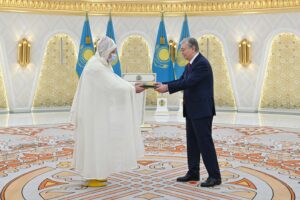
President Kassym-Jomart Tokayev and Mohammed Rashid Maaninou, Ambassador of the Kingdom of Morocco to Kazakhstan, during a ceremony for the presentation of credentials by foreign ambassadors. Photo credit: Akorda
“To be honest, it’s very difficult to be neutral,” he said, noting that Kazakhstan operates among major powers such as Russia and China, while Morocco is closely connected to the European Union, as well as the United States.
“For me, pragmatism is how to change something that looks in the beginning as something that will stop you to something that will help you to grow. How to shift from something that you are afraid of to something you use to be more powerful,” the ambassador said.
He also pointed to President Kassym-Jomart Tokayev’s diplomatic background as an important factor in Kazakhstan’s approach.
“Don’t forget that His Excellency Mr. Tokayev was a diplomat. So he knows how to change these situations,” Maaninou said, describing Kazakhstan’s foreign policy as “very good” since his arrival in the country.
Morocco, he added, has a much longer history of navigating changing international and regional environments.
“Morocco has a long tradition of diplomacy and exists for 14 centuries as a country. So we have a long experience being an African, North African country with all whatever happening around,” he said.
Rather than presenting this experience as a hierarchy, the ambassador’s comments point to a degree of strategic affinity between two countries that have developed different but comparable ways of maintaining autonomy in a complex geopolitical landscape.
Morocco’s industrial experience and Kazakhstan’s market
Maaninou also outlined how Morocco has sought to strengthen its position not simply as a geographical gateway, but as an industrial and investment platform. Around two decades ago, Morocco conducted a strategic assessment of sectors in which it could become internationally competitive, he said.
“You cannot be good in everything. So you have to specialize in the global world,” Maaninou said.
The country subsequently developed major automotive and aerospace industries, while expanding its logistics infrastructure around the Tangier port complex. Morocco is also positioning itself as an investment and distribution hub connecting African, European, American and Arab markets.
Its network of trade agreements is part of that strategy. Maaninou said companies can use Morocco as a production and export base, with local value added allowing access to several markets under preferential trade arrangements. The ambassador stressed that Morocco’s growing industrial base has been accompanied by an emphasis on investment conditions and local capabilities.
“We have also this, what we call the white book for investors. It changes every year. It depends on what we want,” he said, pointing to incentives in sectors such as pharmaceuticals.
But he framed Morocco’s experience less as a template for Kazakhstan than as a possible reference point for companies looking to operate across multiple markets.
For Kazakhstan, he sees particular potential in localization and technology-intensive investment.
“There is no international investor that can come to Morocco without bringing a transfer of technology. If you don’t transfer your technology, these investors will not come,” Maaninou said.
Morocco, he noted, has moved in some sectors from importing equipment to manufacturing components domestically, including elements used in renewable energy.
Renewable energy as another point of convergence
Renewable energy is another area where the two countries could expand cooperation, Maaninou said. He sees strong potential in combining Kazakhstan’s natural conditions and energy resources with growing investment in wind and solar power.
“The sun is here, the wind is here,” he said, pointing particularly to southern Kazakhstan and the country’s wider wind potential.
“Instead of using your own resources that you can sell and have money, it’s better to use what is free and leave the other parts to export and to have money. So you win on both sides,” he said.
Maaninou said Morocco has developed substantial experience in integrating renewable sources into its electricity system, with wind and solar accounting for a significant share of generation. According to the ambassador, 50% of electricity in Morocco comes from wind and solar. The two countries, he suggested, therefore have an opportunity to exchange experience while building projects that reflect their own respective economic and geographical conditions.
From political contacts to people-to-people links
The expansion of diplomatic infrastructure is another sign the relationship is gaining momentum. Kazakhstan now has honorary consulates in Casablanca, Fes and Marrakech, while Morocco has an honorary consulate in Almaty and is considering opening another in Shymkent. The ambassador described Shymkent as a promising regional point of contact because of its expanding business community.
“There is a lot of businessmen from this area that are very aggressive worldwide. So why not going there to see what we can do?” he said.
The opening of the honorary consulate in Marrakech also reflects the potential to widen bilateral ties beyond Astana and Almaty. Maaninou highlighted tourism and agriculture as two areas with particular potential.
Improving connectivity will be critical. The ambassador said negotiations are under way with airlines on a potential connection between Casablanca and Almaty, initially involving a technical stop before a fully direct service becomes possible with the appropriate aircraft.
“When you have direct flights, everything will be more easy,” he said.
Maaninou’s own professional background is closely linked to tourism. Before becoming ambassador, he spent two decades in the sector, including nine years at the Moroccan National Tourism Office.
He said Kazakhstan’s large outbound tourism market immediately stood out to him as an opportunity.
“In Kazakhstan, people travel a lot abroad,” he said.
The ambassador also offered what he described as a “journalist scoop”: plans are being developed for a Moroccan Year in Kazakhstan next year, combining cultural, business and other events across different regions of the country. The initiative is expected to go beyond Astana and Almaty and offer Kazakh audiences a broader picture of Morocco, from culture and traditions to business and knowledge exchange.
At the same time, the two ambassadors are considering a reciprocal initiative that would showcase Kazakhstan across Moroccan cities. For Maaninou, that reciprocal approach is important to the relationship’s next stage: not simply increasing awareness of one another, but creating more channels for businesses, tourists and institutions to interact.
As Kazakhstan and Morocco expand their diplomatic and commercial contacts, the emerging relationship appears increasingly defined by complementarity: Kazakhstan’s position as a major producer and land-linked Eurasian economy meeting Morocco’s role as a geostrategical hub connecting African, European and Atlantic markets. The challenge, as with many long-distance partnerships, will be to translate that strategic fit into regular trade flows, direct connectivity and projects that give businesses a reason to remain engaged.
Credit: Source link