

From Welcome to Repression: How Sudanese Refugees Live in Egypt
Samah Abdel Gawad* did not expect her journey of surviving the raging war in Khartoum would lead her to a different kind of fear in Cairo.
Samah sought refuge in Egypt mid-2023, after the armed conflict between the Sudanese Armed Forces and the Rapid Support Forces destroyed her life and that of her children. Her journey to Egypt was fraught with peril. She hid what remained of her gold and money inside her clothes, fearing it would get stolen, and endured a prolonged wait at the Arqin border crossing before entering Egypt.
Samah believed she would be safe once she reached Egypt. Instead, she found herself caught between the war she left behind and a bureaucratic and security apparatus that continues to constrain her in her country of asylum. Her residency permit is renewed yearly through government procedures that she describes as very slow, often leaving her without valid documentation for long periods of time. During these gaps, she lives in constant fear of being stopped and deported at any moment, despite being registered as a refugee with the United Nations High Commissioner for Refugees (UNHCR).
Samah considered returning to Sudan as part of the “voluntary return” initiative despite the ongoing war and deteriorating humanitarian conditions, after being exhausted by the fear and sense of helplessness in Egypt. In the end however, she decided to stay. “I chose to [stay] here instead of dying with my children in the war or from the epidemics spreading across Sudan,” she said. “But hundreds of others did not have the luxury of tolerating [these conditions] and returned to the unknown.”
Samah’s story is not an exception, but rather reflects the reality facing more than a million Sudanese refugees in Egypt, who fled war only to encounter mounting restrictions in their country of refuge. This comes at a time when the Egyptian authorities are amending the legal framework governing refugees’ presence while striking international agreements through which they receive financial assistance linked to refugee governance.
From welcome, to a legal vacuum, to repression
Since the outbreak of the war in Sudan, Egypt has been a primary destination for those fleeing the conflict. During the first months of the war, Egypt received more than 250,000 Sudanese nationals under a relaxed entry policy that exempted broad categories of arrivals from visa requirements. This initial openness gradually tightened in the months and years that followed: Egyptian authorities introduced prior entry visa requirements for all Sudanese nationals without exception, adopted more restrictive entry and residency policies, all the while a semi-official discourse blaming refugees for the country’s economic and social crises was emerging.
The Sudanese refugee crisis also coincided with a drop in UNHCR funding. Combined with the growing number of arrivals, this disrupted refugee registration procedures and heightened uncertainty surrounding refugees’ legal status and future.
Two of three refugee registration centers in Egypt were shut down leaving the remaining one unable to meet the growing demand. As a result, some asylum seekers have had to wait for months to secure a registration appointment, during which they are left without effective legal status. After registering with the UNHCR, refugees must obtain their residency permit from the Egyptian government, a process that takes months and requires navigating complicated legal procedures. Furthermore, Egyptian security authorities recognize only a valid government residency card as proof of lawful status.
This situation was exacerbated by the enactment of a new law regulating asylum of foreigners in December 2024, which transferred responsibility for receiving and deciding on asylum applications, as well as determining or revoking refugee status, from the UNHCR to a local Egyptian committee. The executive regulations necessary for enforcing the new law were only issued a year and a half later in June 2026. Furthermore, the committee responsible for managing refugee affairs has yet to be formed. To date, only its chairperson has been appointed, with no institutional structure put in place and none of its legally mandated functions exercised. This delay has created a legal and administrative vacuum with direct consequences on thousands of refugees and asylum seekers who have found themselves caught between an old system that no longer functions at full capacity and a new one that has yet to become operational.
Refugees and asylum seekers have found themselves caught between an old system that no longer functions at full capacity and a new one that has yet to become operational
Parallel to this legislative and administrative paralysis, Egypt has witnessed a marked surge in arrest and deportation campaigns, particularly between late 2025 and the first quarter of 2026. These campaigns have included widespread arrests based on racial profiling, repeated raids targeting areas inhabited by refugees, as well as deportations across Egypt’s land borders. These campaigns resulted in at least five deaths at detention centers between August 2025 and February 2026. One prominent case was the death of 67-year-old Sudanese citizen Mubarak Qamar al-Din, in early February 2026, while in custody at the Shorouk Police Station, even though he carried a valid UNHCR refugee card.
Meanwhile, Egyptian authorities have maintained that these campaigns only target “individuals without official papers”. Legal testimonies and documentation, however, refute this claim, and four UN experts expressed alarm over Egypt’s campaign of “human rights violations” against refugees.
These restrictions also affect foreigners who have been residing in Egypt for years with a valid legal status. Some find themselves unable to renew their residency due to growing administrative and financial complications, as well as unwritten rules. The case of Syrian journalist Samer Mokhtar recently shed light on this pattern. Mokhtar lived in Egypt for 14 years, is married to an Egyptian citizen, has a son who holds Egyptian nationality, yet he suddenly found himself unable to renew his residency permit, and ended up being deported and separated from his family.
Seeking aid
As security campaigns against refugees intensified, so did the official narrative portraying them as a heavy economic burden that Egypt bears on behalf of the international community.
In April 2025, the head of the House of Representatives’ Budget Committee stated that the increase of refugees was costing Egypt about $6 billion annually, an estimate that was later described as inaccurate.
Observers have linked this narrative to the comprehensive strategic partnership agreement that Egypt signed with the European Union in 2024, worth 7.4 billion euros, of which 200 million were allocated to migration management and border control. Recent official Egyptian statements have also emphasized the need for “European partners to fulfill their responsibilities in supporting Egypt to bear the burden of hosting millions of refugees and migrants on its territory.”
Refugees in Egypt therefore find themselves caught between a rock and a hard place: an official narrative that uses their presence to bring in more international funding under slogans of “hosting” and “protection,” and actual practices on the ground that make their lives increasingly difficult in an effort to reduce their numbers.
Return trains
In this tense legal and security climate, “return” has emerged in the public sphere as a fundamental approach to dealing with refugees, even when the situation in their countries of origin remains unsafe.
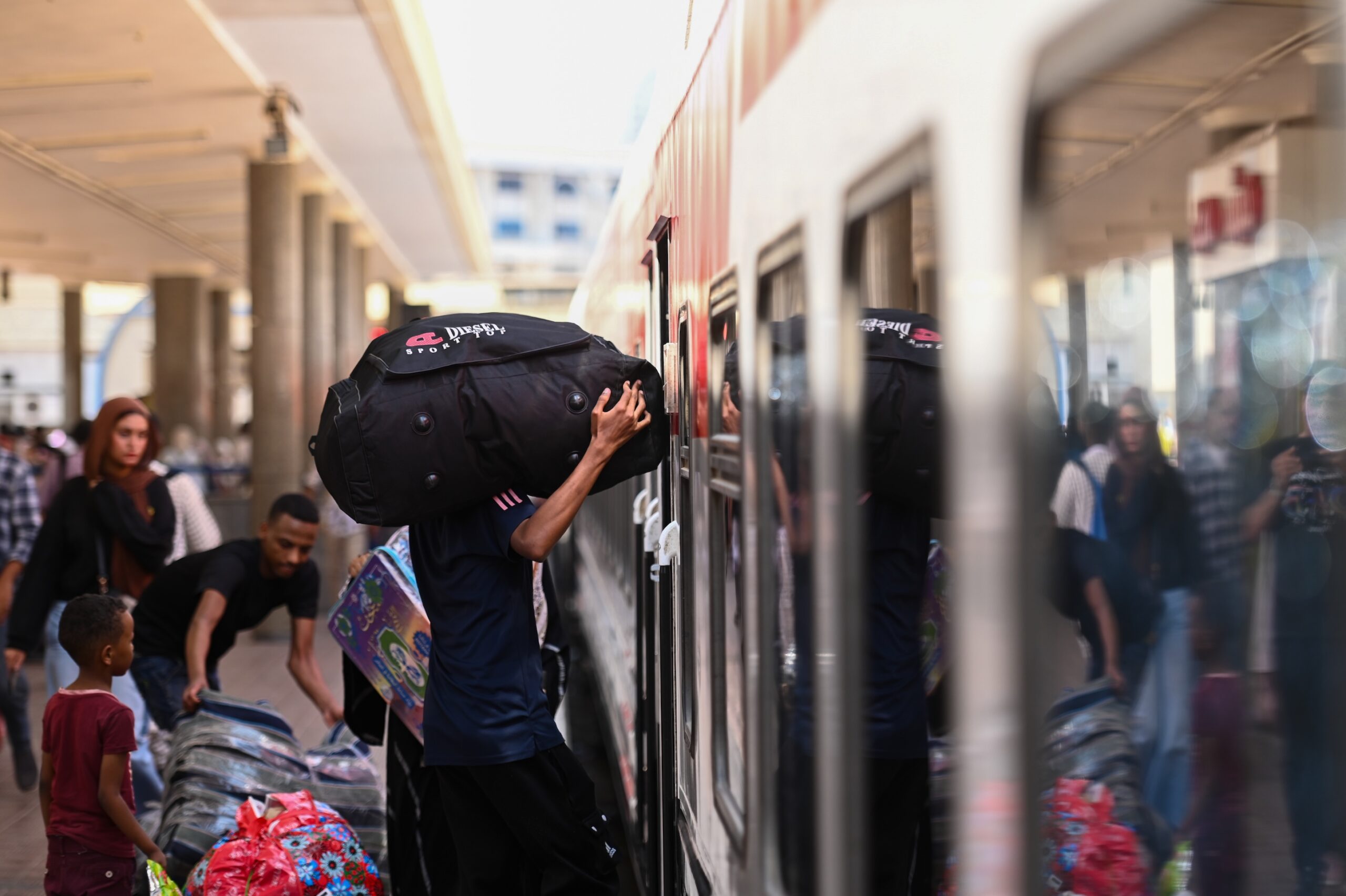
Over the past year, calls have increasingly targeted Sudanese citizens in Egypt to board the so-called “return trains,” operated by the Egyptian government from Cairo southward to Aswan specifically to transport returnees. The Egyptian and Sudanese’s official narratives have framed these returns as voluntary after the Sudanese army recaptured Khartoum. The focus has largely been on the logistics of the operation with no clarification about what awaits those who do return. International organizations have estimated that the number of people who returned was close to 400,000 in the past year.
These actions raise an essential legal question about how voluntary these returns are. Voluntary return stipulates that safety, stability, and dignity are ensured in the country of origin. The decision should also be based on a free and informed choice, free from direct or indirect pressure in the host country. An official deportation order is not required for a departure to be considered forced. It is enough that existing policies or practices create an environment where continued residence is impossible or fraught with serious risks.
An official deportation order is not required for a departure to be considered forced
Applying this framework to Sudan shows that despite the Sudanese army’s control of Khartoum, and despite Sudanese officials’ assurances that the capital is “safe and stable” and their calls for refugees to return, the country continues to experience widespread violence and serious violations of international humanitarian law. This is compounded by the near-total collapse of basic services across large parts of the country, the spread of epidemics, a worsening food crisis, and risks of famine. For many refugees, a fundamental question remains: How are they expected to earn a living upon return, amid the economic collapse and the disappearance of the livelihood they depended on before the war?
It cannot be definitively asserted that all return cases amount to disguised expulsion, as this would require an individual assessment of each case and its circumstances. What is clear, however, is that many of these decisions were made under structural pressure and in a hostile environment that pushes people to leave, rather than through a free and informed choice as the concept of voluntary return stipulates in international law.
Is there a choice?
Samah’s story reveals that the problem lies not only in gaps or shortcomings within the legislative framework, but more significantly in its practical implementation and in law enforcement policies. Even before the adoption of the new asylum law, and while a protection system administered by the UNHCR was still in place, human rights organizations and lawyers documented repeated cases of people being detained despite holding UNHCR registration cards or otherwise having valid legal status. This reflects a clear gap between legal provisions and practices on the ground.
The adoption of new legislation or the establishment of a new national body to manage asylum will therefore not be solely sufficient to guarantee the protection of refugees. It must be accompanied by meaningful changes in policy and implementation, particularly in the approach taken by the Ministry of Interior and other law enforcement authorities toward refugees, asylum seekers, and migrants. Such practices must comply with the Egyptian Constitution and Egypt’s international obligations, primarily the principle of non-refoulement and the rights to protection and due process.
*Name has been changed to protect the individual’s safety
Halem Henish is an Egyptian human rights lawyer and a legal associate at the Tahrir Institute for Middle East Policy.
Credit: Source link